Friday, July 19, 2013

Dashed Yellow Line

In flight school (or if you're both older and diligent about new weather products, when the GFA replaced the FA) you learned that a yellow dashed line on the GFA surrounds an area of reduced visibility in fog or mist. In the north you learn that it might also denote reduced visibility in smoke. While I have encountered reduced visibility in smoke in an urban area due to a mattress factory fire, this usually means forest fire smoke. It's actually a natural state for great swathes of the boreal forest to be on fire at any one time, but because the trees are so valuable in Canada, and because forest fires can threaten towns and cities, we have a vast industry dedicated to detecting, tracking and extinguishing fires. That all takes time, so even with so many resources committed to putting them out there are still a lot of fires. For example here's a map showing the fires burning in Ontario today. The further north you go, the smaller and less valuable the trees get, and the less politically important the settlements are, so the more likely the decision makers are to let the fire just burn. I guess it costs less to evacuate a few hundred people than to fight the fire. So there can be a lot of smoke.

Fog and smoke are very different. Fog sticks around usually for no more than a few hours and while it may render the airports it blankets completely unusable, fog is usually only a few hundred feet thick, so the airspace above it is perfectly usable. Smoke doesn't stop you taking off. Usually visibilities are quite good on the ground and decrease as you climb. Smoke can produce IFR visibilities up to the flight levels and can persist for weeks.

It's sort of cool to see the yellow dashed lines swirling across the map from one GFA to another. In this case its a small burn area, producing lots of smoke and just the wrong winds bringing it to where we wanted to work. We find somewhere else to go, and I check NOTAMs. The runway is reported "90% bare and dry" and it's May. The ten percent is presumably old snow piled up at the sides. Better than April where I got completely snowed in for two days. When it finally stopped snowing I had to get the airport snowplough operator to dig a path so I could get the airplane out. They don't give you dashed yellow lines for low visibility in snow. Precipitation gets green lines. Freezing precipitation gets red lines. Moisture or particles parked in the air and refusing to precipitate get yellow lines. Clouds get brown curlicues. GFAs are very colourful.

Monday, July 15, 2013

Two Odours, A Taste and A Mess

I'm trying to take notes on my days and then turn them into blog entries later. Sometimes the notes are a little too cryptic.

Pulp mill smell. Tour buses. Fragrant weeds. Milkshake. Starter gasket leak.

Clearly I landed in one of the two hundred seven Canadian towns that is within smelling distance of a pulp mill, was obstructed, amused or otherwise influenced by the presence of tour buses, smelled some weeds, drank a noteworthy milkshake and ended the day with oil dribbled all down the front of my engine nacelle.

I remember the oil leak. Seeing oil coming out of the engine that far forward made me suspect a propeller governor, and that's a biggie. But careful examination showed that the oil was not coming from the propeller hub. There was oil pooled inside the cowling, but not very much. I photographed and then cleaned up the evidence, and sent the photos to maintenance. (Oh my god modern technology is so wonderful. The first time I had a maintenance problem at a remote site, I drew a picture of the affected components. Yes, I took an actual piece of paper and a pen and looked at what was wrong and reproduced it with technology barely above Neanderthal (I had a ballpoint pen, not a fire-blackened stick) and then faxed it to the PRM, and I thought that was a pretty savvy use of modern technology. You can't do things like that with a telex machine, after all). Maintenance in the pre-digression instance agreed that a minor oil leak from something other than the propeller at the front of the engine was not a grounding item and I flew it until we reached a town where expertise, parts and availability of maintenance personnel all came together to fix it. We already had an appointment there for troubleshooting on a fuel control unit that my own company maintenance couldn't get to behave quite right.

The maintenance engineer in question was experienced, but at his first day on the job at a new company. That meant he didn't have a dozen things he was supposed to be doing, nor people who knew what he was best at to interrupt him for his help. It also meant that he was keen to show his skills, and supervised by people who wanted to make sure he was doing it right. I think it worked out quite well for all of us. I endured several hours of airport appreciation time--perhaps this is where the milkshake or the weeds came into play--and they gave me a T-shirt along with a functional, properly fuel-controlled and non-leaking airplane, at the end of the day.

The rest, I don't remember. I clearly wanted to tell you about it, but there have been too many towns, odours, weeds, vehicles and beverages to distinguish any in particular.

Thursday, July 11, 2013

Diversions

The days start early in the summer. Our flight planning is done in the space between the completion of eight hours of sleep and the engine start time required to be in the right place at the right time. If we're lucky, hotel breakfast is also available during that period. The real reason my charts need replacing every 56 days has more to do with the effects of toast and orange juice than of airspace changes. Ironically the further the place we need to be is from the place sleep and flight planning occur, the less time in which I have to do flight planning. I look at the GFAs and scan as many NOTAMs as I can for runway closures and fuel unavailability. The weather is generally good, I don't see any problems that will stop us from reaching our destination, or slow us down enough to affect planning.

We have some work to do, but the main goal of the day's flight is to get the airplane back to base for a scheduled inspection, so when the work is done I push a couple of buttons on the magic GPS box--I love that box so much. I can't imagine how much time I would have had to spend flight planning every morning if I had to get from A to B for innumerable values of A and B not necessarily known in advance of take off, without GPS. We don't have enough fuel to get all the way to base, but I have a good picture in my head of the airports along the route, and I can check my intuition by adding my choice as a GPS waypoint to see how far it is and how straight a line it makes. Not requiring a detour is a good property for an en route fuel stop, but I also need to consider the quality of the apron so we won't contaminate or damage our equipment and the ease of fuelling. Better to go a few minutes out of the way for an airport with an easy drive-up fuel pump with a high flow rate than to land at one that is right on the way but requires waiting for a slow response to a callout.

The visibility is dropping straight ahead. It's not obvious at first, because there isn't anything I'm looking for many miles straight ahead, but the next sign is that the cloud layer above gets a little darker. The unmissable sign is when the clouds ahead are illuminated by lightning. I'm flying towards an active thunderstorm. I deviate towards a lighter area of the sky and try to turn back behind the storm that blocked me, but there's another one too close behind it. I call flight services and pick up SIGMET M1, reporting this line of previously unforecast thunderstorms and forecasting them to remain. I love that radar and other modern technologies allow weather forecasters to sit in another province and see the factors that lead to thunderstorms forming, but that these ones still managed to sneak in without being on the GFA. There are enough of them that I have to bypass two airports and proceed to my third choice airport for landing.

I land behind and park next to a small single-engine airplane and chat to the pilot about the weather. It's a smart-looking composite airplane but I don't ask him what it is, because I know it's something I should recognize, and am just blanking on the type. I go in and update the weather at the FBO computer, and then plot an alternate route to destination. The flight services specialist asks me as I line up for take off if I have the SIGMET. "Affimative, we have M2," I say. I sound so like I know what I'm doing. I must know somewhat, as I get home without incident and taxi to our ramp.

I shut down, and complete the post shutdown checklist items, which includes making a journey log entry. The ops manager keeps the journey log in the back of the airplane, but it's always behind the seat when I fly. I like to fill it out before I get out of the airplane. For me it's the best way to make sure it gets done. Meanwhile our maintenance personnel have opened the hangar door, hooked the airplane up to the tug and towed me inside before I even get my seatbelt off. They do this to me a lot. I'm never really fast at getting out of an airplane after a flight.

And I figured it out. It was a Diamond Katana. I'm slow at airplane identification as well as egress.

Sunday, July 07, 2013

Hotel Pet Peeves

There are commercial pilots who don't spend a generous proportion of their nights in hotels. But given that you're in charge of a machine that goes places, and that you are legally required to sleep, there's a good chance that if you're a pilot, you know about these.

I'll start with lamps. When you're at home you know where the light switches are, even if you still haven't completely memorized which switch in the group of three gets the kitchen and which one gets the porch or something else. When you're in a hotel, you can't be expected to know this, so hotels generally have the switches right on the lamps. I don't think they do this to avoid customer confusion over which light switch does what. I think they do it because it's cheaper to put standing lamps in a room and plug them in than it is to install ceiling lights and wire switches. And perhaps because they realize that if they make it a royal pain in the neck to go around and turn on the lights, fewer guests will do it, and they will save on their electrical bills.

So the switches are on the lamps. The thing with a lamp is that it is always either on or off. If it's off, it is dark, so you have to find its switch in the dark. If it's on, it's bright, so you have to find its switch by staring at a bright orb, or groping with your fingers near a hot surface. Lamp controls can be on the lamp base, anywhere on the cord, the collar where the bulb attaches, or somewhere nearby. You might have to press it, pull it, turn it, slide it, or flick it. Or you may just have to reach inside the fixture and retighten the bulb, because the last user gave up before finding the switch. Or stole the lightbulb. Many of the switches on hotel lamps are perfectly logical ways of turning a light on and off. It's just that by definition you have to operate them in unsatisfactory lighting conditions. I hate the little knobs you have to turn inside the fixture next to the bulbs. Sometimes they only turn one way, and I only figure that out after trying to push them. I can't imagine what they're like for the arachnophobic. (I quite like spiders myself. The other day I accidentally vacuumed one up and felt so badly I turned off the vacuum and left it there for a week so the spider could find its way out if it was okay. I'm pleased to report it's back at work building webs. Or at least this spider looks a lot like the first one).

Then there are design decisions made in bathrooms. I guess they aren't decisions. No one would decide. "I think a user of this bathroom should either have to squeeze under the towel rack in order to close the door, or have to straddle the door while sitting on the toilet in order to not have the door bang her in the knees." Or "it would be fun if you have to decide how much toilet paper you will need before sitting down, so let's put the toilet paper dispenser somewhere you can't reach it from the toilet." I stayed recently in a hotel with a beautifully renovated bathroom that had no place for amenities in the shower whatsoever. Being tall, I managed to balance a bar of soap on top of the shower head, but shampoo, conditioner, nowhere to put them. I think that was also the hotel that had a fancy little console in the desk with 110V AC, USB chargers and an iPod dock--but the telephone was next to the bed with a cord too short to reach the desk.

I should stop whining. My apologies to pilots who spend their official rest in ATCO trailers or primitive bivouacs, and who would kill for a lamp, shower or flush toilet. And I hope everyone in flooded areas--this week it's Calgary, but it maybe somewhere else when this posts--soon has a dry place to sleep, and gets to turn their lamps on.

Wednesday, July 03, 2013

Levels of Incompetence

I land at a busy northern airport. It's a resource town, so lots of money, lots of workers and lots of airplanes getting them in here. The ground controller says "taxi in" when I tell him my destination on the field and as I approach it I realize there's an opposite direction jet on the same taxiway. While I'm thinking "Uhhh ..." I realize that it's under tow, so that makes it a motor vehicle not an airplane, giving me the right-of-way. At least I think that's how it works. It's also being pushed backwards away from me. It's opposite facing but in actuality same direction. So not really a conflict. I turn my attention to the FBO.

Sometimes a pilot just turns off the taxiway and parks in front of the FBO, alerting personnel after shutdown to the fact that she would like to buy fuel. Sometimes as I manoeuvre for a likely spot I see someone in an orange vest running and gesticulating with the "place yourself opposite me" gesture. I always taxi slowly on an apron, so I indicate I have seen them, give them time to set themselves up and park as directed unless there is an obstruction or pavement condition that prevents me. I am always very aware that the fueller is a soft squishy human being who in a moment of inattention could run into one of my propellers.

Today there is a small army of people in orange vests, and one is marshalling me. "Place yourself opposite me," then "move nose this way" then a signal I can't remember ever receiving before, "proceed to next marshaller." A chain of vested human beings marshals me one to the next around another aircraft until we are finally given the crossed arms signal to stop there. we're laughing at how many there are. I've never been directed from one to another before and I just went through a chain of five. There are easily twelve on the ramp. I'll tell you quickly than none of them ends up anywhere near the propeller. The title of the post refers to pilot incompetence, especially mine, not any rampee error.

I think their numbers are attributable to a combination of a shift change and training, so every new guy is shadowing an experienced rampee and there are two shifts here at once during the whatever hour this is rush. One of them takes my fuel order and I go inside. There's a bucket under the sink in the women's washroom because the sink u-bend leaks. Internet works. The GFAs forecast everything to be lovely and clear until bedtime. I get NOTAMs and fuel and start up again.

"We are very late," I hear a Jazz pilot explain as she reports an increased mach number to ATC.

A controller calls a foreign airplane, "November eight thousand and echo." Presumably that's N8000E, but I could make a case for N800E. Either way the pilot knows who he is, just as I do when American controllers say "zero" instead of "oscar" for an O in my call sign, or otherwise mangle what to them is alphabet soup. It's quite odd for folks both side of the border to cope with call signs that don't match the standard pattern.

I call for my clearance and accidentally call the controller by the wrong airport name. She's about as offended as if I'd called her by the wrong name in bed, and it doesn't get any better when I discover that I filed my actual flight plan as if I were departing from same wrong aerodrome. It's things like this that make me wonder if I've reached my Peter Principle position of incompetence as opposed to my delusion that I've settled just below it. We sort that out and while I guess I'm not getting another date with that controller, I have a clearance.

I feel slightly better about my incompetence as I hear two airliners in a row asking for clearance direct airports that are not their destinations, each gently corrected by the handling controllers, with reference to their filed flight plans. Chances are high that dispatchers, not the pilots filed the flight plans, so the pilots may know where they took off from, but aren't clear on where they are going.

Another N-registered airplane, not eight thousand and echo, gets a rerouting, from ATC. He copies down one fix and says, "I need another letter, that's just two." It's an NDB, it only has two letters in its identifier. In the south, especially in the US, NDB airways are uncommon. They're always defined by VORs. Up here NDBs are more common. Canada and Australia are I think the only countries that do much with NDB airways. Hands up if you had Cambridge Bay in the navigation section of your Canadian commercial written exam.

An airline pilot is told by ATC that the ILS at his destination is NOTAMed out. You can tell from his response that this is unexpected news. I wonder if it went down since his departure, or his company dispatch fell down in informing him. Or he didn't read his briefing package because it was such a nice day. A bit later I hear him say, "It's overcast. We're going to head for the NDB." We're working not far from there. The overcast is high. He'll break out soon.

Just one of those days, I guess.

Saturday, June 29, 2013

Northern OFP Notes

After take-off I routinely scan the instruments. The left oil temperature is a little high in the climb. It's no concern. The summer heat is here. I climb at a slightly higher speed: that probably sounds contradictory, but that means I leave the power the same and lower the pitch of the nose slightly, giving more airflow through the oil cooler. And I leave the cowl flaps open until after level off. I usually close them a couple of hundred feet below the target altitude.

I'm flying in the north. It doesn't really matter north of what. Every province turns from roads and fields to rocks and trees and lakes as you move north. We're in the north and some of the lakes are still partly frozen. I can't tell if the rocks or trees are frozen, given that they remain solid summer and winter. Also there's smoke again, another constant of the north. Water from the lakes evaporates. The sun heats up the rocks, causing the moist air to rise into thunderstorms which unleash lightning, setting the trees on fire, hence the smoke. The only relief from this is when winter comes and the lakes freeze. Or you get far enough north that you run out of trees. Lichen doesn't support much of a fire. I make a note on the OFP to get maintenance to check the air filters early, and keep flying.

I wrote a few other notes on the OFP to share with you.

"We already nuked the strip." I didn't write down the context for that, but obviously it's Centre's line. The "strip" is the data on where an airplane is going and what clearance they have to get there. It used to be a literal strip of paper, but now it's just data in a computer. Someone must have cancelled IFR and then wanted something that required ATC to have the just-deleted information. It was probably funnier at sixty degrees north.

I'm pretty sure that if I had been able to hear the response to the ATC call "German Air Force 55 heavy, what are your intentions here?" I would have written it down, so we'll all have to wonder together.

An airline pilot was told, "You were cleared for an IFR approach, not a circling." The answer was a testy mumble followed by ATC saying, "Now you're cleared for it all." ATC aren't that forbidding, you just have to ask for what you want before you do it.

The OFP also contains a note about how much I would like to eat BBQ shishkababs.

Tuesday, June 25, 2013

Windex

I'm at an airport. I've been here before. Some of you have too, no doubt, and will recognize it from the following I know the essential things a transient pilot needs to know. I know the gate code to return to airside. It's a truncation of a famous mathematical constant. I know how to find the fueller. He often monitors the traffic frequency so if I announce my need for fuel exiting the runway, he'll probably park the fuel truck in front of the airplane as I shut down, but if that doesn't work, there's no specific FBO frequency. He has an office with an entrance inside the airline office, so I can ask the customer service agents at the airline counter to alert him for me. I know where the women's washroom is. It's downstairs past the stuffed bear. The men's is probably there too, but a sign implies there's a unisex accessible washroom on the main floor, for those who can't navigate stairs. I've filled my water bottle in the women's washroom before, but the water from there tastes terrible. Much better-tasting water, and baked snacks are available at the café.

On this particular occasion all my knowledge of this airport does not help us have a quicker turn because we are waiting here for something. I don't remember what we're waiting for. It' snot my job to decide when it's time to leave. It's my job to be ready to leave when I'm told it's time to leave, or to explain succinctly why we can't. On this occasion I am waiting in the café for whatever configuration of factors is required for it to be time to leave. I have eaten all the baked snacks that I require and am now entertaining myself by reading a book that someone has left at the café. I don't have a really discriminating taste in literature. I'm reading Maximum Boy starring in Attack of the Soggy Underwater People by Dan Greenburg. Its eleven year old male protagonist obtains superpowers from moon rocks. He also has to get his homework done. The story climax is predicated on an immediate need for ammonia at the north pole. Mr. Greenburg nursed my willing suspension of disbelief all the way through the scenes of conflict with the protagonist's sister, negotiations with the titular soggy underwear people and meetings with the president and then broke the whole concept by having Maximum Boy identify the the helicopter pilots (they were also at the north pole, but I won't spoil the whole story) as a potential source of ammonia. They use Windex to clean their helicopter windshields. Noooooo! It spoiled the story for me. It wasn't a detail. It was the pivotal moment in the story, and it was supposed to be a science teaching moment too. There's no way the helicopter pilots were using ammonia-based Windex to clean their acrylic windshields.

If you're cavalier with the integrity of your windshield you might use non-aviation specific products like Pledge furniture polish or acrylic polish marketed for the marine industry, but generally pilots use a product specifically designed and marketed for care of aviation windshields. The windshield allows us to see oncoming aircraft; it keeps the air inside pressurized cockpits and it protects us from the onrush of air and particulate matter we're flying through. If it fails in any one of these endeavours we could die of the results. Windshields and their care are kind of a big deal. I've heard and generally abide by the vertical strokes only rule too. The idea is that if you put a scratch in the window you definitely don't want it to be in a direction that would align with the wings of an oncoming aircraft.

I usually use 210 Polish, but if I run out and I'm in Winnipeg or something, I may have to settle for Prist (not to be confused with the fuel additive). Prist is foamier and doesn't work if you keep it in a cargo compartment where its temperature drops below freezing. And neither of them contains Windex. And that is why I am never supporting the Maximum Boy franchise again. I didn't think much of the new Star Trek either.

Friday, June 21, 2013

Sounds Like It's Raining

The CFS says I need to call for a transponder code at least 30 minutes before entering the control zone for this airport, and that includes entering it by taking off at this airport. I call and tell the flight services specialist who answers my details, including that this will be a local flight, returning to the same airport. He says that flow times are required for all aircraft arriving here from, and then he lists off every airport within a 50 nm radius. Except this one. Heh, loophole. The rule is supposed to give them greater control over local flights, but they weren't expecting me to attack from within. I get my code, and no flow time.

Trim is set for take-off, doors secure and circuit breakers are set. Engine start goes well, each engine catching right away as I motor the starter, with the propeller spinning up perfectly to 1000 rpm. I turn on the avionics master, reset the Shadin fuel flow meter to show full fuel, and power through OK-ing the prompts on the Garmin while I listen to the ATIS. I get my clearance, set up the avionics and when I finish my run up, it's time to call ground for taxi. I see three airplanes all painted with the same airline colours taxiing out from a side apron onto the taxiway I need to follow, so I note with my call, "check the parade." The controller ignores my comment and just gives me clearance. Well I though it was cute. I guess he sees them every day.

When the three airliners have been cleared for take-off I'm next. I roll, ailerons compensating for the crosswind and then rolling to turn into it as soon as I'm airborne, in order to maintain runway heading on climb out. I adjust the power, sync up the props and tweak the mixture to compensate for the engine that otherwise has a higher fuel flow and lower EGT than the other. There's a sound from somewhere in the aircraft like rain on the roof. It's not raining. It's a vibration from somewhere. It's not the props, but I re-synchronize them anyway. The glareshield isn't loose. Maybe there's a screw somewhere rattling around inside the dashboard. The sound goes away before I can troubleshoot it.

Later in the hotel the air conditioner makes the exact same sound. At least, it sounds like rain on the roof. Is rain on the roof my default answer to unidentified sounds? Nothing wrong with rain on the roof, so long as the roof doesn't leak.

Tuesday, June 18, 2013

Mitigate This

I'm definitely out of practice at my job. Oh I can fly the airplane fine, but I almost injured my wrist falling out of the hotel bed in the dark. I forgot that I don't get to sleep in the same bed twice in a row, and there isn't a ledge here. That has to happen periodically: flight crew injuring themselves badly enough while on the road that company has to send someone else out to fly the airplane home. In this case I remember in time while falling to just crash onto the floor and take it on my shoulder rather than try to catch my whole weight on my hand. Crazy reflex that probably works better in species with less complex wrists, and that run on four legs.

Dress, hotel breakfast, check out: I manage to remember the usual routine. Then it turns out company doesn't want us to take the airplane home. They want us to take it to another province. Okay, we can do that. Our current charts include those for the next province over. We can buy clean underwear there, too. After a week on the road we come home wearing Wal-Mart underwear and thrift store t-shirts, carrying our essential toiletries in now-battered plastic bags. I note once I get home that I have bruises on my legs. I always have bruises on my legs after road trips and I'd assumed before that it was from using my legs as a backstop and rebound point as I hurl my suitcase in and out of cabs, airplane and hotel room luggage racks. But there has been no suitcase this week. I have a new theory.

It's hotel room chairs. For some weird reason, few hotels spend any effort making their chairs match their desks in any way, so sometimes I have to grab a couple of pillows for the chair in order to work at a computer on the desk, and sometimes I can't jam my legs underneath the desk while sitting in the provided chair. Sometimes there's no desk at all and I move the TV to one side to do my paperwork on top of the piece of furniture that supports the TV. These hotel chairs usually have armrests, too, so my theory is that I bash my legs getting in and out of hotel chairs in awkward configurations with hotel desks. I don't bash them hard enough to make myself limp around yelling "ow" or to remember doing it, but just hard enough to come home with a week's worth of bruises.

I will also take this opportunity to complain about hotel lamps. This one has been festering for a while. In your own home you know which switches control what, but in a hotel ... you know what, this is going to take more time than I've got right now. It will have to fester a little longer. I will tell you about hotel lamps another time.

Friday, June 14, 2013

Credibility

We're assigned to a short mission at a site not far from base. I'm flying with a new guy who doesn't have a company credit card yet. I don't have one either because I'm a contractor. (I'm still pretending I don't really work here, for some reason. I've so far even completely avoided getting airport ID, using a loophole that allows transient pilots to just show licences. "Just a contractor, here's my pilot's licence," I say to the airport security, who have now stopped asking because I've been here so long they all recognize me and know I belong in, by, or under this company's aircraft). "There's a chance we'll run long and need to refuel before we come back," I say. I'm guessing from his age that the price of a fill-up would push the limit on his personal credit card. My wallet is in my main flight bag, but we were training yesterday so the seat where I usually keep the flight bag had to be cleared out. Instead I have the essentials for one flight crammed into my pockets. I add the wallet just in case, and we take off.

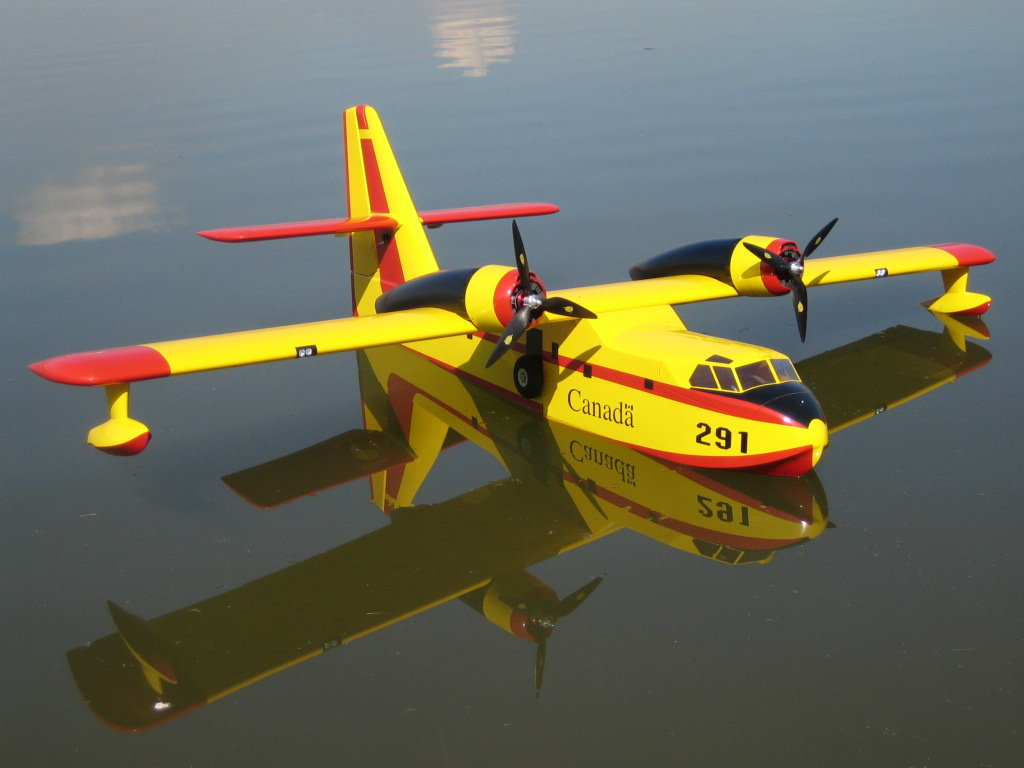
While we're up, near a lake, ATC points out unidentified traffic at five o' clock, after a bit of twisting around I spot and report a yellow and red biplane. After a pause Centre asks me if it might be a water bomber. I look again. Yep. It's a CL-215 in federal colours. I thought it was closer and thus smaller than it is, and that the little sponson was the end of a second wing. I score a D in airplane identification. I swear if you repainted mine when I was at lunch I wouldn't be able to recognize it. The water bomber passes by. I wonder why ATC knew it was there but didn't have it tagged up. Perhaps its pilot called in on a different frequency right after ATC gave me the point out.

We're in uncontrolled airspace, so technically no one needs to call ATC while we're VFR, but we, and presumably the fire-fighters, have taken advantage of the safety afforded by VFR flight following. It doesn't guarantee they'll see or have opportunity to tell us about all collision threats, but it's a lot better than no help at all. Later pick up a controlled VFR clearance in order to climb above 12,500', where we're required to use ATC services. We're not far from a busy airport and there are a lot of jets coming in and out. We keep having to get out of their way. It's pretty inefficient so as I suspected could happen, we don't get all our work done with enough fuel to get home. We don't even get all our work done before we have to land to be within legal reserves. We land at a little GA airport, not the busy one. At the self-serve fuel pumps we're interrogated by a curious GA pilot on a bicycle. He wants to know about our airplane, how much fuel we burn in an hour and what we do. We answer a few questions and then direct him to the company website for the rest. The sky is waiting for us.

The engines are always a little reluctant to start when they're hot, but I coax them back to life and we return to the sky. After I call clear of the GA airport circuit and switch back to the centre frequency I can hear the controller giving me as a point out to another aircraft. The controller even guesses it's us, as he tells the other aircraft the traffic "is probably" our type, and once their conversation is over I come on frequency and confirm it all. We go back up to CVFR altitudes but conditions are no longer appropriate for our work so we turn home and tell ATC and company that we are doing so. ATC says "Roger" but his tone is more like, "Sure, whatever."

A message comes back from company, "Did you bring overnight gear?"

Sigh. I am so out of practice for this job. I didn't even bring a toothbrush. I almost didn't bring my wallet. I tell new guy to message back, something like, "No, but we can adapt." It costs a lot more to fly this thing to base than it does to get two toothbrushes and a hotel for the night. We'll get the work finished in the morning.

Monday, June 10, 2013

Hazard Mitigation

I hear cursing from the operations manager's office and go to investigate. A new client requires all their contractors to submit worker safety hazard mitigation plans for hazards that could exist on the job. We're all for safety. We've had serious discussions on how to mitigate the risk of slip and fall due to water spilled from the water cooler. (Confession: the spilling is usually my fault. I always put too much water in my water bottle and then displace some when I put the cap on). So taken individually, the hazards and need to mitigate them seem reasonable, but when I see the laundry list of hazards our mitigation document requires I can understand how this has caused temporary insanity in the ops manager.

Bears. How will we mitigate the hazard to workers caused by bears? We will not open the doors of the aircraft if there are bears observed in the vicinity. We will not carry uncaged bears on the aircraft. We will not stay at hotels infested with bears. We can't carry bear spray because in an unpressurized but none the less reasonably closed and confined space, the risk of spraying ourselves far exceeds the possible benefits.

Heat/cold stress: How will we mitigate such hazards? We will wear appropriate clothing. We will use the heater and air cooling vents as appropriate. We will drink water and eat food. We will use the sweat glands and shiver reflex that biology has provided us with.

Dehydration: We will mitigate the hazard of dehydration by making potable drinking water available to all crew members at their stations, and drinking it.

Weather fluctuation: We will mitigate the hazards of weather fluctuation by following the basic instructions we learned from our mothers or other caregivers around the time we learned to dress ourselves and walk to the park to play. We will wear appropriate clothing, monitor changing conditions and choose alternate routing or end the mission if the weather proves challenging.

Solar radiation: We will wear sunscreen. And hats. And really cool aviator sunglasses.

Try it. Try to explain with a straight face how you will mitigate the hazard of slipping and falling while boarding an aircraft, and then go on to explain how you will mitigate the hazards of bee stings, fallen trees, earthquakes, traffic accidents, stabbing oneself with the pointy end of a pencil, and encounters with a man wielding a mango. You can do a few, but after a while you end in profanity, sarcasm or wondering sadly about the fate of humanity when workers need a written policy to know when to come in from the rain.

Thursday, June 06, 2013

One of Many Things That May Matter

Remember when I used to obsessively post every detail of almost every flying day? There must have been readers who thought this was a carefully crafted fictional narrative and not a true account, because of the minor details that became recurring themes and that finally ballooned into crucial matters of life and death. There were however thousands of minor details that never turned into anything, because that's the way life is, but we forget those ones. Here's a detail of the sort that occurs every day. Maybe it will be a cool precursor to an inflight incident or a great maintenance catch. Probably it's nothing at all. It's my job to take such things into consideration, day in and day out. I start with background on how the system works.

Very small airplanes, and some older large ones, have a fixed pitch propeller, a single artfully-shaped piece of metal or wood that bolts to the drive shaft and delivers thrust as its airfoil shape spins through the air. Experimentation and science shows that a propeller like this is most efficient at a given angle of attack (or angle of incidence, as the British call it), one particular speed. One can get propellers that are optimized for climbing (useful for a drop zone plane), or for cruise (useful if you rarely need the best climb but want more speed or fuel economy on longer flights), but if you're willing to spend a lot more on a propeller, you can get the best of both worlds: a constant speed propeller.

On a constant speed propeller, each blade is a separate entity, set in a hub in which it can pivot. The pilot sets the desired rotational speed of the propellers and then counterweights within the hub swing out if the propeller is going faster than the set speed and swing in if the propeller is underspeed. When the weights swing in they open a valve, allowing pressurized oil to flow to the hub, twisting the blades to a finer (flatter) pitch. (Americans call it low pitch, I think.) For a given speed and power setting, a finer pitch propeller will turn faster, getting it back on speed. If it goes too fast the counterweights will close the valve, and the propeller blades move towards a coarser pitch, eventually going all the way to the feathered (maximum turning resistance, minimum forward drag profile) position if oil pressure is lost. I can command this drop in hub oil pressure by pulling the propeller lever all the way aft to the "feather" position. The ability to feather is another huge advantage of a constant speed propeller: if one engine fails I can greatly reduce the drag it causes by feathering its propeller.

The oil that does this job is the same oil kept in the crankcase, the oil that performs the regular functions of cleaning, cooling, lubricating and sealing my engine. At start up, this oil is the same temperature as ambient air, and thus it's a little sluggish. The propeller is not feathered during a normal engine shutdown (pins lock the propeller pitch as rotation slows below 1000 rpm) so the oil that was acting to keep the propeller blades at fine pitch before shutdown is still there at start up. Cold oil is not good at circulating nor at moving through little valves, but should I have an engine failure at the worst possible time--right after take-off, low altitude, low speed, nose up attitude, max weight, poor terrain ahead of me--that is what I will urgently need the oil to do. As soon as I recognize an engine failure after take off, and before the propeller slows to below 1000 rpm, I'm going to be pulling the appropriate propeller lever back. I don't just trust that the lever will do its job though. Before the first flight of the day I let the engine warm up enough that the oil can circulate, and then I pull each lever back to the feather position and then forward again, quickly, but just enough that I can see that the rpm is falling in response to the command. I'll do this three times with each propeller, alternating so the rpm can recover in between.

On this particular day I observe that the left propeller doesn't feel quite right on feather check. It doesn't take longer to react. The RPM comes down the same amount. I just don't feel like it's going to feather if I ask it. That's so ridiculously subjective I don't even know what it is. The resistance must be subtly different in the cables. It's the sort of thing I could ignore. There's no quantity check or measure I can point to that it doesn't meet. The left propeller is due for its 500 hour desludging soon. That's probably all it is. But I mention it to maintenance anyway. It's odd what a pilot can sense without knowing how or what. I once told a maintenance unit that the propeller control on a newly overhauled engine didn't feel quite right. I don't know if I had any more specific comment than that, and I don't know whether they took a closer look on account of my statement, or by coincidence, but they told me a few days later that the wrong propeller cable had been installed.

And that's all of this story that I know so far. There are a thousand such stories. Hiccups, unexpectedly difficult starts, flickering gauges, and funny noises and only a few do we ever know the cause of or have any concern about ever again.

Sunday, June 02, 2013

Contingency Planning

Before our season (yup we have a season) had really started yet this year I was already flying regularly because the company subcontracted me and an airplane to another company. They were paying by the hour for the services of me and our airplane, and it's my job to fly where and when they direct as long as I judge it safe, but there didn't seem to be someone there willing to pull the trigger on final decisions.

The guy who comes in the airplane with me to operate the client's equipment is new to their company. I think he has done this job with their pilot in their aircraft, just not for very long. The first day I come out to the airport, get the airplane ready, brief him on emergency equipment, expected behaviour, and the like. He is familiar with sterile cockpit procedures and respects the position of pilot, so this isn't hard. People who haven't flown for long tend to be a little intimidated and those who have become acclimatized to the safety culture. I can't think I've ever had a passenger who was really obnoxious. Nothing worst than the airline regulars who would roll their eyes and hide behind their newspapers during the passenger briefing, or the few that will not put away their cellphones until I am personally and physically headed their way.

Part of being new to his company and having both critical work and expensive contract equipment at his command is that he doesn't want to screw up the go/no-go decision. He relies on advice from a supervisor who seems in turn not to do anything without talking to a project manager who is on paternity leave in another province. On day one the weather was marginal. I don't remember whether we flew or not, just that confusion reigned. For example prior to engine start I ran through my company prestart mission briefing which includes clarifying the locations and timing of the flight. It's all right near the airport. The client wanted to do area A now at 2500' and proceed to area B to be there for 0617z at 2000'. I ask the client, as we peer at the clouds so low they reflect the city lights, if area A is not flyable does he wish to go to B early, hold airborne until 0617, or land and wait? This provokes a new flurry of telephone calls. I brief before take off on what I will do if one of the engines happens to quit during departure and these guys haven't considered what will happen if the clouds don't cooperate?

I did manage to get a list of required weather criteria for their work. The specified altitudes can be reduced a little. It should not be raining or snowing. We must not be in or above cloud. Light mist is okay. I've done this type of work before, but every project manager bends the rules in different directions. On day two they ask if I can come out to the airport for a flight.

It's interesting being asked not told. Knowing how busy they will keep me during our season, my company made it clear that I did not have to do this work if I didn't want to, it's just an opportunity to make some extra money. And for me it's an opportunity to increase my currency. My recurrent PPC ride (flight test to renew my credentials) is coming up, always a fun thing to do when you're out of practice from an off-season layoff. It seems that the voluntary nature of my participation in this project has been stressed to the client. To my mind once I agreed to the work I agreed to complete it, or at least work up to the agreed-upon cut-off date, but it sounds as though they think I might refuse on any day. I have specified a couple of days on which I have appointments. The off-season is my only chance to make appointments I can keep, because otherwise I may be out of town at short notice.

So here we are on day two. I am available, and make it clear that it is safe to fly and I will do so if they want, but I point out some discrepancies between their mission criteria and the actual and forecast weather. Finally they do that delayed response consultation thing again and cancel the flight. On day three I send them updates with each new forecast, interpreting the weather products and indicating the current weather and the forecast weather, along with what I think is the best and worst they can expect. The weather is horrible, but they have pressure from their client, so still want to try the mission. I go along, because it's safe, and me flying is how my company gets paid. It turns out to be an eighteen minute flight. The odd thing is that both my contact and at least one of the chain of command above him are able to read METAR, TAF and GFA weather information. They just seem to skip the step of comparing it to their needs. On day four I can't believe the client wants to fly again. In the middle of the night. The forecast weather won't support their mission. I go have a two hour nap. At the last minute they cancel. On day 5, they cancel at a reasonable hour.

The project drags on like for weeks, almost until the cut-off date. I nevertheless tried to coach them in subtle ways on how to make more efficient choices. At one point I sent I think they had an appreciation for it too, because I found out later that they wanted to keep me. Nuh-uh. My company wants to keep me more. It's so nice being wanted. I came home from that stint with a new appreciation for my own company's communication, planning, training and efficiency.

Wednesday, May 29, 2013

Traffic Twelve o' Clock

I've come to pick up an airplane from routine maintenance, but the compass swing is due in a few days, and who knows how many days I'll be on the road. I'm asked to help maintenance perform the check before I depart. The compass swing is a test and calibration to ensure that the magnetic compass is accurate to a few degrees on all headings, and to provide offset information on what compass heading to steer to be exactly on each heading. It's a bit of an anachronism now, but the compass is a completely independent navigation system, not needing electrical, pitot-static, hydraulic, vacuum or anything else in the airplane to do its job. If it's to be my last best hope when everything else fails, let's spend a few minutes a year making sure it can do its job.

The typical aircraft compass, indeed every one I can ever remember using, is a dome that is free to pivot and swing about its apex, inside a container of fluid, to damp its oscillations. It used to be called a "whiskey compass" but I think the fluid is now something thicker than whiskey. I had one leak once and I seem to recall the fluid was more oily than volatile. The points of the compass are displayed around the edge of the dome, and the whole thing is mounted in the middle of the windshield, usually near the top, and less frequently down by the dashboard. It's in front of the pilots, so that the pilot is looking at the back edge of the dome. That means that if the airplane is pointed north, the edge of the dome with the S on it pojnts north, facing the windshield and the edge with the N on it faces the pilot.

In the olden days, the pilot drew a line on a map from A (where she was) to B (where she wanted to be), used a protractor to determine the bearing of the line, used a circular slide rule to determine the bearing required to correct for wind drift, converted that bearing from true (aviation map grid lines are meridians of longitude, which run towards true north) to magnetic, and then consulted the compass card to determine the direction to steer in order to fly that heading. The compass card is a piece of paper, often a sticker now, but some compasses have a little bracket to retain a piece of card. It looks like this:

So if the pilot calculated she needed to steer 135 degrees magnetic to compensate for the wind, based on that compass correction card she should steer 136, splitting the difference between the correction for 120 and 150. If I were making a trip over water or featureless terrain with only compass bearings to guide me, I would have to remember to do this. I can hardly imagine depending on a mere compass to that extent. First I have to read the compass indication, as the dome bobs and sways in turbulence. Then I have to transfer that reading to the gyroscopic heading indicator. Then I have consult the correction card to see what to steer, and then I have to steer accurately by the heading indicator. If the error introduced by the other three steps doesn't exceed the required correction, I'm doing very well. I don't remember the last time I looked at a compass card for a purpose other than to see if the compass swing was due. As this one is.

My role consists of taxiing the plane. I, an AME, and an apprentice pile into the airplane and taxi off towards the compass rose like we were in a pick-up truck. I get a clearance, first, as I have to go through a controlled apron to get there, but the compass rose itself is down a taxiway that leads to a runway not in use, so there's no one else taxiing on it. I'm trundling along, looking for the correct turn off to the compass rose, when suddenly a non-aircraft vehicle is barrelling towards me on the taxiway. I can't suddenly veer off to the side when you're taxiing an airplane. The steering radius isn't that great, and I'm so wide it wouldn't make much difference. I can't honk. I have to admit being momentarily stunned, so before I could gather words to key the mike to say "yo don't crash into the airplane!" or "Ground, there's a vehicle at my twelve o' clock." (What would YOU say>?) the vehicle driver has looked up from whatever task took his attention, and done a hard right off the taxiway into the grass beside it.

Well, um, that works. I probably should have advised the ground controller of the near miss at that point, or made a phone call later, but I didn't. If you're the one who almost crashed an airport vehicle into a taxiing aircraft, you probably owe me one. Buy one for your nearest pilot just to keep your karma in line. We just went and did the compass swing.

At the compass rose, one of the maintenance guys gets out and the other one stays in. The one on the ground directs me to line me up exactly with the painted lines on the pavement while the other one adjusts the compass with a little screwdriver. With all the avionics on, I turn to north. He adjusts the compass so it reads exactly north. I turn to west. He makes it read exactly west. I turn to south. He takes out half the error. I turn to east. He takes out half of that error. And finally I turn to each heading in turn so the values for the compass correction card can be recorded. We return to the hangar without encountering any more crazy drivers, and after a bit more paperwork, the airplane is good to go.

Here's the cheater's way to do it.

Saturday, May 25, 2013

Cub Dreams

The following was written by a non-pilot, a man I have known since before I started this blog. He has always wanted to fly, but hasn't had the opportunity. He attended Oshkosh last year and when he sent me this, I asked for his permission to share it.

I bought tickets for the sweepstakes giveaway airplane of the year, a 1940 Piper Cub. I've learned enough about it to enjoy it even if I don't win it, though I have a strange sense that its already been determined that I will. This is based on an odd number significance. When I was a kid, for no reason, I got the sense that the number 22 was going to be significant for me. It was going to change my life. Not a bunch of times. Just once. I should watch for it. Not that I should choose it. I should just observe it.

Tickets were $1 each. There were various bundled amounts. $20 bought 27 tickets. Pages of tickets had 30 tickets per page. While tearing off the three tickets from the page that I hadn't purchased, the ticket seller said, "for $2, I'll sell you these three." So, I bought the rest of the page, suckered in for another $2. It was maybe half an hour or more later that I realized that I'd paid $22. At that point, I got the even weirder feeling that the 29th ticket was the winner. Not that I'd be able to tell, even if I won.

So, I visited this Cub every day. One day, another fellow was there and started talking to me. He said he had "the disease". He had already bought, restored and sold several cubs. He knew them inside out. He clued me in on some details I could not have otherwise recognized, and with this recognition, I can now differentiate this Cub from the 5,500 other Cubs still registered to fly. This one has a wooden prop with metal leading edge. The engine cowling has two little dents in it that looks like some tourist poked it with fingertips a little too hard. The air filter is a rectangular box with a forward/downward slant to the front face below the engine. Sticking out of the bottom of this box is a fat tube roughly 6" long and 1" in diameter with a sharply angled cutoff, leaving a hole facing down/back. This is the bypass for the carburetor heat and cabin heat. Butterfly valves divert this air flow to the carburetor or cabin, or not. Inside the cowling, you can see the two hoses (they look like vacuum cleaner hoses) going off to the sides toward these components).

The cylinder heads stick out of the cowling with a black sheet metal cover that wraps over the top, then down over the cylinder heads, perhaps to channel air flow or to shield from rainfall. The exhaust manifold goes down from the heads, then back and inward through holes in the cowling at the seam between the top cowling and the bottom cowling. In the bottom cowling, toward the pilot's right, behind the air intake is the exhaust. It seems to actually have a muffler, or at least a spark arrester. Behind the exhaust, poking through the same hole in the cowling is a much thinner pipe about 4" long that is apparently the oil sump vent. The expert told me that if this was his airplane, he'd cut that off shorter, then run a small hose from it down to the landing gear struts so that the oil mist would not dirty up the fuselage. He warned that this would happen with the current arrangement. I've seen several other Cubs. This is the only one I've seen with that particular size, angle and placement of the bypass tube and the sump tube.

The expert didn't like the leather covers over the bungee cords that make up the suspension springs. Too bulky, they'd add too much wind resistance. In his opinion. Flying 70mph, I'm not sure it really would make that much difference. They had snow skis mounted on the landing gear instead of wheel pants. Apparently, when delivered, the Cub will have both, though both can't be mounted at the same time, and the skis are offered by a sponsor, so, of course, that's what's mounted on the airplane while on display. Also, likely, kids would stand and jump on the wheel pants denting them up, so it's probably good that they don't have them on while on display.

Most Cubs don't have the foot pegs (more of a triangle, really) mounted on the leading edge of the landing gear struts. The one on the pilot's left is to help reach the one wing tank in the left wing. Since the Cub has a sunlight, the valve for the wing tank and the clear tube used as a fuel gauge are both in that inner face of the left wing, next to the magneto switch. The wing tank's air vent in the filler cap is bent 90 degrees to face toward the leading edge of the aircraft. The header tank's filler cap has the fuel gauge wire sticking up out of it. The header tank is painted black in this one, though it has been bare metal in most Cubs I've looked at, though one Cub had no header tank at all and instead had two wing tanks so the instrument panel could include deeper instruments. This one has the basic instruments installed, from left to right, the tachometer (which turns counterclockwise as it revs up), air speed (in mph), the magnetic compass (with the compass card just below it and the N-number above it), and the oil pressure and temperature gauges. It doesn't have a turn and bank indicator. Yet.

In the right corner of the dashboard is the primer. There's a smaller, black, unlabeled handle of similar shape in the left corner, which I guess must be the cabin heat. Low, on the right, in front of the door is the carburetor heat control. On the left, in a corresponding low, forward position is the header tank fuel valve. A little higher and farther back is the car-window-crank handle for the elevator trim with the rivet that moves in the slot above the handle as the position indicator. At shoulder height, each seat has a throttle handle, and each seat has a stick, rudders, and heel brakes. Different Cubs seem to have the heel brakes placed a little differently. These are somewhat inboard and closer to the seat than the rudder pedals. I think it would be challenging to both brake and work the rudders at the same time, though as I understand it, this would be pretty rare, anyway. The brakes are mostly for turning on one wheel during taxiing or for holding the position when one person is in the plane and the other is out hand propping. I think I'd prefer hand propping from behind the prop, anyway. This is common on Cubs and it just seems nicer that if the aircraft surges, it would dump me into the door toward the throttle, instead of chewing me up in the prop.

I took a workshop on hand propping. I was surprised at how little the compression resisted turning the prop. Of course, they did have a dead engine, since this was a workshop for which they had not purchased extensive insurance. This Cub has brackets on it behind the connection points for the landing gear struts, apparently for attaching something to the bottom edges of the fuselage. I have not seen another Cub with this feature and I have no idea what it's for. The leather upholstery and wood paneling floor and rear deck cover to the storage compartment are all nicely done. It's painted in the classic Cub yellow with the black lightning bolt stripe and the teddy bear Cub logo on the vertical stabilizer. It has the steerable rear wheel (not that it's very effective) spring-loaded to follow the rudder, with the click-release in case something gets hung or knocked.

I kinda know the plane now. Learning it has been fun. And though they didn't let me fly it, I did stumble on a tent with a couple of flight simulators (the machine, not just the software), and one of them was painted Cub yellow with the black lightning-bolt stripe. They even put a prop in the front of it and require you to spin the prop in order to start the engine.

Another older guy was flying it when I walked up. He was coming down to the airport rolling almost 45 degrees in each directly, alternating, fluttering his way to the ground. Once landed, he staggered out of the simulator and left it on the airport with the engine running. After asking permission, I climbed into the pilot's seat (no, they didn't have two of them, so I couldn't climb into the back one) and noted that there were no brakes and no carburetor heat. The header fuel gauge showed plenty of fuel, so I noted the compass direction and watched out the side window (since the front window showed only sky) to stay straight with the runway while smoothly, but quickly pushing to full throttle. A couple seconds later, the tail raised up and I could see in front of me. Minding the rudder to stay straight with the landing strip, I quickly pulled up to about 15' off the ground and held it there while I picked up speed. Once I passed 70, I pulled back on the stick and picked my pitch to keep the speed at 60-70mph. Keeping to less than three minutes at full throttle, I pulled back to what I guessed was 3/4 throttle. I don't know what the ideal cruising RPM should be. That's something I will learn when I win the Cub.

I leveled off, turned left and watched for the airport. Once it was beside and parallel to me, I pulled the throttle back to idle and started the downwind leg. I was a little low, so I had to bump the throttle a couple times through the pattern to stretch it out, but the turn to base and final were uneventful, and I landed straight, if a little to the right of the middle stripe on the landing strip. No noticeable cross-wind. Since I couldn't see the wheels, I couldn't judge height well enough to try a three point landing, but I kept flying the airplane until it stopped.

So, I soloed in a Cub. Sort of.

Someone else won the cub that year. I think the Winner should swing by Virginia and give my friend a ride, though.

Tuesday, May 21, 2013

Death Before Dishonour

Years ago, a chief pilot I was fond of told me during a flight that he was leaving for another company. I congratulated him (we were both working for the kind of company that even being fired from was probably grounds for congratulations) and then I reflected silently for a while, knowing I would miss him. I asked him who would be chief pilot after he left, because there wasn't a great depth of talent. He named the individual and I asked, a little puzzled, "Does he want to be chief pilot?" My soon-to-be ex-chief pilot laughed and said, "He's not as smart as you, Aviatrix." I'd always thought I was regarded as a bumbling idiot at that company, so that was a bit of a surprise.

Being chief pilot is a lot of work, and also responsibility. It probably sounds strange that a bit of legally weighted paperwork would deter someone charged with the responsibility of being the final word on whether an aircraft and prevailing conditions are safe for flight, and of operating that airplane, including making all inflight decisions down to a safe landing. If a pilot does not live up to the responsibility given to her as pilot-in-command she might not live, potentially killing herself or others. If she fails to fulfill the responsibilities of the position of chief pilot she could be fined, possibly even imprisoned. Not killed or maimed. But somehow that's a more daunting responsibility.

I want to fly airplanes, not ride herd on pilots to see if they've done their recurrent exams. I've turned down a job interview on the Groucho Marxist premise that I didn't want to work for a company that would hire me as chief pilot. You could say I've spent my career avoiding that duty. So you know what's about to happen.

I currently contract my services as a pilot. For all intents and purposes I'm an employee, but I hide behind the premise that I'm "just a contractor." Like the guy who thinks he isn't in as deep because they're only living together, not married. And then she gets pregnant. Or in my case the person holding the office of chief pilot gets out of currency and the operations manager designates me as "acting chief pilot." I look around for where to hide, but I'm the only other person in the operation qualified to hold the position of chief pilot, so there's no one I can tag. I want to fly airplanes, and the company isn't allowed to have airplanes flying without a chief pilot. I've been outmaneuvred. The "acting" part of the title goes away and now I'm it.

Sigh. If I mess up and go to jail, someone will bail me out. Or do something to get me free, right?

Saturday, May 18, 2013

Screw Bronze

Commenter Pete Templin broke the news here first: the remarkable author, athlete and rights advocate Dr. Elizabeth McClung passed away at the end of April, after spending years defying doctors' prognoses and anyone's expectations of what or who she was or could do. I met her some years ago through her blog Screw Bronze, stumbling upon an entry after a Google search and finding her to be such an interesting person that I went back to the very beginning of the blog and read it chronologically, over a number of days. As I witnessed her health worsen I compared the dates of the blog entries to the date I was reading them and feared the blog would end abruptly before the current date. It didn't. The writer was still alive, and still her despite what her condition was taking from her.

We talked in e-mail, and I sent her a number of postcards, but none as spectacular as the postcards she sent me. She had a talent for figuring out what would suit people, and make them happy, and she sent postcards to people all around the world, little rays of sunshine to people who wanted them. I felt a little guilty that she was sending me such artfully constructed postcards, and well I tried, but not hard enough. Ten minutes for her was such a great percentage of her productive time in a week that it was the equivalent to my spending hours on something. I started to hold back a bit, because she wouldn't acquiesce to my please to just enjoy what I sent and not reciprocate. That wasn't who she was. The title Screw Bronze is a reference to the frequency with which Canadian athletes achieve third place results in the Olympics. Being in the top three in the world is great, but Elizabeth fought for the gold every time, for herself and on behalf of others, and berated those who didn't to shape up. No excuses. I copied a quote someone posted in memoriam, but now I can't find the attribution. She was "a really amazing woman who went through the fires of hell and described them in detail, and still found joy in life."

We didn't always agree on things. We once got into an e-mail argument that had a serious physical effect on her, and her wife Linda had to intervene to protect her. I know Elizabeth didn't want to be treated like a delicate flower. She certainly wasn't one. She was strong beyond belief. She loved animé and manga and Japanese fandom. I'm not very conversant with these genres, so I'm probably using the wrong terminology. She also liked some aspects of Victorian gothic, but not, to my knowledge, the white make up. A composite image Elizabeth has her wearing a corset, skull earrings and Hello Kitty socks while feeding squirrels from her wheelchair, amid old tombstones adorned with spires and stone angels.

I only met her in person once. I found her as passionate about her ideas and as well informed on the topics she addresses in real life as she is on her blog. She had a seizure while I was visiting, but shrugged it off, "This is normal," I think she said afterwards. Maybe even "boring." If you read on her blog about what other medical issues she had, I suppose a seizure is boring in comparison. She had some memory issues, but also had remarkable coping strategies.

She never wanted a funeral, but on May 19th, what would have been Elizabeth's 43rd birthday, those who wish to remember her are invited to celebrate by sporting a corset and/or a skull (temporary) tattoo and telling people why.

There's a postcard from her on my desk. Amongst the colourful stamps on the back, it asks, "I'm still alive. Are you?" Yes, yes, I am Beth, and more so for having met you. Pledge to be alive your whole life, people. If you have the power to conceive of and express an excuse, you have what it takes to do something positive instead.

Thursday, May 09, 2013

Ramblings Including Oxygen

This is a story about helping to train a pilot who was hired to take my job after I leave. I want to keep this job now, but then I want every aviation job. I cried handing in my resignation from a flight instruction job to work at an airline, and I once worked three different flying jobs at once because I loved them all. Crazy girl. My resume is kind of hard to follow, and my tendency to take temporary jobs probably makes it look worse. But look! I get to fly an airplane!

The new pilot isn't on line yet. He doesn't have previous time on the aircraft type, so the insurance company has said he can't fly it until he has logged ten hours. (I happened to have flown the type before, logging time in exchange for using my navigational skills to keep the owner from getting lost. Aviation sluttery has its merits. And wow, modern GPS units have totally devalued my once-marketable excellent navigational skills.) So he is on this road trip to fly the plane and learn the ropes while I serve as the insured pilot in command. He flew the repositioning flight out here from base and handled the airplane well, but doing the part of the job that isn't getting from A to B is going to be more challenging. We've settled the FBO bill for ramp fees and fuel, walked around the airplane, and packed everything into the cargo area. I have pared down my road trip packing list (no computer!) in preparation for this, but at the last minute the boss decides we will leave him behind because we're doing high altitude work, and it may be difficult to get an oxygen refill on this holiday weekend. We literally put him on a bus.

One of the things I like about aviation is something some people might hate: nothing can be taken for granted. The airplane won't give me a pass because I flew it really well yesterday, or because it knows I know how to handle an engine failure better than that, or because it likes the look of my ass. I have to fly it correctly right now for all values of now. And the things that non pilots take for granted during their workday: access to water, restroom facilities, food, oxygen, heat, not having a mountain come through your office window... they all have to be planned.

This airplane is non-pressurized, so we have to bring and mete out compressed oxygen for all flight above 10,000'. (US rules are different, but it's 10,000' here). Technically we can be between 10,000' and 13,000' for 30 minutes without oxygen, but company policy is just to use the oxygen, because it's harder to plan exactly how long we'll be up there than it would be if we were an A to B type operation. Curiously, Canadian air law dictates that High Altitude Training is required for flight crew operating aircraft above 13,000 feet ASL before the first assignment on a pressurized aircraft and every three years thereafter. As far as I can see, this is a huge loophole through which I can fly my unpressurized aircraft at flight level 220. I assume that the framers of that law didn't consider that there are crews out here operating unpressurized aircraft in the flight levels, and not that they really thought only crew of pressurized aircraft need altitude-specific training.

Fortunately my company doesn't stop at minimum training. I was assigned to present a seminar covering the required material. Here's a little table I should know better giving time of useful consciousness at various altitudes without supplemental oxygen./p>

FL 150 30 min or more
FL 180 20 to 30 min
FL 220 5-10 min
FL 250 3 to 6 min
FL 300 1 to 3 mins

These are pretty variable between individuals. The body has an ability to acclimatize, but acclimatization takes weeks and is lost soon after descending so it doesn't really apply to flight. For example, Mt. Everest is pretty close to 30,000' tall--i.e. almost reaches FL300--but humans have climbed it without oxygen. One of my own co-workers spent a week at Everest base camp and didn't become an idiot after 20-30 minutes. I have no idea where I fall. I'm pretty fit, but does tolerance to a low partial pressure of oxygen relate to long distance running and cycling ability? We often work in the 5-10 minute zone of that chart, which is kind of a sweet spot, because I can descend from there to a level where I can breathe indefinitely in five to ten minutes, depending on how viciously I'm willing to cool the engines.

Today, after I called out in (normal) descent, "through ten thousand, oxygen off," my co-worker said, "Taking off oxygen is like taking off ski boots." Oxygen is essential, but nice to get the mask or cannula off after a while.

Oh and before you ask where I am going or about my new job: there isn't one. New guy couldn't handle the lifestyle so I came back to work again. I love the lifestyle. Five fifteen a.m. start tomorrow, so bed now.

Wednesday, May 01, 2013

Bad Vibrations?

Summer pre-dawn departure. I do the preflight inspection in a lighter hangar, then tow the airplane out onto the ramp. The sky is black, with slightly lighter grey patches where a few stratus clouds reflect city lights back towards me. The fuel truck arrives, its headlights sweeping through the dark patches between the well-lit areas of the ramp. They can't exactly put light standards in the middle of an airport ramp. I take a full load of fuel then check the tanks with a flashlight before calling ready to board. No passengers, just crew. We confirm we've completed all the pre-mission items and then go to prestart checks. Master on, nav lights on, cockpit lights on, put the flashlight down. I prime the engine, clear left, turning number one... Start goes smoothly and I record the time on the operational flight plan then start flicking the switches that distribute electrical power to where it needs to be.

Taxiing in the dark is harder than during the day. There are lights along the edges of the taxiway, but spaced out, and it's difficult to see whether a gap between two lights leads onto the next taxiway, or onto the grass. Once I have my taxi clearance I follow the yellow centre line carefully, especially through the corners and at intersections, up to the hold short line. Cleared for take-off I put in the power and watch the runway lights stream towards me until rotation speed when they drop out of sight. Everything drops out of sight. All I can see is the instrument panel and blackness out the front windshield. A night departure is a bit like a departure into IMC. My eyes drop to the gauges and I see the airplane accelerate to blue line, the single engine best rate of climb speed that I must maintain in the event of an engine failure. That's when I raise the gear, tapping the brakes first so I don't put spinning wheels in the wings, then I accelerate to my two engine best rate of climb and turn on course as I was cleared to. As I level off at en route altitude for our eastbound flight, the horizon ahead of me glows in a faint line, illuminated by the not-yet-rising sun. I take pictures, but looking at them later all I see is black. The eye sees what the cheap camera through windscreen cannot.

The second member of the crew is not a pilot. He has no duties on this repositioning flight. When I glance back I see that he has wrapped himself in one of our survival supplies sleeping bags and fallen asleep. I switch the intercom to isolate so the radio calls won't disturb him. When passengers fall asleep I have the same fuzzy trusted feeling as when a kitten sleeps in my lap. In Fate is the Hunter Ernest Gann describes looking back into the cabin during a tense time on the flight deck and seeing a mother nursing a baby. Trust. It makes me proud, but I feel its weight, too.

The sun climbs higher and my coworker wakes up. He hollers, or throws something out the snack bag at me, I don't remember which, to get me to turn the intercom back on. He has seen something outside that disturbs him. There are little sticks, each not much longer than my longest finger attached along the trailing edge of the wings and horizontal stabilizer, part of the design of the aircraft. He has noticed that one of them is vibrating wildly. They are static wicks, designed to safely discharge any static electrical charge that builds up on the aircraft, preventing it from discharging from a more essential part of the airplane and possibly damaging it. The wiggling one did not appear loose on preflight, but everything falls off eventually, I suppose. I reassure him that even if that wick departs the aircraft, it will not affect the flight nor the continued airworthiness of the vessel.

On landing we inspect it. There is no problem at all with either the wick or its attachment point. On this aircraft the static wicks are coated wire, kind of like pipe-cleaners, but not fuzzy. It's a good design because it means they don't poke me in the head when I'm inspecting the control surfaces, and they don't snap off like the plastic ones when someone accidentally brushes against them. They just bend out of the way. and that's what this one has done. It was bent in such a way that air flow over it made it vibrate. We straighten it out and all is good. Maybe it will decrease our drag. This particular crewmember likes things to be straight. I flew with him for months before I realized he was taking time to ensure that propellers were aligned symmetrically after shutdown, before we left the apron after flight. This attention to detail is part of what makes him good at his job.

Wednesday, April 24, 2013

Made in China

Li Jingchun, a farmer in China has built what amounts to an art installation or perhaps a plaything, a tribute to his love of airplanes. It's something that he's clearly been inspired to create. It's fun to look at and he has every right to be proud of it, but the media coverage is strange.

Not strange that it's covered at all. I'm assuming the story originated in the PRC, a local man does cool thing story. The same photos and pretty much the same story have appeared in other countries' press. There's nothing wrong with the news featuring a person pursuing an unusual hobby, it's just that the media seems to be unquestioningly accepting that the man built an airplane. An airplane is an aircraft that generates lift by airflow over surfaces that remain fixed while in flight. Look at the picture. Is the media humouring him, or do they really think an engine would solve the issues with this "aircraft"?

It's made of recycled iron plates. There is no camber to the wings or stabilizer. There are no control surfaces or provisions to attach any. The wing surface area is tiny. The propeller is clearly ornamental. Am I just being a spoilsport? I would love to play in Li Jingchun's creation with him. I think it's marvellous. But why does this bother me? There are two reasons.

One is scientific literacy. I'm scared that the people who wrote edited and approved these stories for publication can't tell that's a creative, fun structure inspired by airplane form, and not an airplane. I'm scared that readers depending on media for information will take it at face value that the structure in question is an airplane, thereby discounting the skill and calculation that goes into actually designing and constructing airplanes. Lack of respect for knowledge, skill and engineering leads to lack of willingness to fund education, research and safety.

And the other is that there are people who really do design and build airplanes in their back yards, a project as different from Li Jingchun's as writing a story in Chinese is from creating faux-Chinese writing wallpaper. Many homebuilt aircraft builders don't have access to the education and research that I just whined about in the previous paragraph, but function is inspiring form.

It's not clear whether Ding Shilu's project actually flies, but it appears he designed it himself with some knowledge of aerodynamics. Here's an EAA critique of the might-be airplane.

I don't have this guy's name, or a picture of anything other than his crotch, and his creation isn't an airplane either. It's a freaking gyrocopter. If you think the footage bluescreeened, there's more here, along with someone else in a homebuilt helicopter.

Yang Weiming built his from a kit, and the test flight was reportedly his first solo. Here's video of the flight. While the Gizmodo article suggests that the gyrocopter pilot avoided showing his face because he was doing something frowned on by authorities, the Chinese article implies that the government is quite proud of this activity and puts no restrictions at all on experimental aircraft.