Showing posts with label security. Show all posts

Friday, June 03, 2016

Antitailgating Access Portal

I'm currently struggling with a security clearance issue. I can't talk about it specifically, because the security training includes my agreement not to disclose details. I'm hoping this issue is a misunderstanding or an incompletely articulated policy, because like many valid security procedures, makes no f[iretr]ucking sense. While researching the issue in search of more definitive information on what I am allowed to do in secure areas with the pass I hold, I was amused by this:

Three airports – Kelowna, Winnipeg and London – have installed an access control system called a “mantrap,” so named by Washington-based Newton Security Inc., the manufacturer of the operative mantrap technology called T-DAR; Canadian airports variously refer to it as a mantrap, persontrap or, in Winnipeg, antitailgating access portal.

Who would have guessed that little Winnipeg was the epicentre of Canadian overnaming conventions? Henceforth I shall call them Stargates, and fully expect that every time I pass through one, there is a good chance I will encounter an alien civilization that curiously speaks English or French almost exactly the way they do in my part of the universe.

Also, here's your daily dose of pilots landing a Cessna on a highway.

Not a lot of detail there. The Mayday call reports engine trouble. The vehicles following seem to have figured out that tailgating is not a good idea.

Wednesday, May 11, 2016

Resident Coyotes

I'm taxiing out at an airport that I haven't been to much and I can hear the ground controller coordinating with wildlife control, with input from various pilots, in pursuit of a coyote that is on the airport. I don't see the coyote, and I depart. A few days later I land at that airport again, and in the short time I'm taxiing, hear another report of a coyote on the grass. The ground controller thanks that pilot for the report. I overnight, and when I depart the next day the coyote is still a topic of conversation on the ground frequency. One pilot suggests that they just issue the animal an airside access permit and be done with it. Another counters that he wouldn't make it though the security interview. The ground controller shushes the wise-asses, but a few days later the authorities seem to have accepted the suggestion.

Pilot, "Ground, there's a fox or something just crossed the taxiway."

Ground, "That's just one of our resident coyotes."

I suspect that eventually wildlife control will shoot the animals, because they could cause an accident, but in the meantime I cheer for their wiliness and adaptability. I hope it's a tranquilizer gun and that they find them a home with fewer aircraft. A coworker suggested that they issue the coyotes transponder-equipped collars so we at least know where they are.

Wednesday, March 23, 2016

Security Cordon

I woke up today to social media reacting to the attacks in Brussels. I prepared for work not knowing exactly what they were reacting to, then before I went out the door, read a news story that was low on details, telling me only of locations and explosions with the implication of Islamic terrorism. On the way into work I had the radio on, tuned to the French language station. I'm not fluent in French, so I have to use mental effort to divine meaning from the sounds, to connect the words with their meanings and have them evoke picture of what they mean. I don't comprehend every detail, and I have no mental capacity left over with which to permit the words and pictures to evoke additional thoughts. What's normally just a way to practise my French in the car also serves as a layer of insulation against the world.

I need that insulation. I empathize very easily. I enjoy bawling at fictional people's lives and deaths on Grey's Anatomy. I cry over the crises in my friends' lives. Back in 1991 I sat at the kitchen table with the newspaper front page story on the Highway of Death in Kuwait, and I cried for hours. My roommates took it in futile shifts to try to console me. I can't live like that. I have to insulate myself from other people's horror. When the next Gulf War came along and the coalition went into Iraq, I activated a mental forcefield. I cordoned off Iraq--and most of that region--as a place where bad things happen, where life is worth less. It's not. I'm sure a person in Iraq would be just as sad as you or I would be if her cat died, or he didn't get the job he really wanted, or her child got picked on in school. People don't modulate their emotions to maintain proportion to other people's tragedies. They depth of the heartbreak you feel when the person you love is no longer there for you does not vary with the number of people who died in a Peruvian bus crash the same day. The comparison might make you feel foolish on an intellectual level, but it doesn't diminish what you feel inside about your own tragedy.

The forcefield around places where bad things happen cushions me as the Daesh violence spreads north, because apparently Turkey was already inside the forcefield I was maintaining. And articles like this one show that it's not just me who uses this kind of forcefield. To switch metaphors, when there's a forest fire raging in an area, it's common to create a firebreak. Firefighters take out a swath of trees ahead of the path of the fire, to prevent it from progressing. (I have seen a situation where a forest fire was sweeping through a community, and firefighters drove a bulldozer through a mall, to create an urban firebreak). If the fire is wild enough and the wind strong enough, the fire can jump over the firebreak and spread to the trees beyond the break, or the other end of the mall, or Belgium.

I didn't realize how close to home the attacks in Belgium were, until I was approaching an international airport today. Terrorists attacked an international airport. I'm not afraid that I'm going to be attacked. I'm not walking around the terminal jumping away from Kalashnikov-toting shadows. I'm just angry that terrorists hit where I live. It's not only the people in Brussels and Ankara, and in aviation and public transit, who were hit where they live this week. Islamic people were too. I try to imagine what it would be like if someone committed an act of terrorism in the name of something I believe in. I can imagine if someone maybe killed someone in the name of equal rights for women. There would be a level on which I could empathize with the person. Yeah, it sucks being told to your face that the job is unavailable to people with your genitalia, but it's not a reason to blow people up. If it happened, there would be people hurling all kinds of retaliatory abuse at women in general, and at me in particular for being one. Heck, that happens even in response to lawful protests. I would feel a more immediate need to defend myself against the backlash, than to condemn the one or the few that carried out the act of terrorism. And then there would be men criticizing me for not immediately condemning the terrorist in the same terms that they did.

I understand how people write off all of Islam as a bad thing. Plenty of people condemn all Christians because some of them picket gay veterans' funerals or shoot up abortion clinics. It's emotionally complex to consider that there could be people who pray side by side to the same God, using the same words, but one of them would plan the death of other human beings in the name of that God, and another would be horrified beyond words that anyone could do that.

Despite my self-serving walls, I realize the ubiquity of the human willingness to do horrible things to one another. My sympathy to the victims, to those whose city or trade has been attacked, and to the innocents who are persecuted for their similarity to the perpetrators.

Wednesday, March 16, 2016

All Other Names Used

I'm filling out security clearance forms today. The blank "All other names used" always amuses yet scares me. I know that most people are comfortable mentally editing this to "all other names you've ever had on a credit card" or something of the sort, but it says ALL. The same need to be honest and correct that reduced me to a quivering wreck when airport security used to ask me "Has anyone placed anything in your baggage without your knowledge?" now compels me to frown intensely at that little blank and consider getting out a separate sheet of paper and listing every alias I've ever used since they called me "Spaghetti" at camp. Or maybe I should go back to when I couldn't pronounce my own name and called myself something my parents documented as gaah. The authorities know this is the age of the Internet, but they can't possibly want all my noms de blog and Twitter handles, can they? I use the tiny size of the blank as justification to winnow the list down to just the names that have ever appeared on my ID or in media stories about me.

Maybe security checks should look at people's social media accounts. "I'm sorry, you've been denied a security clearance because you shared a really stupid meme without fact checking it." Do we really want to give someone clearance to walk around an international airport with a screwdriver in her pocket if she retweets everything Justin Bieber says? Attitudes to security do change. Once upon a time it was considered a security risk to be homosexual. Why? Because someone could blackmail you into compromising security. When society reached the point where the worst consequence of being outed by a blackmailer would be losing your security clearance, there was no reason to have such a rule anymore. Your reputation as a Wikipedia editor or a redditor may be a better indicator of your reliability as an employee than what your grade twelve soccer coach has to say about you.

I am officially challenging you to include at least one social media handle amongst "All Other Names Used" on your next airside pass or other security application.

Wednesday, September 24, 2014

Cold, Hypoxia and Spiders

From time to time a person stows away in the wheel well of an airliner. There's a big space up there, with room for all the hydraulics, a retracted wheel, and a person. Doors close over the opening to provide streamlining, but I don't know that they close tightly enough to prevent draughts. Mine certainly don't. My gear doors don't even cover the whole opening. There is no pressurization and no heating in that space. At altitude the proportion of oxygen in the air is the same as at sea level, but the total air pressure is less, so the partial pressure of oxygen is also less. This pressure is important. A person can't get sufficient oxygen just by breathing faster. The pressure of the oxygen is what allows oxygen to enter the bloodstream. If the pressure isn't high enough, there is insufficient oxygen for the brain to function. A person loses the ability to make decisions, passes out and if the deprivation is severe enough, eventually dies.

The air temperature decreases by two or three degrees for every thousand feet of altitude, down to about -56C. I've never seen one of these where the stowaway had sufficient knowledge--or resources--to wear a parka. I've been outdoors in temperatures down to about -40. Wearing a parka, and gloves, and a toque underneath my parka hood, and giant Sorel boots, and mittens, while physically active. If I had stopped and curled up for a few hours I know I would have become very very cold.

Most of the time the cold, lack of oxygen and sometimes falling out of the wheelwell kills the stowaway. But sometimes they make it, like this kid from California. Humans can be freaking tough. I find it hilarious, but not that surprising that an unhappy teenager successfully breached airfield security. There is trust involved in aviation. Many places we pay for fuel on the honour system. It takes no genius and rarely requires tools to breech an airport gate. There is also a trade off, mutual assistance among aviators is a tradition much older than airfield security. It's hard to stop people from helping one another. And absolutely any tool someone might need on an airport can literally fly over the fence.

I'm amused that the commenters on that CBC piece include someone who insists a wheelwell monitoring camera and pre-departure check thereof should be standard, someone who doesn't believe the incident happened at all, and someone who sees a conspiracy theory at work.

My airplane often carries little stowaways that seem to suffer no ill effect. Spiders crawl up in my wheel wells. I landed the other day, taxied a short distance off the runway, shut down and got out to clean the windshield. In that time, maybe five minutes since the propellers had stopped spinning, a spider had already strung silk from the propeller across to the fuselage, such that I had to break the web to access my forward cargo area, where the windshield cleaner is. I don't know that it was one of the spiders I carry with me, but I like to think the conditions are producing super spiders. I wonder if insects are attracted to the heat coming off the nacelles, making that a prime spot for web building.

Saturday, December 14, 2013

As Pretty As An Airport

Douglas Adams said many sage things. Way back in school I was asked to write a term paper on the Brandt Report, and I summarized my criticism with Douglas Adams' observation on the oddity of proposing movement of small green pieces paper as solutions to the problems of people being miserable, given that it wasn't the small green pieces of paper that were unhappy in the first place. But when, in The Long Dark Tea-Time of the Soul Adams asserts, "It can hardly be a coincidence that no language on Earth has ever produced the expression 'As pretty as an airport'," it becomes clear that he does not understand the true beauty of an airport.

An airport is soothing when it appears along my route, its inviting stretch of flat unobstructed pavement serving as a marker that I am on course, a milestone in my journey and a source of refuge if anything should go wrong. An airport is pretty when it comes into sight right ahead during descent, and I am cleared to the circuit, especially if I need to pee. An airport is a stunningly beautiful sight, dark and lashed with pounding rain, blowing snow or almost obscured in fog, when it appears at minima on an IFR approach. No one who has ever flown any distance with peripheral vision repeatedly drawing her eyes to needles flickering at the E on the fuel gauges, or the red line on the oil pressure, or illuminated red caution lights on the glare panel can fail to appreciate the all-surpassing glory of an airport.

The closure of an airport is the loss of a refuge, and in the case of Edmonton City Centre, which finally closed on 30 November of this year, it's the loss of a great place to stay when there's no emergency either. It really was in the centre of the city, within walking distance--with luggage--to hotels, restaurants and malls. It's been under threat of closure for years. They shut down runway 16/34 years ago, meaning that when the afternoon winds picked up there was almost always an exciting crosswind challenge getting in there. YXD has dodged the axe so many times that I haven't flight planned into it for a few years without double-checking that they were still open, and still had fuel available. Lately that caution has been warranted. A month or so ago the FBO sold their oxygen equipment, so we had to go to Edmonton International for an O2 fill. The last time I was there, less than a month before it closed, I had to track down airport security to get off the airport. It had been designed around 24-hour FBOs and when the last one cut its hours, there were no pedestrian gates to let me out after midnight.

In 1926 the Edmonton City Council approved a $400 outlay to pack the soil and cut a few trees to turn the Hagmann Farm into Jimmy Bell's Air Harbour. It became Canada's first licensed airfield and was later named Blatchford Field, after the mayor who approved it. It has also been known as #2 Air Observer School, RCAF Western Air Command, Industrial Airport, and Municipal Airport. I've been a passenger on a B737 that landed at Edmonton International, made a short hop to the Muni, and then continued north to Grande Prairie and Fort Nelson.

This site used to discuss the decision to close the airport but now that it's a done deal, it's just a page about the development process, mentioning the airport only as history of the site. I suppose we'll be landing at the International more often. Their ATC are great, handling our little aircraft without making us feel like we're second class, and the FBO we used provided everything we needed, plus they had an Estonian consulate on site, because you never know when you're going to need one of those. Once you leave the airport you're in a little bubble of hotels, way the hell out of town, and the other remaining airports in the area are no better. You can't even get a pizza delivered to Villeneuve.

CYXD, I'll miss you.

Edit: I looked it up on the NavCanada weather site.

METAR/TAF

CYXD -> Invalid or unknown aerodrome ID

Erased from existence.

Friday, June 14, 2013

Credibility

We're assigned to a short mission at a site not far from base. I'm flying with a new guy who doesn't have a company credit card yet. I don't have one either because I'm a contractor. (I'm still pretending I don't really work here, for some reason. I've so far even completely avoided getting airport ID, using a loophole that allows transient pilots to just show licences. "Just a contractor, here's my pilot's licence," I say to the airport security, who have now stopped asking because I've been here so long they all recognize me and know I belong in, by, or under this company's aircraft). "There's a chance we'll run long and need to refuel before we come back," I say. I'm guessing from his age that the price of a fill-up would push the limit on his personal credit card. My wallet is in my main flight bag, but we were training yesterday so the seat where I usually keep the flight bag had to be cleared out. Instead I have the essentials for one flight crammed into my pockets. I add the wallet just in case, and we take off.

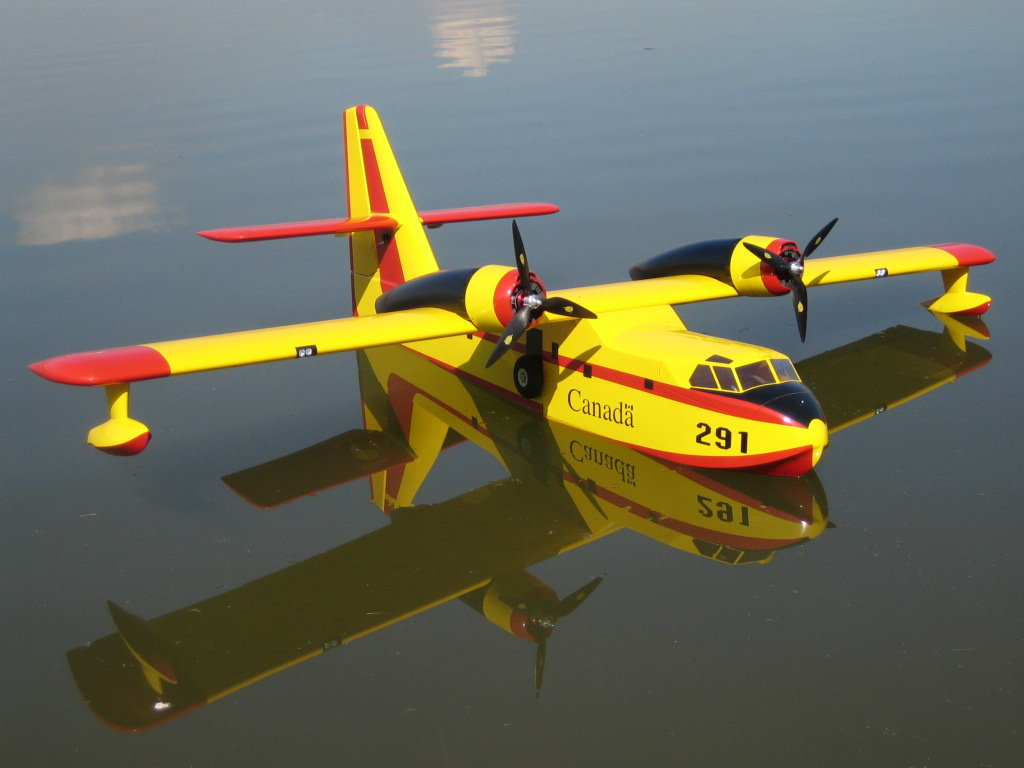
While we're up, near a lake, ATC points out unidentified traffic at five o' clock, after a bit of twisting around I spot and report a yellow and red biplane. After a pause Centre asks me if it might be a water bomber. I look again. Yep. It's a CL-215 in federal colours. I thought it was closer and thus smaller than it is, and that the little sponson was the end of a second wing. I score a D in airplane identification. I swear if you repainted mine when I was at lunch I wouldn't be able to recognize it. The water bomber passes by. I wonder why ATC knew it was there but didn't have it tagged up. Perhaps its pilot called in on a different frequency right after ATC gave me the point out.

We're in uncontrolled airspace, so technically no one needs to call ATC while we're VFR, but we, and presumably the fire-fighters, have taken advantage of the safety afforded by VFR flight following. It doesn't guarantee they'll see or have opportunity to tell us about all collision threats, but it's a lot better than no help at all. Later pick up a controlled VFR clearance in order to climb above 12,500', where we're required to use ATC services. We're not far from a busy airport and there are a lot of jets coming in and out. We keep having to get out of their way. It's pretty inefficient so as I suspected could happen, we don't get all our work done with enough fuel to get home. We don't even get all our work done before we have to land to be within legal reserves. We land at a little GA airport, not the busy one. At the self-serve fuel pumps we're interrogated by a curious GA pilot on a bicycle. He wants to know about our airplane, how much fuel we burn in an hour and what we do. We answer a few questions and then direct him to the company website for the rest. The sky is waiting for us.

The engines are always a little reluctant to start when they're hot, but I coax them back to life and we return to the sky. After I call clear of the GA airport circuit and switch back to the centre frequency I can hear the controller giving me as a point out to another aircraft. The controller even guesses it's us, as he tells the other aircraft the traffic "is probably" our type, and once their conversation is over I come on frequency and confirm it all. We go back up to CVFR altitudes but conditions are no longer appropriate for our work so we turn home and tell ATC and company that we are doing so. ATC says "Roger" but his tone is more like, "Sure, whatever."

A message comes back from company, "Did you bring overnight gear?"

Sigh. I am so out of practice for this job. I didn't even bring a toothbrush. I almost didn't bring my wallet. I tell new guy to message back, something like, "No, but we can adapt." It costs a lot more to fly this thing to base than it does to get two toothbrushes and a hotel for the night. We'll get the work finished in the morning.

Thursday, August 18, 2011

Pipeline Around the World

We're flying a pipeline today. The pipeline has already been built, so presumably the owners know where it is, but they want pictures of it, and we get paid to take pictures, so we fuel up and go. The flight is a little unusual in that we're training a new camera operator, so there are three people on board. But the more the merrier, as far as I'm concerned.

Linguistic aside I wrote the previous sentence and then tabbed over to my notes file to see what in particular I had to say about the pipeline flight. By pure coincidence, while I scrolled past the random thoughts at the beginning of the file, looking for the flight-by-flight notes, my eyes found something I wrote months ago about the expression I had just used. The grammar of the more the merrier isn't explainable through modern English grammar. The adverbial use of the is a relic of Old English þy, which was originally the instrumentive case of the neuter demonstrative þæt. So it literally meant something like "in what degree more, in that degree merrier." I think it's cool that I randomly use expressions of such ancient lineage and my language happily accommodates them. The people who have little fits about "hopefully" or "could care less" really don't have a leg to stand on. English has forever been about what people say, not what makes any kind of logical sense.

But merrily and numerously we taxi out for takeoff and persuade the controller to give us a departure clearance. There's a double delay and I wonder if I've managed to file the flight along some airway that is not authorized for use on Tuesdays, but the controllers are just puzzling out where to fling a CVFR flight. The first controller seemed to understand that I was CVFR, but there was a controller handoff between my calling for clearance them receiving it from centre and the new controller gave me an IFR departure. I don't really care. IFR or VFR I'm going to take off, switch to the next frequency, and follow their vectors and altitude restrictions until I'm in my photo blocks, so I accept the departure and follow it after I'm given a take-off clearance. The next controller gives me a vector that is close enough to direct my entry point that it doesn't matter, and I'm cheerfully following it when he calls back.

"Are you IFR or controlled VFR?" he asks.

"I'm on a controlled VFR flight plan."

"Have you been IFR at any point today?"

"I accepted a published IFR departure."

I think he asked me if I considered myself IFR right now. I tried to give him a professional and aviation-speak version of, "Seeing as I'm pointed in the direction I want to go, climbing towards the altitude I want, I really don't care." If we didn't have the op spec for extended single-pilot IFR duty days it might matter, but as it is it makes literally no difference to me. The only functional difference between VFR and IFR in cruise on a nice day is whether I have to read back clearances or not. And in busy airspace where most traffic is IFR, I often read back VFR clearances to fit in with the crowd. Technically under IFR the controller not me is responsible for my terrain and traffic, but it's not like I'm really abdicating those responsibilities, especially as I can see the terrain.

It shouldn't make that much difference to the controller, either. Under CVFR he's responsible for separating me from other traffic. That's the whole purpose of CVFR: to allow VFR traffic in airspace where IFR separation is required. But I don't mind. I wish I knew the words to make this controller happy. He tells me I'm CVFR and I'm happy with that. He hnds me off to another frequency.

The pipeline goes into the foothills, so that's where we're working. Usually I get a clearance for such and such photo blocks, for such an such a block altitude and then I just work, without a peep out of the controllers. But this lady won't give me a block altitude. I have to ask for every altitude change and heading change, and as often as not it's denied. There's traffic at that altitude, I can't have it. We end up skipping some lines for cloud and other lines because we just can't get by the controller. The thing about filing photo blocks is that theoretically they are supposed to give you the whole block, yours, exclusively. It never really works that way, and I wouldn't really want it to, but this controller doesn't get what is going on.

If I want to fly direct Calgary at 11,000' and there's traffic preventing me from doing so, I can continue towards Calgary at 9000' until the traffic is by me, then accept the climb to 11,000' and I have been inconvenienced only a tiny bit. If my direct Calgary course is 150 degrees and I'm restricted to south for five minutes, I've still been making progress towards Calgary and not a lot of time has been wasted in the five minutes before the controller says, "cleared direct Calgary." But if I want to fly along a line that starts exactly here and goes to exactly there on a track of 150.27 degrees (yes, my heading is displayed in front of me to two decimal places. I remember thinking +/-5 degrees on the commercial flight test was rigourous) at 11,000', it is completely useless to me to be cleared along it at 9000'. And if I need to turn NOW to get onto the line, a five minute heading restriction is worse than useless, because it will have carried me five minutes away from the start of the line and I have to turn around and go back.

In order to improve efficiency I start calling her a few dots before the end of a line, multitasking with my radio call and my dot tracking to try and get the next turn or next altitude approved before I hit the last dot and am ready to turn. It's a little overloading, as I'm focusing almost all my attention on those little dots and don't have a lot of attention over for the designations of photo blocks. The conversation is supposed to go like this:

Me: "In one mile Dotsmasher One requests left turn to zero eight five at one four thousand seven hundred."

Her: "Dotsmasher One cleared left turn zero eight five degrees at one four thousand seven hundred."

Me: "Left zero eight five degrees at one four thousand seven hundred, Dotsmasher One."

Her: "Readback correct."

Yeah, what is usually me flying around doing what I need to has turned into a four line conversation. And what is really going on includes both operators telling me what I need next and me reading back what they have said if it isn't clear or I think I have forgotten. So sometimes when I ask the controller for an altitude and she approves it I just say "Dotsmasher One." She corrects me snippily when I miss or muss a readback and the second time I apologize with, "Sorry, I'm just not feeling as though I'm IFR today." I'm turning and swooping and visually negotiating hills. There's a pause as she talks to other traffic then she calls me back just to deride me for that comment. "It doesn't matter," she says, "whether you are VFR or IFR you must always read back assigned altitudes and headings." I just bite my tongue on that one. It's a nice sunny day and she's stuck in a box with a screen while I get to fly in the mountains. I do my best to read everything back and am glad when our progress is sufficient that I am passed on to the next controller.

I give him a request based on the town I know we are working our way towards, then I realize I'm overhead it. Despite the cranky clearances we've been making good progress. The new controller finally gives us a block of airspace and leaves us alone. We keep flying along the pipeline, watching the scenery go by. There are some clouds on the horizon, but we hope we can complete the job before they cast shadows on our work. The senior operator says he wants someone to build a pipeline around the world so we can fly it, segment by segment, all the way around the world. I'd like to do that too, but I tell him he'd have to give me a bit more notice of where he wanted to land so I could arrange customs clearance. We're almost finished when clouds arrive and we're done for the day. We spiral down out of the sky towards the nearest airport for fuel.

The FSS there has a single in the circuit but no other traffic, and I let him know how many minutes I'll be in descent before arriving. I descend over a nearby navaid, then head for the airport when I can arrive at circuit altitude at a reasonable speed and descent rate. He points me out as arriving traffic, calling me a Piper Cherokee. I'm not usually too picky about what controllers call me, as long as they call me cleared to land, but I correct that one. If you're looking for a single and a twin turns up on final you may think you have a conflict.

Airports mostly look the same once you're on the ground, even if they are quite large, because you can't really see that far. We taxi to the self-serve fuel pumps and I shut down and fill out the logbook for the flight. The operator discovers that he has forgotten the company credit card, and his personal credit card doesn't work. Can I possibly ...?

I have an insane credit limit from all those years of ferrying airplanes around North America, so I toss them my credit card as I head to the terminal to find a washroom. I open the door to the terminal and see that there are airline counters and uniformed security inside. I have my pilot licence with me, but I need to make sure I can get back out again. I wave down one of the security guys and make sure he'll let me out. He tells me the code to get back out the door, and says it's written on the outside. Oops, didn't see it. I use the washroom, pick up the payphone to file an ordinary VFR flight plan home, and go back out the door. The code is written on the outside in teeny, tiny letters I didn't see. The senior operator is coming in as I go out. I tell him the code and he says, "I know." He's been here before.

It's funny these little airports. They're all the same to me. There's nothing in the CFS to indicate which ones have which level of security. It's not a function of runway length or altitude or type of air traffic service or of any other published datum. You land and look for somwhere to dump the contents of your bladder, and at some that means watering the grass at the edge of the taxiway while at others it means running the gauntlet of CATSA and throngs of passengers at the x-ray machines. It's disorienting, and without local knowledge you have to be on your toes to walk in the correct door, know the correct codes, have the correct documents and get back to your airplane.

In the meantime a small airliner has landed, but it doesn't need the fuel pumps. We all get back in the airplane and take off before the airliner needs out. We fly home. It takes a quarter the time to get back as it did to get here, because we're not circling around to get on the right lines, and we're talking only to traffic on 126.7 until it's time to talk to the airport controllers.

I land and taxi in, and the boss is waiting with a cheque for the exact amount of the fuel. The operator called ahead with the amount. Fastest expense reimbursement ever.

Saturday, July 16, 2011

Whirlwind Tour

The weather is good in BC, so I'm checking NOTAMs for a whole list of airports all over the province. It doesn't matter which ones I check, I'll be told to fly to somewhere I didn't check, and once airborne I'll be asked to land somewhere entirely different. I check the major northern Alberta ones like Whitecourt (no issues), Fort Mac (surrounded by forest fires), Slave Lake (surprisingly normal considering what they've gone through), Peace River (unlighted obstructions), Edmonton City Centre (all the approaches are messed up), Calgary (closed taxiways) and Lloydminster (more unlighted obstructions). I'm mostly interested in showstoppers like fuel unavailability or closed runways. The obstructions are typically 300' agl and more than a mile away. Unless it's right on final approach, it's not going to be in my path, and to be honest if something went so wrong that I was at 300' agl and not just under a mile back stabilized on final, I wouldn't have room in my brain to remember where the I end up having to update my NOTAMs after I have put away my computer in the morning, so I call a briefer with my embarrassingly long list of possible landing spots. McBride, Nakusp, Vernon, Squamish, Prince George, Fort St. John, Vancouver, everywhere we might go. The briefer tells me it will take a while because it's difficult to know where the NOTAMs are filed for small aerodromes. "They aren't just listed under the airports?" I ask. Nope. It all depends on what was done in the 1940s. Vernon, for example, was a military training base or something, so although it has no air traffic services, it has its own NOTAM file. Larger aerodromes elsewhere in the province are kept in other aerodrome files. The briefer tracks it all down for me.

We head out across the mountains, VFR this time, because we want to take pictures on the way and passing through cloud gets water on the camera, and might leave streaks on the glass that would show up in the pictures. Around Whitecourt there is a lot of cloud and it's raining, so I try to dodge it all, going way south and even a bit east in an attempt to avoid getting wet. Then I make an attempt to outclimb billowing cumulus. I know where this is going, as every altitude I climb too just shows more tops. They probably can't grow faster than I can climb they way they could when I was in Florida in an ultralight, but it's still silly trying to outclimb them. I go back down below the clouds and work on outlasting them. I know the low ones don't extend that far to the west.

I'll be going through a mountain pass below the clouds and this is something that GPSes with their straight pink (the guys call them "magenta") lines aren't as good at as old-fashioned technology. I have my chart out, folded so I can see Grande Cache and the mountains beyond, just as I see Grande Cache below and just ahead. I have a pencil, and I have an accurate watch. I identify my location on the chart and I mark the time I am there, resetting the directional gyro to the compass and paying close attention to which valley I go down. I can cheat big time because the GPS gives me both terrain and exact lat-long position, but this is the way to do it, so you don't lose track of where you are in identical-looking valleys with very different things at their ends, and so that if you take a wrong turn or encounter adverse weather, you know where you were when things were good and how to get back. And it gives me an excuse to look ahead and anticipate where I will see lakes and rivers around the corners.

We cross the Great Divide, which forms the Alberta-BC border here, and marks the time zone boundary as well as the high point of the mountain range. Our destination was originally Prince George but I've gone far enough south in the avoidance manoeuvre that the valley I've chosen will bring me out just south of McBride. I adjust the range on the GPS to show the operator this. He is surprised to learn that there is an airport at McBride. To him it's just a place that we will take pictures. "Can we land there?" he wants to know.

"Pass me that book."

That book is the manual for the airplane, because when it's not a flight test at an airport with a runway twice as long as I need, I do do my calculations. Not landing distance, but take-off, because "Can we land?" really means, "Can we land and then take off again?" and take-off distance is greater. I look up the airport elevation and then follow the line for the next highest elevation, at the hottest temperature it could possibly be down there, rounding up on the weight and assuming no wind, and there is still plenty of runway available to get out of there. "Yes, we can land."

We do, and the operator double-checks the camera glass, plus we both reset our bladders before taking off and taking pictures. We continue up the valley to Prince George, where we climb up to ten thousand feet or so and take some more pictures. We continue in this fashion, a giant, province-wide game of connect-the-dots that doesn't even draw anything, but wow is it scenic. Fuel is down to a little over an hour remaining as we approach Revelstoke, but I bypass it for one more set of photos. Part of my job is to plan fuel for efficient flight, and that means not always having the happy empty bladder and full fuel tanks that one would if it were a pleasure flight. There's opposite direction traffic at Nakusp, where we're taking pictures of a ski resort next to a lake, or maybe a lake next to a ski resort. We let him go by and then descend for the second set of photos, and then it's off to Vernon to land.

Approaching Vernon, I tune their frequency and hear a skydiving airplane preparing to drop. Argh, that wasn't in the NOTAMs. Closer scrutiny of the chart shows the airport to be in a marked advisory area for continuous daytime parachute activity, so it doesn't need a NOTAM. I advise that I will hold outside the area until the jumpers are on the ground. I'm irritated with myself for not noting this earlier, and it must have come out in my voice as the operator asks me if I'm mad at the drop plane pilot. I'm not. The drop plane pilot is pretty lackadaisical about his meatbombs, assuring me that there's no conflict. I ask how long the drop will take and something about the way he starts the sentence makes me think he's going to say "it depends on whether they remember to open their chutes or not." He doesn't though, just describes the seconds of freefall followed by where they open their chutes. I follow his advice and join a downwind without crossing the field. It's a little close to the runway, because of terrain, so I fly an ugly teardrop through final and back again, then over a big group of trees to the runway. The operator says pilots always come in high here because of the trees.

I backtrack to the apron and shut down behind another airplane at the fuel pumps, then we haul ours up to the pumps and fuel. We're pumping a lot of litres in, and quite a line forms behind us as the pilots who normally take maybe thirty to fifty litres at a time wait for us to fill all the tanks with an order of magnitude more fuel. No one is in too much of a hurry, though. They help us shove the airplane off the pump so the next people can fuel. There's a washroom but no payphone in the terminal, an increasing and annoying trend these days. Cellphones die. Payphones connect. I do succeed in filing a flight plan, pretty much guessing at how long our remaining work will take and where we'll end up, then jump in the airplane and fire it up.

We taxi out and take off straight away, climbing straight out over the lake to avoid the parachutes, and then up a valley to get to altitude before the hills do in this heat. Some photos of a secret lake, and then set course for an Indian reserve. Although we're dodging jagged mountain peaks with no sign of any civilization in sight, the chart tells me that I'm approaching Vancouver's inverted wedding cake airspace and lists a frequency to call Vancouver Centre before I enter Class C. Theoretically there's a number there, written against the violent colours and squiggles of the hypsometric tints and contour lines. I think I need bifocal sunglasses. I call the controller for clearance into the airspace and to advise her of a few photo lines that we'll be flying within the area controlled by Vancouver terminal. She has trouble understanding me at first. It's amazing she receives me at all. Do they have repeating antennae out here in the barren mountains? Wouldn't they just blow down, get covered in snow, or be destroyed by rutting moose and itchy bears? She clears me into the class C, but advises me that there are too many photo aircraft in the area and the mission will not be approved. Grr. Damn damn damn. The sun angle will be too low soon, so we can't wait long. I would have got preapproval this morning before coming but it was hard to predict when we would be here and truth-be-told I had some of today's assignment mixed up with the work we did last time we were here, so I didn't realize those Vancouver area dots were new work and not completed work. Communication: important.

The first valley we're in is below the reaches of Vancouver's airspace, so they can't tell us what we can and can't do. I have to fly up a valley towards mountains while on line, which is a little nerve-wracking because it's difficult to look at terrain and photo dots at the same time. I have to assure myself that there is no risk of CFIT on the line, but I still want to look out the window. We have to take a couple of runs at some lines because it takes a bit of a run-in to get on line and from one direction there isn't room to do that. There's a lot of snow up here still and at least one photo is just an overexposed white blob from the glare of the snow.

The next area has very few lines, and is partly in and partly out of terminal airspace. I get on the first line heading towards the airspace boundary, and then call up terminal for clearance in. Nothing about photo lines, just where I am, my altitude, and where I'm going. No problem. I'm coming down a valley and at an altitude where this is a pretty normal request. The line is complete. I look at the chart and where we need to be next. Now I'm taking advantage of the poor communication I've observed between layers of control in the Vancouver airport. I'm betting this guy has no idea I'm a photo flight that was denied.

"Request to overfly Bowen Island west to east at six thousand."

"That's approved."

The operator is laughing at me, because he sees what I'm doing, and it's working. No pressure though. I can't screw up my casual "overflight" of the island. I have to be right on line, but it's not anywhere any airplane might not be. Finishing that line of photos I ask to continue to the river ahead, and that's approved, too. Sneaky, but done before the sun angle or fuel level got too low or my duty day ended. And then I land. As I roll out I see that it was almost to the minute right on the flight plan, which greatly amuses me, considering where I pulled those numbers from. I have an experienced ... hat.

We barely needed the heater, but it seems to work.


On the subject of pulling things out of body parts, we have the latest thing to be paranoid about: surgically implanted explosives. Perhaps I am glad I'm not going through the secure side of airports much these days. I wonder what proportion of the travelling public has had surgery recently enough to raise TSA suspicions. If the explosive device were disguised in a breast implant as they suggest, the incision could be hidden under the breast where it would take a very thorough search to find it, especially if one covered the mark with that make up putty and made it look like an old implant incision.

Wednesday, July 13, 2011

SouvenAIRs

Company has rush-ordered a new heater, we're almost due for scheduled maintenance, and the weather is turning bad all over the province, and it's already bad in the neighbouring ones. It's a rare convergence of circumstances that suggest so strongly that we fly the airplane back to base, so we check out of yet another hotel and fly home VFR.

The co-owner welcomes us in, then I tidy up the airplane. I don't track down a vacuum cleaner before closing time, but I do neaten up the seatbelts, pick all the muffin crumbs out of the carpet, find my headset bag and stow my headset in it, and refold all the charts properly and sort them all back neatly in the racks where they can be reached for the next flight. When I'm travelling with an airplane, a lot of garbage ends up in locker where I store cleaning supplies. That's because I'll be preflighting, open that locker to get out a cloth and 210 spray (a type of plastic polish for airplane windshields), clean the windows, and toss the spray bottle and used wipe back in. Then I'll check the oil, get out a funnel and a couple of litres of oil. They're actually 946 mL, a quarter of a US gallon: that's the standard size all over North America, and it looks like even in Europe, maybe because the crankcases on American-made airplanes hold an even number of US quarts. Anyway, we call them litres, even though they aren't. I'll add the required oil, then when I get tired of waiting for the last drips to come out of the bottle into the crankcase, I put the lid back on the bottle tightly, and toss the bottle in the locker with the funnel and the other empties. Empty bottles don't weight much and the home airport has some kind of environmental disposal for them, so rather than run around a strange apron looking for a FOD bin, I haul them all home.

As I do so, I'm always amused by the way the bulging and squashed sides of the various bottles tell the story of the trip. Putting the cap on tightly seals in those few millilitres that didn't drip out while the bottle was inverted over the crankcase, but mostly what it seals in is air. Air at the pressure of the aerodrome where I added the oil. If it's a sea level airport, the sides of the bottle bulge out at higher elevations. If it's a mountain airport, pressure at a lower elevation crushes the bottle. I'm easily amused.

I clean things up best I can, report the minor snags (right engine has almost double the oil consumption to the left, noticeable split in the throttles to maintain equal manifold pressure above 10,000', and some hydraulic seepage). Then I am "released" from call for a few days. This will give me time to get my camera repaired, take my friend's kids to the amusement park as I've been promising for so long, and do my laundry.

Back soon with clean underwear!

---

On the subject of this stun gun, it's interesting to see that the seatback pockets are the same security hole for JetBlue as they were for Victory Airways. Whenever we'd boarded with something that wouldn't get through security, but we were going south, we'd pop it in the seatback pocket, get off and go through security and have it waiting for us back on board. CATSA never swept the airplane itself.

Monday, June 27, 2011

Mountain Valleys

The next morning's weather actually is better, it wasn't just a procrastination technique on my part. I let the operator know I'm willing to do the flight. The weather at Vancouver is still marginal, but the altitudes I need through the Rockies should be ice-free, so I file an IFR flight plan for the trip. I may be able to do it VFR, depending on when the operator actually chooses to go, but I'd like a chance to fly this airplane IFR before the ride. I also get his okay on doing the approach to destination (in visual weather) with the power to one engine pulled back, so I can see what this airplane flies like on one engine.

We go to the airport, but now the operator doesn't want to leave yet. I unpack various cleaning supplies from the nose and use the leather cleaner to try and make the seats look nicer. They aren't disgusting, just a little grimy, but like all cleaners, the product isn't magical and while my effort makes the rags noticeably dirtier, it doesn't make the seats seem a lot cleaner. This is an airport where people have security badges like crazy, and I don't have one. I go on the airport website to try and find a ramp badge policy, but there doesn't seem to be one. I know I could get in trouble if I'm standing about poking at an airplane with no badge, if I'm supposed to have one. But I can't tell if I am. I call security to ask about the south side badging policy. The guy puts me on hold twice. I get the idea it's his first day. Or maybe he's the team enforcer. He seems to be telling me that it's the responsibility of whoever's hangar we're working out of. That would be the maintenance unit that looked into the EGT overtemp situation, but they aren't escorting me. They said my pilot licence would do the trick. I try to get security guy to confirm that my pilot licence is sufficient ID for a ramp check here, but he defers to my employer. Well of course THEY say I can be here. How does he know I don't work for a radical BC Separatist organization that wants to bomb the local legislature? I ask if it's possible to get a temporary badge, but apparently it would take a couple of weeks just to get an interview to apply for any sort of badge. Funny that. A friend who works at Air Canada said that the non-union temp workers they brought in to cover during the strike all seemed to get badges overnight.

I get an e-mail with an examiner's name and instructions to call and arrange the ride directly. I leave voice mail with my own e-mail and phone number and the fact that I am on the road, but am hoping to be there to do a ride on Tuesday. My guess for when we are leaving is about to expire, so I call back to flight services to change my filed departure time, just guessing a new one, I can change it again later. While I am waiting to be told to I sit down to study the aircraft operating handbook and the CAP GEN for my mysteriously situated PPC ride. I think I know most of it. I was well-prepared last time, but I'll never forget the ride I was underprepared for. It was a similar situation, "I did a ride recently. I know this stuff," but I didn't. So I study again.

When the operator is ready to go, I discover the weather is pretty good now, and also good on the webcams through the mountains. He only wants to get across the first mountain range tonight, to be sure we won't be trapped in Vancouver by coastal weather. I call Flight Services to file a VFR flight plan (can probably do the whole trip around 9,500' and get out of here more efficiently) to possibly replace the IFR flight one (at 15,000'). For some reason this is a big deal for them. It turns out that I've called on the day that some kind of changeover is happening, so they could have done it easily yesterday and will be able to do it effortlessly tomorrow, but today it's an issue. They can't have two flight plans in the system at once for the same airplane. I suggest that they put the VFR one with a proposed departure after the ETA of the IFR one and then I can change it just before departure if I go VFR, but that doesn't work for them. I can't remember how we resolved that, possibly by departing IFR and then taking advantage of the phenomenally poor tower-terminal relationship to cancel in the air. Or the ground controller was surprisingly accommodating and helped me have the best of both worlds. There's a massive banner on the control tower, cheering on the Vancouver Canucks hockey team.

I was originally planning to fly eastbound along the Fraser River to Hope and up the highway, but once airborne, I see that the more northerly route looks better initially, and that ties in with the worst of the weather being to the south, too. I request an altitude that will take me through the passes up the valley overhead Whistler Mountain, where the 2010 Winter Olympics were. I'd show you pictures, but did I tell you? My camera is sort of broken. In some sort of cosmic joke, while I fly a giant camera around, the one in my flight bag doesn't work. It still thinks it is taking pictures, but all the resulting saved images are just pure black rectangles. I hope maybe there's just a broken spring (do cameras even have springs anymore?) somewhere and that the shutter isn't opening properly. I'll try to get it repaired, and in the meantime I may be able to borrow one.

I plug a few coordinates in on the GPS and set it in terrain mode, but mostly this kind of flying is about looking out the window and making sure the valleys in real life match the valleys on the VFR chart. There are clouds above, but not in sufficient numbers to hamper my turning around if some low ones block the valley, and I don't think they will. Their bases get higher as I go up the valley. I do reach one wall of cloud. It's a cumulus build-up along a ridge that I thought I could hop over by going visually between peaks. There are too many clouds to do that, so I turn south along the valley the ridge defines, to climb in order to turn back and go over them. Normally outclimbing a bank of Cu is a poor proposition, because there tend to be higher and higher ones beyond. This I'm pretty sure is just at this ridge, with a lower plateau without the buildups beyond it. I'm right, but as we climb over it, there's a kind of a slapping sound, like a loose strap or a hatch come open. Maybe it's the new headset. Wouldn't that be rich, buy a new headset and have it be defective.

There's that noise again. Maybe it's a cable slap. The ailerons make some odd noises as a result of rerouting for the camera port in the belly. That's a little freaky, but it's all STCed and frequently inspected. The sound stops. I ask the operator if he heard it, and he did. I pull my headset plugs out to see if he still hears it. There's a long pause, but it happens again without my headset in the system. And then it's quiet. Maybe the ANR screwed up the intercom. I've been blamed for intercom problems before, back when I was an early adopter of ANR technology and everyone else with passive DC units would blame problems on freaky electronic headset girl. But the operator still hears the noise when he unplugs from the intercom.

Some minutes later I hear it again, variously a banging, slapping, popping sound. I have to adjust the trim as the operator wanders around trying to pinpoint the source. It seems more on the left than the right, sometimes further forward, sometimes further back. There is no yawing or fluctuating engine indication. We keep thinking it's stopped, then it starts again. The operator suggests turning off the heater, and I try that. It doesn't happen for a long time ... then it continues to not happen for a further long time. It seems to have stopped. Not good. The heater burns fuel. We hate to think what it's doing when it malfunctions.

We continue without further incident over the plateau and then dip down over the lake to land at Salmon Arm, the same place in the BC mountains where I surveyed last summer. I make a call on the traffic frequency and there's a small airplane up. He tells me the wind is calm. I cross over the town and join downwind, the narrow valley clearly showing why the CFS recommends using this airport at night unless you are very familiar with the area, and all the hazard beacons are operating. I land close over the trees and the golf course and roll out to the exit. There's a guy in a little airplane in the run up area. I wave and taxi in for fuel, which according to the CFS is available for another thirty minutes.

We park at the pumps and call all the numbers listed for fuel, with no reply. I walk over to the hangar where the pilot has parked and ask him when the fuel is open until. He agrees that it should still be open this time of year and says the guy was around recently. He gives me another number, and I call that. It's now about seven minutes to the time the CFS says fuel closes. The fueller doesn't want to come out now, so he agrees to come in a bit early the next morning to get us going on time.

Meanwhile, it's obvious the heater was the problem. There's a stream of soot down the belly of the airplane. I wipe off what I can and put "soot remover" on my shopping list. The pilot is done in his hangar and gives us a ride into town where we get a hotel and a quick meal. The waitress is intrigued by our "detailed maps" as we pore over the next day's flying, and she is very helpful in packing "to-go" meals for tomorrow's lunch. The time we have to leave in the morning is the same time breakfast starts at the hotel, but we can probably grab muffins and fruit to go as the cab arrives.

Thursday, January 27, 2011

So Out of Here

Saturday is another miserable weather day, unsuitable for our work, and the client hasn't given up to send us anywhere else. All evidence points to my replacement coworker having boarded the plane to here, so I pack, check out of the hotel and get a ride to the terminal. It's a wooden shack at the end of a mostly empty parking lot. The driver jokes, "Do you think this this the right concourse? I probably won't get towed if you want to go in and check." The airplane hasn't landed yet, but I'm sure it will be along shortly.

I check in, with a human, no kiosks and they're nice to me. We're too far north for security, so that's it. I sit down in the waiting area where there is a 3D jigsaw puzzle for waiting passengers to work on. It's not a 3D structure, but the picture on it is 3D, kind of disconcerting, as it's difficult to look at and hard to actually tell what matches. I and a geological engineer work on it for a bit, matching a few blue pieces, sea or sky or little wooden houses in Newfoundland, I don't remember which, then we board the flight. There isn't much space under seats and no overhead bins, so they offer to gatecheck bags, but they stipulate no computers allowed in gatecheck, so I find somewhere to stuff mine in the cabin. There's a young Chinese male FO; that's more unusual than a white female one. Considering the number of people in Canada with Chinese ancestry, there are incredibly few in aviation. I can't think that I've ever seen a Chinese female flying an airliner in Canada. I'm in an exit row and he gives me an extra exit briefing, plus I look at the card. It's the usual stuff. Obey flight attendants, ditch door, leave stuff.

We launch into the murk. In the top-of-descent briefing the captain informs us that the destination airport weather is "sunny with crazy winds." I love small airlines. They haven't had the honesty beaten and memoed out of them. The descent is predictably bumpy, and we're yawing on final, back and forth. There's no cockpit door and I can see the runway lurching back and forth through the cockpit windows.

This is where I landed after the thunderstorm. It's the same runway and the same very abrupt turn off onto the taxiway. The crew parks, we disembark, and I wait for my checked bag. I take it to security and they clear it through to be loaded on my connecting flight. It "connects" in the loosest sense of the word, in that it will be at this airport in a couple of hours, but what are you going to do. I go to security and stand behind a man who appears to be in line, but he indicates that he's not waiting, just watching "the little one" go through. I peer ahead to see the unaccompanied minor off on his or her first flight, but the man's son is a fully-grown adult of what appears to be normal physical and mental function, the sort of guy you'd have no qualms dropping off at the curb. Parents!

There's more turbulence getting out of here, but that's to be expected. The flight attendant gives me a handful of extra snacks, woo! Flight attendants always treat me well. I wonder if it's a reward for my paying rapt attention during the safety briefing. I eat my way through all the snacks and my computer battery, and then I'm home. Double woo! My stuff and car are all safe and waiting for me, and my insurance hasn't even expired yet.

I'm not using the car really, so I was just going to say "who cares" and let it lapse for a while: I don't have anywhere to go that I can't walk to, but the same insurance covers it if the parking garage burns down or it's stolen, so I'll pay up and renew it.

Dinner is NOT Boston Pizza. And the next posts will be in chronological order.

Friday, January 21, 2011

Prophylactic Security Measures

Finally, after a string of tentative aviation but not work posts, I'm ready to finish up posts on my last shift at work. This might be a little confusing because I tried hard to get these done before I left for Cambodia, but they really take place before then. So we rejoin me during the final week of my last shift before I left Cambodia.

I'm lazing about in an anonymous hotel. 'Tis not the season for working very hard in Canada, so here is a story from someone else who was working hard at a US airline which I won't name. I have his permission to post it, properly anonymized, so if you're close enough to the story to recognize the players, please don't say anything to give it away.

We had a serious situation on our flight yesterday that resulted in a diversion to an airport where we have no base, and a full evacuation. A few passengers received minor injuries during the evacuation, but otherwise everything was fine. We had no staff based there, but another airline came to the rescue in helping us with locating buses and assisting our passengers. They even had some of their staff mobilize to get bags off the aircraft. As a result of the landing, the airport was forced to close for most of the day yesterday and into this morning because the brakes had locked and we could not move the aircraft. This airport doesn't even have a towbar appropriate for the aircraft, so we trucked one in from another city along with other ground support equipment to help with moving the aircraft.

Once our airplane was no longer impeding airport operations, the next priority was to return it to serviceability. We brought our own employees, all appropriately badged for airside access at two of our other bases, but the TSA would not permit them onto the field here, to work in a maintenance hangar. The airport authority and the airline are in agreement that this incident is an emergency situation which requires mitigative response in allowing our personnel to fix the aircraft immediately without having to go through SIDA training for the new airport. TSA maintains stoically that any staff working to get this plane operating need to go through SIDA training.

SIDA stands for Security Identification Display Area. Every airport has its own application procedure including a short training course. Presumably the training consists mainly of being told not to let anyone into a secure area, not to enter one without your badge, and not to lose your badge, plus lots of threats and scary information about what happens if you disobey. Perhaps the airport-specific part includes a map showing all the secure areas on the airport in question, and an introduction to the head of security who will kick your ass if you don't comply. That takes about 45 minutes (the training, not the ass-kicking) so the lengthy part of the application procedure is the ten day wait for a background check. You can't use the fact that you got a background check at three other airports to waive this requirement, as the airport badge must be issued right after the passed background check.

The eye-rolling frustration of this policy is evident from the quoted diversion incident and the details of the SIDA application process itself. Plus the first google hit for SIDA training TSA is a plea to standardize the training for all airports. While I'd agree that a trainee aircraft groomer at SeaTac shouldn't automatically have an all-access pass at DCA, I can't conceive of a reason why an aircraft mechanic with 20 years experience at JFK can't be issued a temporary pass to work on a company aircraft at LAX, after the validity of her JFK pass has been confirmed. Can you? It's not like it's hard to identify the secure areas at an unfamiliar airport. They have a stop sign sticker with the SIDA acronym, and they're usually locked, anyway.

I always flinch slightly when I see the SIDA sticker on airport doors, not because I've ever been badged at a US airport, but because they happen to have chosen the same acronym as the French term for AIDS, as in the HIV+ disease. Not that that's something one contracts by turning the wrong doorknob, but it is an extra deterrent to keep me out of secured areas.

It's pasta Tuesday, the highlight of the week in northern wherever we are. We all go to Boston Pizza.

Update: The missing paragraph of the post is now visible. I accidentally hid it through an html error.

Saturday, December 11, 2010

As Seen on the Internet

Hong Kong International airport is huge and modern, signed in Cantonese first and British English second, with Vietnamese, Japanese, Korean, and what may be Indonesian ("Perhatikan waktu Hong Kong saat mengecek jadwal keberangkatan") or Tagalog ("Mangyari po lamang na alamin ang takdang oras ng pageakay sa 'Hongkong local time'") on some signs. Surrounding the airport we can see two concentric barbed wire topped fences with about a four-metre no-man's-land gap between the two. I've never seen that level of physical security around an airport perimeter. I've seen less at some Canadian prisons. Security screening is simple, quick and polite: shoes on, belongings into little numbered baskets for which you get a laminated claim card in case of disputes about who owns what once it comes out of the scanner. Something on my person triggers the scanner to beep. I stop and hold out my arms and am told to put them down. I'm not sure if I was holding them too high for the little security officer to reach comfortably with the wand, or if assuming the position just isn't required here.

We have a tight connection, so hustle up the elevator, through the mall, down the escalator and out to the terminal transfer bus, backed in by the door. We start to walk down the right side of the bus as we would at home and are stopped with an "excuse me, this way." Oh right Hong Kong. They drive on the left, so we board the bus on the left. Signs like "please press bell before alighting" also demonstrate Hong Kong's heritage as a British possession. The bus takes us out to the airplane, where we alight. Without pressing the bell actually. It must be a repurposed city bus. The air smells like the inside of a poorly ventilated garage. We board a Dragonair A321, and once we're underway they serve us Dim Sum for breakfast. Hey, it's Saturday morning. It is Dim Sum time. eh?

My first hint that I'm actually going to Cambodia is the immigration forms that are handed around, in Khmer and English. I fill those out and then a couple of hours later we're on approach into Phnom Penh. There's no city evident at first, just a wide muddy river --it's the Tonlé Sap--with some small buildings along it, and fields laid out among tropical trees. We then spot the city. From above it looks like a cross between Paris and Spain: Paris for the star-shaped city with broad avenues and boulevards radiating from circular hubs, and Spain for the red tile roofs and tropical trees. The airplane makes an unusual number of turns for an airline approach in visual conditions, and other passengers comment on the steep bank angle. I wonder if we're maneuvering for traffic or if Phnom Penh tower doesn't have radar, and we're joining the circuit with full VFR procedures rather than just being vectored for a visual approach to the straight in. Later fellow passengers will ask my professional opinion about the landing, and I'll tell them that, without knowing the wind, runway and systems conditions that the crew were considering, I can't evaluate the choice or execution of landing technique. And I've never flown an Airbus outside of a simulator. It was a smooth touchdown and we exited the runway via a taxiway, not over the end or side, without painful deceleration, so it seemed fine to me. We're in Cambodia.

Inside the terminal we present our various completed forms, pay $25 for an embossed, shiny tourist visa and collect our bags. Signs in the airport are in Khmer and English, except for the one for the prayer room, which adds Arabic. We present our passports, newly issued visas and other paperwork and exit into Cambodia. It still looks a fair bit like an airport, an appearance that is not changed by our loading our bags and ourselves onto an air conditioned bus. Yeah, a blog entry and a half of this drivel and I still haven't told you anything about Cambodia. Travel has a big downside, doesn't it?

With our noses pressed against the windows, we join the traffic and head into town towards the hotel. Here, through the bus window, are approximately four of our fellow road users. On one small motorbike. The streets teem with vehicles, powered by engines, people or animals, overloaded to an extent I wouldn't have believed possible if I didn't read Failblog, and weaving in and out of one another's path like the RCMP musical ride. There doesn't seem to be any distinction between different sorts of road users. The backdrop is mostly tropical trees, low plastered buildings, many under construction, renovation or maybe just falling apart, and decorated walls.

As we watch the scenery and receive our first impressions of the country, one of the group leaders provides a narration, as if we would not otherwise be able to comprehend what is passing in front of our eyes. After a few minutes I tap him gently on the arm and ask, "Please, can we just experience it for ourselves?" He is a capable and very organized leader who keeps us well-informed. I had the impression that he had just left his mouth engaged after giving us the necessary information about hotel and agenda. I may have been wrong, though. He stops the play-by-play, but later another leader indicated that she thought many people appreciated the commentary. I've never been on a group tour before. Maybe it's only bloggers whose are constantly composing their own commentaries, and other people need it done for them.

After a couple of kilometres the bus turns right though a gate into a field. Just a field, with grass, and some dirt tracks and a bunch of other vehicles parked in it. I don't see a hotel. It turns out that for the Water Festival this week, they have set up traffic barricades, and vehicles over a certain size are not permitted any closer to the centre of town. I don't think it's a security measure, just a way to reduce the crush of traffic on a busy weekend, the way a downtown street in Canada might become a pedestrian mall for special events. The local officers are wearing street clothes, their badge of office is just a baseball cap with official insignia. The bus driver and one of our group participants go to negotiate with the police, and after a fair amount of handwaving a police officer wearing an entire uniform, not just a ball cap, arrives and grants us special permission to go to our hotel. I'm not sure if that included a police escort, or how exactly we got through the successive barricades. Looks like I did need the commentary after all.

What I did see was increasing amounts of traffic, vendors squatting on the sidewalks next to their wares, people smiling and waving to us from cafés and other vehicles. It is not at all intimidating. I've never been to Asia before, and I was prepared to be sickened by overwhelming poverty, frightened by an unidentifiably alien environment, or simply to have no link to the culture. But it's exciting and welcoming. I had an interview once on a Caribbean island and there was the same chaotic disrepair in the streets and buildings, and the same feeling of people everywhere selling things with minimal infrastructure. People seem better off here than in much of Nunavut, and I don't just mean the weather.

We check into the hotel, which is not a hovel. There's a shrine on the floor of the lobby, along with some clocks telling the time in six places: Hong Kong, United States, Australia, England, Australia and France. Yep, I know, but they apparently don't. Check-in is efficient and polite. The staff are amused that I can recite my room number in Khmer. I learned the numbers and some basic expressions from YouTube before I left Canada. My roommate and I go up to the room. There's a TV, a bathroom, two good sized beds with firm mattresses, mirrors, cupboards, a dresser and a fridge. There's a balcony, but when we go out on it, the outside is walled off with plastic sheets, so we can't see anything. I think it faces the back of another building, anyway. It's also clean. I've had worse hotel rooms in Saskatchewan. Also the internet doesn't work and the hotel staff say they're getting it fixed. Some things are universal.

It's only early afternoon, so I go out to stretch my legs and look around. People are friendly, even if they aren't selling anything, but there are lots of people who are selling things, probably more than usual, seeing as there's a festival underway. I still need some clothes appropriate to the climate. I buy a sunhat for a dollar. It's made out of strips of dried leaves which I assume are palm fronds, all stitched together on a sewing machine and decorated with fabric strips.

Another vendor sells me a loose fitting cotton shirt decorated with a picture of a cat and circles of letters from the Latin alphabet, all printed in reverse, and spelling nothing. She states the price as seven, I offer five (yes, I am a sucky bargainer) and she tells me in almost perfectly accented English that it's a fixed price. Turns out it's not seven dollars, but seven thousand riels, which is just under two dollars.

On another street a man asks me "parlez vous français?" I'm not too surprised, as my guidebook said that some older people might speak French, as a remnant of this region's history as "Indochine." I answer in the affirmative and in the ensuing conversation tell him I'm from Canada. He says he lives in Montréal, and I must have given him a look of complete disbelief, because he opens his wallet to produce a Canadian SIN card and a Québec permis de conduire. I sit down at his invitation for a chat. I haven't been here long enough to have many questions ready to ask. I have heard that the water festival marks the reversal of the flow of the Tonlé Sap so I ask him about that. He confuses me by saying that the festival commemorates a thousand-years-ago naval victory over Islamic forces, a victory that was facilitated by the reversal of the waters. This website says it was started by King Preah Bat Jayvarman VII as an opportunity to train and select skilled boatsmen for the navy, and other sources say it dates back to the 7th century as a thanksgiving festival. Given that under three hundred years has produced some drift in the meaning of the American thanksgiving, I'll cut the Cambodians some slack and say, hey, their river starts flowing the other way. Why not have a three day party? At any rate the experience teaches me not to make assumptions about the worldliness of the people here. Except it doesn't. I'll do it again later in the trip.

Dinner that night is all together with the group at a tourist-oriented local restaurant. Appetizers start with salted roasted peanuts with some little tiny chili pepper garnishes. Yes, one guy eats a chili pepper. For the record, the little tiny red ones are much hotter than jalapeños. While he tries to put out the fire in his mouth by guzzling water, I recommend rice, and it arrives just in time for it to make me his hero. Another appetizer plate includes bean sprouts and vegetables in a sauce that has an offensive fish odour. I try it out, and fight the gag reflex to get it down. It tastes worse than it smells. I hope the "fish Khmer style" that I ordered will be better. It is. It's a delicious curry, spiced warm not hot, with all kinds of exciting flavours going on, none of which is gag-inducing fish guts.

After dinner there is a traditional music performance, with instruments including a boatlike wooden xylophone, a long-necked stringed instrument played with a bow, and a drum. The drummer is sitting cross-legged on the floor and I can see the bottom of his foot. Before coming to Cambodia we were lectured sternly about customs, including taking off shoes in people's homes, sitting or squatting on the floor, and not displaying the bottoms of our feet to anyone. I tried to figure out a way to sit cross-legged on the floor without doing so, and couldn't, so I'm kind of pleased to see that the culture doesn't demand the physically impossible. Or for all I know the drummer thinks it's hilarious to moon the stupid tourists.

Wednesday, December 08, 2010

Songs of My Country

We got everything ready and took off today, but after flying back and forth for about five minutes, before all the green lights were even lined up on the mission, we were forced to abort for poor environmental conditions. I love this plane, because I can carry full fuel and a mission specialist and still land immediately after take off. All airplanes in the fleet are not the same, and one that is heavier empty may require me to fly for about an hour before I'm down to landing weight. I have no ability to dump fuel. In an emergency I could land overweight, and if it was a high quality landing on a sufficient length runway, there would be no damage at all. But the specifications for the aircraft have to allow for the sloppiest normally acceptable landing--I don't know if that's defined somewhere, it's a corner of the envelope I've never elected nor had the misfortune to push--and still land safely at the max allowable weight. So I must legally burn down to that before landing. This lovely, svelte aircraft would let me do touch and goes with my full mission payload. So when the mission specialist calls it, I'm wheels on the ground as soon as the local FSS confirms the runway is mine. It's always the mission specialist's call to land for any mission-related reasons, of just because he or she feels like it, just as he or she can't overrule my decision to land for any safety reason. I don't get to call flights on whims though.

The AME arrives to meet the flight. It's one of the guys I was working with down south, just not the same one as was up here before. They swapped over and used their overlap days to do the inspection. He's here this afternoon just to make sure there is no aircraft reason for the quick return, and to familiarize himself with the working environment up here. I feel like I'm on the Snowbirds or something with this attentive ground support.

Back at the hotel, I have e-mail with an iTunes recommendation, based on my quoting Robert Service. He's right, I like this. I've heard it many times, but never remembered the title or artist at a moment when I was downloading music.

My country is definitely wild and savage. The song goes into my cross country playlist along with all the songs that contain the names of states and provinces or other places I fly over. Yes, my list is heavy on Stompin' Tom. My correspondent reminds me that Stan Rogers also has an aviation connection, as he was killed in the fire on the Air Canada deathwish plane.

Meanwhile iTunes censors the word "Honky" in Honky Tonk Man and Honky Tonk Blues censored. What the heck? How is this a bad word? I believe it's a really old fashioned derogatory term for caucasians, based I suppose on the fact that white people have the biggest noses of any race, but has anyone ever been actually offended by the word? I love reading stories about ridiculous things done in the name of profanity filtering, but I don't like it so much when they affect things I'm trying to look at.

A victory has been achieved against the forces for terrorist infiltration of hotels, as the card encoder works again, and we can all go in and out of our hotel rooms without an escort.

Sunday, December 05, 2010

Retracing My Steps

Back to the hangar, for what should be the last time. We said we'd have the airplane back to the customer today, but this airport is fogged in solid, so we have a little while to work before the pressure is really on. It's cold again today, even colder. I crank the heat on the hangar. We're paying to rent it. I nerd on the iPod for a bit then ask if they are done the cabin inspection so I can close up in there. "Oh, cabin inspection, right." That would be a no. They are done in the nose, so I replace all the gear. It always looks like something is missing when I put it back, because it fits so much better when you have it all out and can play tetris with it to get the best fit, as compared to when you're just digging something out and shoving it back. Then it's like this sort of tetris. My high score there is 100.

I call flight services for an update on weather, seeing as I can't see more than a couple of hundred metres past the door of the hangar. I think I can see further inside than outside. The weather is not good at destination yet, either, but both should improve before long. There's still no NOTAM on the drag racing, so I call the local Flight Services personnel to ask. They tell me the races take place on a disused taxiway on the other side of the airport and have no impact on operations. Ahh. I call back the FSS briefer to pass on this information, so they can mollify any other pilot who is concerned by the signs.

The cabin inspection is complete and one of the AMEs is closing up the panels there. I feel guilty that he is fixing the mess I made in the cabin, pulling everything apart to get to the cables. Those panels come in and out a lot so there were different kinds of holes, different sizes of screws, carpet and other miscellany. As they get ready to tow the aircraft out, I put the seats back in the cockpit. They always go back in easier than out, the opposite of the cabin seats. I see as I secure the locks on the rails that he has done a beautiful job reassembling the floor. It's better than when I started.

I compliment him on that, it's an easy thing to be lazy about, hence the mess it was in when I started. Both guys seem grateful for my help over the last few days, despite my sometimes self-sabotaging assistance. I suppose just having company is good, too. Now it's time for me to go do what I'm good at.

I walkaround and make sure that we haven't left any important bits unattached, then start up and run up the engines. Everything looks fine, sounds fine. They want a fairly long run so call for taxi and, after I let a Cessna 180 go by, go out on the runway to do the break-in for the new brake pads. A couple of accelerate-stops and then I'm back to the ramp. They pull the cowls again and I assume my note "leak check goo" means that it was all good with no leaks, because after that we went back to the hotel to get Internet access for the references needed to finish the last of the paperwork. I load bags my bags into the airplane, thank the guys again for their work and leave while they are still cleaning the hangar.

After take off I keep the speed down so I can cycle the gear a couple of times. Everything works as well as it did on the jacks. Sometimes with the airflow going by the calibration or something isn't quite right, but today it's perfect. I text an "all good" (or possibly "all goo," hope they understood) and steer direct for the waiting customers.

My northbound track takes me right through where the storm was on the way down. I haven't cleared the GPS track, so you can see my route south, my initial 180, slightly kidney shaped as I deked the visible lightning, another foray to the south east, and then a big wide semi-cardiod shape completely avoiding the area of thunderstorms before rejoining the planned track to destination. A little avgas and a little airframe time doesn't compare to the risk of lightning, downdrafts, disorientation and severe turbulence inside those monsters. Now there is nothing but sky and nice little puffy clouds. At destination it's approach, land, rollout, park, text, and get a ride to the hotel. They tell me the sky went black here after I left, too. They saw the same monster that I tickled.

The cardkey encoder still doesn't work at the hotel, so I need to wait in the lobby for an escort to my room. As the encoder is an American-designed security device containing encryption technology it has been held up at customs. At least they ordered two, so they won't be in this bind next time. It could be so miserable for the employees having to deal with customers complaining over this, but my escort has chosen to be unassailably cheerful and friendly about it all. I don't think it would be possible to be miserable to her about the situation. Any negativity you tried to direct at her would bounce right off.

Dinner brings me back to Boston Pizza. No, I didn't miss it. Back in the hotel I watch Casino Royale. I've seen and even "reviewed" it before, but now I'm looking at it in the context of a "reset" in the manner of the new Star Trek movie: take a long-running franchise, retell the beginning of the legend, and then start over in a new time period. I'm sure this has been done again and again, but it's the first time I've noticed it. That's not counting anachronisms like obviously European architecture and principals in biblical artwork, or the stories in Shakespeare being retold in different eras, like Romeo and Juliet becoming West Side Story. It's a good idea, really just an extension of translation to allow people to identify with a work that would otherwise be too far removed from their knowledge. Vesper is still the stupidest password ever, though.

Wednesday, November 24, 2010

National Opt-Out Day

As the use of whole-body imaging scanners increases at airport security checkpoints in the US, so does public objection to the technology. Voiced opposition is a combination of concern about the radiation exposure, objection to being seen virtually naked (and to the possibility of the resulting images being disseminated), and defence of the American "fourth amendment" which protects citizens from unreasonable searches.

There are two technologies being deployed, backscatter x-rays and millimetre-wave scanners. They both produce similar resolution images using different technologies. The US FDA says that passing through a TSA backscatter x-ray scanner delivers radiation equivalent to two minutes of airline flight or 42 minutes of everyday living. Other sources disagree on whether the effect is proportional.

The millimeter wave is electromagnetic radiation at the extreme high frequency end of the radio band. The waves are transmitted simultaneously from two antennas that rotate around the body of the person being screened. The reflected energy is detected and analyzed into a three-dimensional image. The millimetre waves have not been demonstrated to cause any health effects, but the technology is new and this study suggests that terahertz radiation may affect DNA.

There are not yet enough scanners to make them the standard. At checkpoints where the new scanners have been installed, selected passengers are asked to pass through them, with the option of declining the scanner and submitting instead to a thorough manual search, including (through clothing) the genital and breast areas. It certainly makes for good slogans. One way or another, the TSA is going to examine your junk. It's the porno scanners versus the grope search. If you want to get on an airplane, the choice is between having them look at your body or feel it. Excepting Islamic nations, the US has one of the most body-private cultures I know of, and this is where people are starting to draw the line.

A citizen has made a call for people to join in a national Opt Out Day, refusing the scanners and requesting the manual pat down. It's not that the organizers believe that the manual search is less invasive, but that they want opter-outers to receive their pat down in public so that occasional or unthinking travellers can see the extent of the examination. They have chosen November 24th because it is a day when many infrequent travellers who may not be familiar with all the new regulations are in the airports and then afterwards everyone will sit down with their families and perhaps make the airport experience, and whether it has gone too far, part of their family discussion. The action may impede efficient movement on one of the busiest air travel days in the US, but on the other hand if many people are refusing the scanners, then perhaps it leaves the scanners free as a fast lane for those not participating in the protest. Perhaps some of my readers will report back on what it was like. And to my American readers, whether you celebrate or mourn that day, I give you my best wishes for you and your family.

Airline pilots are especially incensed by the intrusion. I haven't been subjected to either type of scanner or the enhanced search yet, but it is inevitable with my travel pattern. I suppose I'll try each way at least once, and probably stick with the enhanced search. I usually prefer human contact over being shut up alone in a box. I have done only momentary research on the topic, but whenever something is proclaimed safe for humans, I remember hearing that in the 1950s they had x-ray machines in shoe stores so you could see how well your toes fit inside the shoes.

If you prefer your radiation in the visible spectrum and to see underwater creatures over blurrily naked Americans, http://www.backscatter.com offers some beautiful images, and the gear used to photograph them.

Thursday, September 30, 2010

Runway Ten

And it's time to go back to work. Expedia.ca can't find any flights into my destination, but I've flown there before and I know the airline that goes there still serves it. They must have had a fight with the Expedia people. I book the connecting flight separately and then work on the leg into the boondocks. I was going to say disdainful things about the little airline, but one of my friends works there, so I'll just bitch about their website. The customer service staff are wonderful, obviously the pilots are terrific (you'd better appreciate this if you're reading, girl), but the website really sucks. It's hard to find flights that go where you're going unless you're familiar with the route structure, and then when you buy a ticket there's a blank box that says "Enter Terms and Conditions here." It's the same level of not- caring demonstrated by spammers who begin their missives with "Dear %name%." Do they never look at the hideousness of their own website? I enter a constructive comment on the feedback form and it responds with an error message instructing me to use the latin alphabet. I did. No accented characters at all. I try again, gradually eliminating top row symbols, numerals, and all punctuation, but the box keeps urging me to restrict myself to the latin alphabet. I call up an online English to Latin translation site and copy from it the Latin translation result of "This is the worst air ship site ever." When I paste that into the comment form, the website stops responding to inputs all together.

I reload it in a new tab, and now the flight I found earlier is listed as unavailable. I pick up the phone and speak to one of the ever -helpful customer service agents, who completes the transaction. And then the next day--yes that's the sort of notice I get of where I'm going--I get on a plane.

At the connecting airport I have to go all the way down to the end of a terminal and go outside to board the airplane. It's a tight connection--maybe that's why Expedia wouldn't approve it--and I run all the way down the concourse and show my boarding pass through the gate onto the ramp. There are two airplanes parked there: one is a Dash-8, like it says on my ticket, but is not the right airline. The other is the same airline as it says on my ticket, but is not the right type. I walk towards the one that is the right airline and the captain puts his head out the window to ask where I'm going, then directs me back to the Dash-8. I guess they are subcontractors.

This Dash-8 is familiar. This is the same Dash-8 that skirt woman was so vigourously defending in Dawson Creek. And guess where we are landing enroute to refuel: Dawson Creek! I don't disembark there, but I crane my neck looking for skirt woman. I don't see her but I want to run to the doorway and yell, "I'm SECURE! I'm coming from VANCOUVER!"

I'm a good little passenger and stay in my seat. There's an interesting passenger announcement while we are there, directing all passengers to remain seated and unfasten our seatbelts during fuelling. It's obviously to facilitate emergency evacuation in the case of a fulling accident, but I've never encountered this before. The CARs forbid fuelling with passengers on board unless it is in compliance with the company operations manual, which means that a company needs individual approval from Transport Canada and a set of procedures in their company manual regarding how it is to be done. Evidentally this company has included seatbelts unfastened in their manual.

As we depart I can see that there is a big white X on the grass in front of the water landing area. An X is the 'closed' symbol for airport maneuvering areas, and sure enough when I get a chance to check the NOTAMs for the airport I see that it is closed until the 6th of October.

NOTAM 100062 CYDQ DAWSON CREEK(WATER)
CBD3 AD CLSD
1007060600 TIL APRX 1010061800

No explanation is included. The water looked full of algae, but it probably always does. There was plenty of water, it's nowhere near freeze-up. I suppose there could have been some kind of construction going on, but nothing I noticed that would justify closing one of the few fuel stops for float planes on the Alaska Highway route.

We have a quick hop to destination, then it turns out there's another airplane that beat us to the airport and it's on the IFR approach, so we hold. You really don't know the difference between turning and straight in a properly coordinated airplane with no visual reference. We get our approach clearance and land. I think the airplane that we had to wait for was the same one that I didn't gt on in Vancouver.

I collect my bags, which somehow made it, and call the hotel shuttle. The guy at the hotel asks my to clarify which part of the airport I'm at. Aha! They know it's not all about the passenger terminal. The shuttle picks me up and then stops again at an ATCO trailer to pick up three people who arrived in a C172. They are VFR and the weather to the south is too iffy for them. It looks nice here now. I mean it's raining, but a decent ceiling. Yet I know how nasty it can get around here. Also it's July and I'm wearing a heavy jacket, the one I wear in January. Love the north.

I check into the hotel. My room not ready, but at least they have a booking for me this time. The airplane is not here yet. Another pilot is bringing it. I sit down in the lobby and make some local calls, phoning around to find hangar space for scheduled maintenance. Someone has a hangar, but isn't sure that the airplane will fit inside. I know my dimensions, and they say yes, they've had this type in the hangar before, some fit, some don't. Does it have a high beacon on top of the tail? I have a photo of the airplane that will be coming here on my iPod and I zoom in to look. Yes, it has a beacon on the top of the vertical stabilizer. We'll see, maybe we can maneuver it in.

I go for a meal (perogies) and then get into my room and e-mail the other pilot about what I've learned about hangar space. He says nope, the airplane doesn't have that beacon anymore. It stopped working and instead of repairing it they took it off, capped off the hole, and replaced it with a multi LED belly beacon.