Showing posts with label biology. Show all posts

Friday, October 23, 2015

Oxygen Exchange

I work in an unpressurized aircraft at altitudes where the atmospheric pressure is low enough that oxygen is required. Between 10,000' and F180 (about 18,000') I wear a nasal cannula: an arrangement of tubes, including two blowing oxygen up my up my nostrils. Above FL180 I wear a mask that covers my nose and mouth. I could skip the cannula and wear the mask any time I was above 10,000' but I can't eat or drink while wearing it, so it gets old fast. Plus the design of the cannula is such that it recycles exhaled oxygen, meaning that the oxygen supply lasts a lot longer on cannulas. Thus we only use the masks if we're working above 18,000'.

Putting the mask on involves taking off my headset, putting the mask over my face, pulling the head strap into place, putting the headset back on, and fastening another mask strap behind my neck. Finally I have to swap the microphone plug for the headset boom mike with the microphone plug for the in-mask mic. I can do all this before take-off, which I will if I'm in busy airspace. I started up next to a military jet once and noticed its pilot put on his oxygen mask before start up. If I am in uncontrolled airspace, I typically put my mask on just before I climb through 10,000'. If I'm expected to be monitoring a frequency, I wait until a needy or slow-talking pilot starts to make a call irrelevant to me, and then I can get the headset off, mask on, and headset back on before the call is over, ensuring I don't miss any calls. It takes less than thirty seconds. On descent, I can use the same technique, or just leave it on until I park, likely confusing the FBO marshallers.

Sometimes the day starts out with an hour of work at at 20,000' and then progresses to three more at 15,000'. Obviously I need the mask for the high level work, but would prefer to be able to eat and drink for the rest of the flight. In this case the swap involves all of the above, plus disconnecting the mask from the oxygen receptacle, connecting the cannula, and putting the cannula in my nostrils. It looks just like the cannulas the patients in House wear, but rather than looping around my ears and hanging down in front, it just goes around my head, held up by my headset earcups, and secured in place with a baseball cap. The point of this post is that I think about perfecting the swap between oxygen supplies at altitude. Should I breathe normally, or hold my breath during the swap?

The way breathing works is that the partial pressure in the air I inhale is greater than that in the lung capillaries it is in contact with. The imbalance causes oxygen to diffuse into the capillary, until the partial pressures are equal, the way any gas does across any membrane. So if the partial pressure in the ambient air is less than that of my lung capillaries, the act of breathing will actually decrease the oxygen level in my blood, and it would be better to hold my breath while I switch between mask and cannula.

The partial pressure of oxygen in ambient air at sea level is 21% of 29.92 inches of mercury, which is 6.28 inches of mercury. I'm going to convert that 160 mm Hg, not because I'm obsessed with metric, but because Wikipedia gives me biological numbers in millimetres of mercury so I have to convert one of them in order to do the math. At 18,000' the partial pressure of oxygen in the ambient air is half that at sea level, so 80 mm Hg. The partial pressure of oxygen in lung capillaries at sea level is 20-40 mm Hg, and as the mask maintains my blood oxygen at the same saturation as at sea level, then that's the partial pressure of oxygen while I'm wearing an oxygen mask. Eighty is clearly greater than forty, so even at 18,000' breathing is better than holding my breath to maximize blood oxygen during the mask swap.

So at what altitude should I hold my breath? At 32,800' the partial pressure of oxygen in the atmosphere is 25% of the sea level pressure, which is 40 mm Hg, the top of the range for lung capillary pressure. I would say, "so up to 32,000 it's better to breathe than hold one's breath when swapping oxygen sources" but above 32,000' the time of useful consciousness without oxygen is around a minute, even with no physical activity, so one shouldn't be messing around with one's oxygen source at such altitudes. But my conclusion is that above that, hold your breath for those few seconds of scrabbling before you either get your oxygen on or forget how and pass out.

I only took biology to about grade eight, so most of what I know about the human cardiovascular system comes from lifeguard class. I welcome any corrections to this analysis, even if you're stopping by years after I wrote it.

Tuesday, April 08, 2014

Fireproof Clothing One Can Pee Out Of

Fireproof clothing that doesn't need to be removed before urinating: is that too much to ask? I have asked this question before on this blog, but then it was more rhetorical, Now I'm actually in the market for Nomex flightsuits compatible with in-flight urination. Preferably in company colours. (Protip: if you want to save money on flightsuits in company colours, make your company colours navy blue or khaki). So I turn to the first resort of anyone in the 21st century looking for anything: Google (because my phone isn't new enough to have Siri).

Try and guess what the entire first page of Google returns for "flight suit reviews" consists of. Just try.

Unless you guessed diapers for pet birds, you guessed wrong. You'd be close if you guessed Halloween costumes, like this one, that comes complete with Top Gun patches and aviator sunglasses. Or the kid-sized replica of the NASA Advanced Crew Escape Suit the author of this blog entry started out reviewing, before she got distracted by thinking about what it would really be like to be an astronaut's mother. And then there are the ones that don't seem to be costumes, but marketed like costumes, as though their primary customer just wants to look like a pilot. They sell a women's flight suit, at about a hundred and fifty dollars more than the typical men's price I've seen, but I'm not sure whether the mark-up is for the smaller woman's market, or because this is for people who want "genuine, authentic flight suits like real pilots wear," as opposed to those who want to put genuine fireproof clothing on real pilots. I'm also wary of ordering a "women's flight suit" that is only available in men's sizes, and is sold on a page with the html title "MENS POLYCOTTON FLIGHTSUIT".

When I do find women's suits listed, and this one looks pretty good, it is sometimes difficult to determine which is the corresponding men's suit. I don't object to the men having a much greater selection of styles nor to the women's ones often being more expensive: I do understand economies of scale. I just want there to be a corresponding men's suit to the one women's suit on offer. These are, after all, intended as a uniform. I want male and female crew members to have the same pocket layout and styling, for the overall look even if what's underneath our zippers is a little different.

Because of the difference under the zipper, I'm looking closely at the styling, trying to work out how I pee in there. If the zipper went far enough down, I could get a portable urinal in there. If there's lots of extra room in the legs, I guess I could get the bag to hang down one leg while I used it. Some of the pictures don't even look like they would make it convenient for the males to engage their equipment with a relief tube. Zippers are men's natural enemies, right? And I'm still not finding reviews of flight suits intended for those without cloacae. If you wear or have worn one, and are not an incontinent bird, let me know what you think of yours, what features you like or wish it has, and whether you can pee in it without, you know, peeing IN it.

I hope I can find a better solution than this style, although I do appreciate the fact that the vendor charges less for the women's version, in light of the reduction in fabric required. I'm seriously tempted to buy that last one and show up in it on Halloween.

Wednesday, December 18, 2013

Legs

A few people have asked about NaNoWriMo, my one-month novel-writing stint. National Novel Writing Month is a thing people do, an international event, despite the name, open to anyone but largely done by English-speakers because it started in the US and the website is monolingual. The exercise is to write 50,000 words of a novel in the month of November. Everyone who writes fifty thousand words or more is considered a winner. You're allowed to develop your characters, conduct research, or outline a plot before the beginning of the month, and you're allowed to continue writing after the month is over, but I'm doing other things the rest of the year, so I finish writing and print out a copy before December starts. My NaNo started November first with a few ideas scrawled on a post-it, and the File New command. I had arranged to meet a couple of friends downtown at seven a.m. for the ceremonial beginning of our novels, but before I could leave for that, I was called into work.

I'm usually pretty happy to go to work. I get to fly an airplane, with great people, over spectacular Canadian scenery, but this has been a long season with a lot of flying, plus more than I wanted to do of that other stuff I have to do since I succumbed to the pressure and let them make me chief pilot. I stomped a little. I went to the airport, researched the route, filed a flight plan, walked around the airplane, hauled it outside, supervised fuelling, sorted out charts and an operational flight plan, and loaded the gear. The flight was then postponed for a couple of hours.

I started up my computer and banged out a couple of pages about a pilot who had something else to do but had to work, and about a bitchy charter passenger, who was also going the to last place she wanted to be. Write what you know, they say, but I got off track pretty fast. I had a cow spontaneously burst into flames by the end of that chapter. The flight was eventually cancelled. I kept writing. I wrote at home on the couch, on airplanes, in airports, on trains and buses, in hotels, in restaurants and coffee shops and at my friend's house. There are some airplanes, sentient electromagnetic catapults, a volcano, and radioactive Polynesian artifacts. Now even without the foregoing you have to know that a novel written in a couple of hours a day over the course of a month is not going to be a work of art. The working title was "Legs," and my point-of-view characters legs number between zero and ten. Not all of the characters are human, although one of the zero-legged ones is. He and the hermit crab (technically a decapod) are my favourites. I think I might bring them back for a sequel. Of course the sequel might turn out to be a bad Victorian era mystery drama instead of a bad science fiction drama. I was initially intending to write a tech horror, but space aliens turned up and they were having so much fun that the genetically engineered pine beetle predators (six legs each) who were supposed to kick off the plot barely got a cameo. So did Ian Hanomansing. I like him.

I thought the novel might be horrifying, but fortunately it's ridiculous enough that I think it's just funny. It's not very funny, scientifically accurate, poignant, or gripping. It's not even very weird. It's just your everyday novel about biologists who don't even know they are dealing with a new life form, and explorers who take too long to figure that out.

Here's an excerpt. The space aliens aren't very knowledgeable about matter. They're visiting Earth, and they have just discovered gravity.

Having a sense of the organization of such a complex planet was empowering to the group, so when they detected a large piece of solid matter suspended well above the rest of the solid matter, up in the gas layer with the clouds, they were confused and disappointed. They analyzed the situation more closely.

The outside of the object was solid, but it enclosed both liquid and gas components. There were no photosynthesizing plants present, but the front of the object was emitting moderate amount of heat energy, and parts of the structure contained constrained linear flows of electrical energy, so common on this planet. The electrical energy transmuted into heat and light in some places, but nothing other than its suspension in midair seemed unusual. There was moving warm matter present too, two discrete quantities. They scanned the larger one. It was extremely complex, had to be a product of intelligence, but what was it for? It didn't convert energy in any way they could detect. And then suddenly they spotted something they had missed before with animal matter. The warm matter contained double helix energy signatures. It was not a mistake, or some stray plant matter. The same signature was repeated throughout the structure, always identical, missing only from the dead, outer layers in some places. But this was alive.

They started paying closer attention to the energy flows within the structure, and found that the main electrical flow was from the inside of the roughly spherical top part, down a roughly straight column. From there it branched out to the other parts. They probed the inside where the electrical impulses were centred. It was a kind of solid liquid mixture. They couldn't figure out what the impulses were for. They were not being transmitted anywhere outside the structure, and were not resonating at all with the energy flows that produced heat and light. The electrical activity of the alive thing increased, and the ends of the structure moved around quite a lot. That was very interesting. They thought that might be a reaction to stimulus, but after a short while the electrical activity stopped all together.

So yeah, the Nobel committee doesn't haven me on their short list this year, but I had fun. Any other NaNoers among my readers?

Wednesday, July 31, 2013

Safety Dance

I always pee before departure. It's part of the ritual. The "safety pee" I call it. I get back from the restroom (or from behind a tree, depending on the sophistication of the available facilities) and then do one more circumnavigation of the airplane before boarding. That last walk is where I spot unsecured baggage doors, FOD, items placed on the airplane, or the remainder of interrupted tasks. This isn't what I mean by my preflight walkaround: that is more thorough. It's just a last look before I board.

Yesterday I completed the safety pee, walked around the airplane, got in the cockpit, flew for 5.7 hours, drank water when I was thirsty, landed, unloaded, fuelled, taxied from the fuel pumps to parking, and then went to pee, because I felt like I needed to a little. Today I took off after the same preflight ritual and only an hour and fifteen minutes later had to pee so badly I was doing the pee-pee dance right there in the cockpit. I wasn't going to make it to the destination, only forty minutes away. When it comes to technology that makes my life better, folks, the pee bag rivals the wheel. I have landed airplanes without wheels, but landing is so much harder with my legs crossed. So I succumb to the biological need and fill a pee bag to the 600 mL mark. Yeah, my pee bags are calibrated. I have no earthly idea why. Maybe some people like to keep track. Or brag. Am I bragging? Six hundred millilitres isn't bragworthy. I can pee much more than that. I can hold much more than that. Why did my body desperately have to void that 600 mL then and there, when on another day it would happily tanker 900 mL to destination?

So I peed in the bag, flew to destination, landed, threw out the full pee bag, drank more water, and then flew another 5.8 hours without even thinking about my bladder. Body, what are you doing in there? Millions of years of evolution and for most of them our ancestors could pee wherever they were. I did a bunch of reading once on the various nerves and systems that allow us to pee and signal to us that we need to, but it didn't answer the question of why frequency and timing of urgency is so poorly correlated to water intake and recency of voiding.

Tuesday, June 18, 2013

Mitigate This

I'm definitely out of practice at my job. Oh I can fly the airplane fine, but I almost injured my wrist falling out of the hotel bed in the dark. I forgot that I don't get to sleep in the same bed twice in a row, and there isn't a ledge here. That has to happen periodically: flight crew injuring themselves badly enough while on the road that company has to send someone else out to fly the airplane home. In this case I remember in time while falling to just crash onto the floor and take it on my shoulder rather than try to catch my whole weight on my hand. Crazy reflex that probably works better in species with less complex wrists, and that run on four legs.

Dress, hotel breakfast, check out: I manage to remember the usual routine. Then it turns out company doesn't want us to take the airplane home. They want us to take it to another province. Okay, we can do that. Our current charts include those for the next province over. We can buy clean underwear there, too. After a week on the road we come home wearing Wal-Mart underwear and thrift store t-shirts, carrying our essential toiletries in now-battered plastic bags. I note once I get home that I have bruises on my legs. I always have bruises on my legs after road trips and I'd assumed before that it was from using my legs as a backstop and rebound point as I hurl my suitcase in and out of cabs, airplane and hotel room luggage racks. But there has been no suitcase this week. I have a new theory.

It's hotel room chairs. For some weird reason, few hotels spend any effort making their chairs match their desks in any way, so sometimes I have to grab a couple of pillows for the chair in order to work at a computer on the desk, and sometimes I can't jam my legs underneath the desk while sitting in the provided chair. Sometimes there's no desk at all and I move the TV to one side to do my paperwork on top of the piece of furniture that supports the TV. These hotel chairs usually have armrests, too, so my theory is that I bash my legs getting in and out of hotel chairs in awkward configurations with hotel desks. I don't bash them hard enough to make myself limp around yelling "ow" or to remember doing it, but just hard enough to come home with a week's worth of bruises.

I will also take this opportunity to complain about hotel lamps. This one has been festering for a while. In your own home you know which switches control what, but in a hotel ... you know what, this is going to take more time than I've got right now. It will have to fester a little longer. I will tell you about hotel lamps another time.

Monday, June 10, 2013

Hazard Mitigation

I hear cursing from the operations manager's office and go to investigate. A new client requires all their contractors to submit worker safety hazard mitigation plans for hazards that could exist on the job. We're all for safety. We've had serious discussions on how to mitigate the risk of slip and fall due to water spilled from the water cooler. (Confession: the spilling is usually my fault. I always put too much water in my water bottle and then displace some when I put the cap on). So taken individually, the hazards and need to mitigate them seem reasonable, but when I see the laundry list of hazards our mitigation document requires I can understand how this has caused temporary insanity in the ops manager.

Bears. How will we mitigate the hazard to workers caused by bears? We will not open the doors of the aircraft if there are bears observed in the vicinity. We will not carry uncaged bears on the aircraft. We will not stay at hotels infested with bears. We can't carry bear spray because in an unpressurized but none the less reasonably closed and confined space, the risk of spraying ourselves far exceeds the possible benefits.

Heat/cold stress: How will we mitigate such hazards? We will wear appropriate clothing. We will use the heater and air cooling vents as appropriate. We will drink water and eat food. We will use the sweat glands and shiver reflex that biology has provided us with.

Dehydration: We will mitigate the hazard of dehydration by making potable drinking water available to all crew members at their stations, and drinking it.

Weather fluctuation: We will mitigate the hazards of weather fluctuation by following the basic instructions we learned from our mothers or other caregivers around the time we learned to dress ourselves and walk to the park to play. We will wear appropriate clothing, monitor changing conditions and choose alternate routing or end the mission if the weather proves challenging.

Solar radiation: We will wear sunscreen. And hats. And really cool aviator sunglasses.

Try it. Try to explain with a straight face how you will mitigate the hazard of slipping and falling while boarding an aircraft, and then go on to explain how you will mitigate the hazards of bee stings, fallen trees, earthquakes, traffic accidents, stabbing oneself with the pointy end of a pencil, and encounters with a man wielding a mango. You can do a few, but after a while you end in profanity, sarcasm or wondering sadly about the fate of humanity when workers need a written policy to know when to come in from the rain.

Thursday, July 14, 2011

Everybody Counts

It's a Census year in Canada, all the ones ending in 1 are, I believe. June was the census month, and my household received two copies of the official form, one addressed to the basement. There's no basement, not even a crawl space you could hide a body in. Normal people just throw out an extra form like that. But me, I'm not normal people. It says it has to be filled out, by law. I can't just throw it in the recycling. I call the number on the form. The woman says I only have to do one.

"So I can do two for fun?" I ask, because that's what sort of idiot I am.

"If you want to." Good grief. How the heck are we going to count who lives here, if that's the advice they give? But I do do two, but by the electronic method. I log into the website and enter the code from the form, and then enter an accurate count of who actually lives here. For the second form I enter zero in the number field. No one lives in the non-existent basement. Why do I do this? I expect it to reject it, and I enjoy feeling superior to computers, and being stupidly accurate. To my surprise the site has a page ready for my response, with half a dozen reasonable suggestions for why there might be zero people at an address. I pick "does not exist or apartment has been merged with main dwelling," which perfectly describes the situation.

I'm impressed. Now you can see I'm not cranky about all questionnaires. Just the vast majority of poorly written ones. My only complaint is that they required every person in the household to be classified as either male or female, no other option. Requiring one or the other has caused pain and persecution for a lot of people. Biology isn't always binary, but boxes on forms and societal pressure cause people to be physically forced into one box or the other shortly after birth, even when they aren't. The expectation and the forced compliance are so pervasive that a lot of people don't even know that not everyone is born into one of the boxes. Everyone wants to know if it's a boy or a girl, but for one in every 1500 to 2000 births in North America, a specialist is called in to decide which box the baby goes into, often via surgical alteration. And although most people have little difficulty identifying with one sex or the other, one in a hundred people has a body that differs from the standard minimum equipment list for their placarded gender. If people are equally represented in the blogosphere as in the delivery room, that's about ten pageviews a day on this blog. Hello ten people, who possibly don't all even know that your bits don't match the spec! You count too.

Thursday, May 26, 2011

Flying, Finally

There is time for a Seagull flight before I go home, but the chief pilot has been up most of the night at the hospital, and says he is not fit to fly. This scores more points with me, because it indicates the company's safety culture. The boss doesn't press him for a moment, despite the fact that it is pretty inconvenient, and the boss says he'll take me flying, at which point the chief pilot elects to go along as a passenger.

We go out to the flight line, walk around the airplane. It has a pilot relief tube, something I've coveted for a few years of landing cross-legged. The boss hasn't hired a female before, and this is one of those rare cases in employment where having the boss think about your personal anatomy as part of the hiring process actually makes sense. I know I can manage with products like the TravelJohn, but he's come up with a solution that he thinks is better for everyone. The airplane type already has one passenger seat that hides a toilet, so he's going to re-install those. Zipper placement on the flight suits might be more of an issue if the manufacturer hasn't thought of anatomical variations. Mr. Seagull indicates that the flight suit manufacturer has placed safety over anatomical convenience, giving as an example the fact that the forward hip pockets are actual pockets not open at the bottom. "Ah yes," I indicate my understanding, "So you can't get at the things in your regular pockets." That, too, he admits, but the primary inconvenience is that when you're a guy, sitting for any period of time, sometimes things need adjusting, and that's difficult to do in a flight suit. Flying is a full body job. It's a feminist cry that unless a job actually requires a penis or a vagina it should be open to all, and I don't disagree. I'm just amused that I am coming on board in an operation where the equipment I will be operating actually has a penis-to-airframe interface. I think I can improvise a female-to-male adaptor for it, though.

I take the left seat and we go for a short local flight, where I do some standard manoeuvres and I would discuss the rest of the flight but instead I will report a conversation from the day before.

Me: I guess I have one more question. You know I keep a blog. I don't name companies, coworkers, customers or anything that I think could place the company in a bad light, are there any aspects of your operation that ...

Him: No, you can't blog about this.

That also explains the Xs, Ys and Qs you might have wondered about in the previous post about potential work locations. I'll still tell you stories, I'll let you know what I'm learning, and perhaps the friend of Mr. Seagull who connected me with this company will have a chance to explain that my style reveals nothing, and get my leash loosened, but as a show of good faith I'm cutting off here, even though it was an interesting flight.

I went back to the passenger terminal and flew home, expecting to be called for a contract in a month and a half or so. My houseguest has forgiven me for abandoning her, but hasn't been as successful this week as I have. And there waiting for me at home is a very polite rejection letter from the previous company that interviewed me. That's good in a way. Never being told is like never finding the body.

Friday, January 14, 2011

In Search of a Cornfrog

Here are a few more pictures that trigger some stories

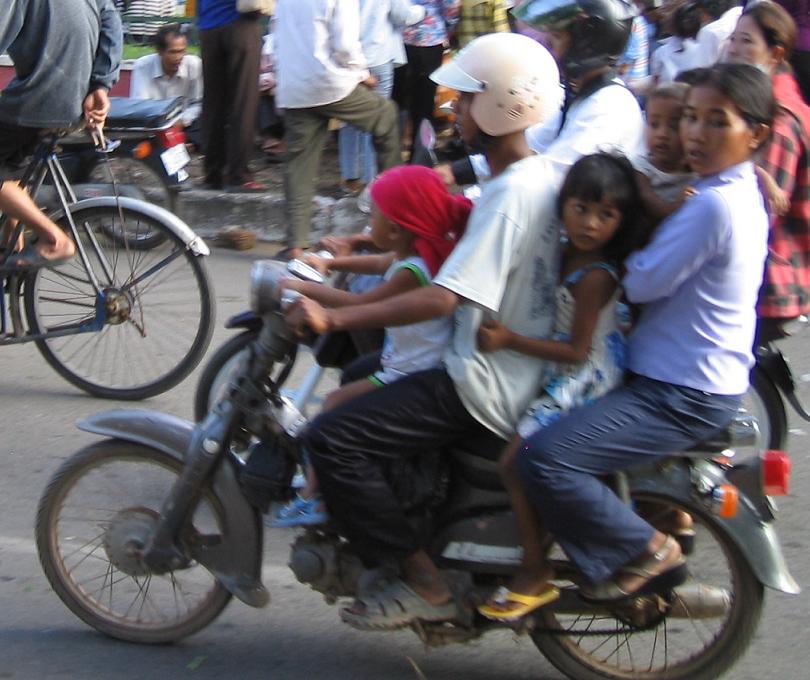
Above: five people on one motorbike. Below: six people on one motorbike. That's the most I ever managed to photograph, but a fellow traveller has a shot of seven people and two cases of noodles on one motorbike. Both of these motorbike pictures were taken at Wat Phnom during the Water Festival.

A broom and basket vendor. It makes me sad that this basic equipment is being replaced by Swiffers, leaf blowers, and plastic bags. Most people hate leaf blowers because of the noise, for me they subvert the whole leaf management exercise. Instead of gathering up the leaves and using them for compost or fuel or just putting them somewhere where they won't bother anyone, you blow them away onto everyone else's property? If next door neighbours have leaf blowers, so they blow the leaves back and forth all year until they rot or someone knuckles under and buys a mulcher? They really don't seem more efficient than rakes.

I turned down a plastic bag from a postcard vendor, as I was just going to put the cards in my knapsack. She seemed confused that I didn't want the bag, and spoke some English, so I tried some evangelism. If everyone that comes from a rich country is going to push their point of view on foreigners anyway, I might as well get my say. A simplification of the great plastic island: "I don't like plastic bags because they go in the water and birds and fish eat them and die." I don't know if she understood that, but she understands that they blow everywhere. This was in the jungle by Angkor Wat and she gestured at the trees and swamps around indicating that she knew they went everywhere and look bad. I nod. "Cambodia is beautiful. I like it that way."

And finally here's more food. People preparing, transporting and selling food of all kinds on the street in every makeshift container. If I go back I'll spend less time looking at things and more time eating, plus I'll refuse to eat a single boring catered-for-tourists meal.

My last day in Phnom Penh I set out around eleven am to find myself a corn frog for lunch. I asked all the food vendors I could find if they had kongkep, frog? And some pointed me to others who might, and so on. In the end, I walked all the way to the Russian Market, teeming with vendors of everything and was rewarded with directions to someone who had kongkep. He was fishing battered frogs out of a deep-fryer. I was going to surrender and have one of those, but I really wasn't in the mood for deep fried food. I should have brought the cookbook, which not only has the Khmer written out, but has a picture, useful because literacy is not high among adults here. I hadn't, but I had my terrible phrasebook, and its forté is providing phrases for whiny demanding tourists. Its menu pages do not mention such delicacies as frog-kebabs, but they did give me what I needed to produce my most complex Khmer utterance of the whole trip: this deep fry frog. I no want deep fry frog. I want barbecue frog. where I can get barbecue frog? Sadly, it was not available. I was like someone on a Thursday afternoon in November suddenly deciding that she must have a corndog. Where would you go, right now to get a corndog? As far as I know, that's a food that is only available at fairs. You can probably buy McCain's Frozen Corndogs in the grocery store, but Cambodian signature dishes have not yet been reduced to processed food. (No, it's not just a potato! Read the ingredients. It's potato plus a bunch of garbage you're trying to pretend isn't in the product. I hate that ad. Non-Canadians can look serious and nod now). I had seen cornfrogs everywhere during the water festival and had not been smart enough to get mine while the getting was good. I'll add it to the reasons to return to Cambodia.

I had instead some chive cakes, so fresh I had to line up and wait for them to come off the grill. They were cooked in a metal pan with little eggcup like depressions in it to hold the batter. I had seen the equivalent pan in terra-cotta pottery, on an ox-drawn pottery vending stall, but I imagine the metal ones are easier to transport, heat and handle without breaking.

At the end of my expedition I was ready to kill the next person who offered me a tuktuk ride. I think I'll invest in a t-shirt that says no I do not need a tuktuk! You can't walk half a block without being offered a tuktuk ride or a moto ride.

Tomorrow we fly to Hong Kong.

Wednesday, December 15, 2010

The Depressingest Day

This is not a cheerful post. The faint-of-heart may wish to skip it and read about happy cute children, tomorrow.

The next day I come down to the breakfast room at 6:30, when breakfast is scheduled to start, but it's not open yet. I go out into the lobby to find out if there is a problem and before I can say anything some members of my group say, "You haven't heard?" Uh, heard what? They gesture at the TV and tell me: hundreds of people were killed and injured last night during the fireworks.

The bridge that I saw night before last and realized must go over the river I was looking for was the site of last night's carnage. There's an island in the river, a festival site, and the police were trying to set it up so there was one bridge to the island and one bridge from the island, but policing, as I've unintentionally documented, is stretched thin and not in your face. I think in a culture that was so recently so devastated by brutal police action, it's important for the police to not be party killers. People started going both ways on both bridges, causing a human traffic jam, like the one I was in the night before. All it takes at that point is for someone to faint or otherwise fall and people to push over them and trip, and you have a pile-up and people trampled. Tragically the police tried to clear the logjam with water cannons, while people were trying to escape by grabbing onto the electrical wires overhead, leading to electrocution as another cause of injury. I see by this article (I know it's from an unorthodox source, but it gives most of the other information as I know it) that officials deny electrocutions, so that is not confirmed. Some people jumped off the bridge to escape and were injured or drowned that way. This Guardian article has an interview implying that some people may have drowned without realizing they could stand up in the shallow river.

It's so Third World. You hear some kind of news report like this at least every year. Hundreds of people killed in a firetrap building or a ferryboat sinking. We gasp and murmur about how it wouldn't happen here because we have safety standards, then the news moves on to the stock market report or a by-election in Sudbury. But now it is here. The TV is tuned to a local station, showing the grisly remains on the bridge after surging crowds trampled some people and others were electrocuted by overhead wiring while trying to escape. Desk staff switch the TV station to CNN in English for the foreigners. CNN moves on to catalogue other mass deaths at public events and we switch back to the Khmer station. This is footage from last night showing people being carried away from the scene, dangling by their arms and legs. Local television live coverage shows some close-ups of the bodies laid out on the ground like so many items in the lost & found, as relatives walk between the rows, looking for missing loved ones. The customs of what media show are different here. In Canada they would take some footage of the shoes, clothing and souvenirs that still litter the bridge, and interview a bereaved family. Here we see the actual victims of trampling and suffocation. Another detail that struck me from the English language newspaper story is the actions of bystanders trying to help. It said that they placed pieces of cardboard over the faces of people who were obviously dead, and used pieces of cardboard to fan those they felt might be alive. In Canada it would have been jackets or blankets. The generic thing that an untrained or unequipped person does in a first aid situation in Canada is to cover the victim with a blanket or jacket to keep them warm. I wonder how many first aid manuals have that advice, oblivious to the fact that the opposite may be called for.

The Prime Minister is announcing a national day of mourning. After breakfast I Google for local mourning customs and then change into a white shirt, it's a pilot shirt, the only white I have.

We get on a bus and go to the Tabitha headquarters to be briefed on the project. We go in through the store, upstairs past all kinds of brightly coloured silk items and up to the roof where chairs are arranged for us under a cardboard awning. Some women are sitting up there working on handicrafts. Someone hands out bottles of water for us and Nari introduces herself. Jean, the founder and head of Tabitha is not here because she is in hospital. She would normally give this briefing. Nari is Khmer and apologizes in advance for her imperfect grammar and accent, but is perfectly understandable throughout.

There have been 1053 houses built this year under Tabitha's auspices. I don't know how many have been by clumsy foreigners and how many by local contractors. She teaches us and has us practice a formal Khmer greeting jum reap sur and good-bye jum reap lea. Ground rules include a strict admonition not to touch children: the parents may think we want to take them, and may actually offer them over, producing bad feelings all around when we reject them. We must not cry out or show pain or anger if we are injured during the building. It's bad luck for the house. Smile, walk away, and seek first aid at a distance. There will be a latrine for our use. Bring toilet paper. Eat salty food for breakfast on the morning of the build and be sure to drink at least eight bottles of water--that's four litres--during the day. Take a water break every twenty minutes. Wear sunscreen. Tabitha will have bread and water for us, it's up to us to buy sandwich fillings if we want them. (We want, and already have a committee organized to do that). Do not leave food behind: the villagers don't know how to eat cheese and butter and other foods that we consider normal. There will be a table provided for us to put our personal belongings, where they will be safe. Don't stash things elsewhere in the village, because they can't vouch for things not being touched there. Get permission to take photographs. No gifts for anyone, unless we have the same for everyone in the village. The Cambodians will finish up at the end of the day if we are unable to.

Today we have some mandatory sightseeing so that we understand the context of Cambodia's situation, and Nari is going to send us off with her personal story. In 1975 when the Khmer Rouge marched into the city to overthrow the government, people welcomed them, believing that this would mean the end of the civil war and the US bombing attacks. The army announced that the city was to be evacuated immediately because of an imminent attack. Nari's family took very little, both because of the short notice and because they were told it was to be a three day evacuation. She was gone for three years eight months and twenty days. During that time, young Nari was immediately separated from her parents, and there was no school, market, banks or hospitals. They had to work from four a.m. until nine p.m. in the rice fields then walk back to their camp. Sometimes soldiers came in the night with flashlights to take people away for interrogation. If you answered their questions properly you were okay, but the interrogation might take until four a.m., meaning no sleep before you had to go back to work. As she tells it, it's almost as if she's willing to accept those working hours, even willing to endure interrogation, but that stealing her sleep is the last straw. She's clearly still angry at that. She uses the two syllables "Pol Pot" to refer to the whole episode. "In Pol Pot" means "during the Pol Pot regime" and "the atrocities perpetuated by Pol Pot" and anything else associated with that time.

In 1979 she was allowed to leave the camp and went straight back to Phnom Penh to find her parents. She went to S21, where our tour group will be going next, when the blood was still fresh on the floor to look at mugshots. Nari was the only survivor of her whole family. She still fears the night. They have stolen her sleep permanently, not just for those almost four years.

She says that Tabitha is not about giving people things, but getting people who have become passive from occupation and abuse to do things for themselves. She describes the first time that she was sent to greet an arriving build group at the airport. She didn't speak English, she wasn't used to foreigners or strangers, but she was just told to go. The anger at that is still there, too, but she says she went, with a sign and found the group, and so on from there. I assume from the fact that she is giving a briefing normally made by the head of the organization that she is a senior administrator, but she doesn't have any more airs about it than the women who sit on the floor behind her, occasionally checking us out as they work.

She thanks us, and we thank her, and offer her the formal goodbye that she taught us. We have a few minutes to shop in the store before we go, buying beautiful handmade silk things at factory polyester prices. I buy Christmas presents. And how about a new handbag to go with those shoes? We hang onto those colourful pieces of silk, because they are the bright spots in a pretty grim day.

We get back on the bus and stop at the Tuol Sleng Genocide Museum. Yeah, it's going to be that kind of day. This is a former high school in an urban area, but when the Khmer Rouge closed all the schools and evacuated everyone from urban areas, they converted it into Security Office 21, a detention and torture centre. Everyone who had an education, a profession, spoke a foreign language, or even who wore glasses was a suspect. Our polite tour guide, probably born more than ten years after S21 closed down, recites graphic details of the meaning of each room and artifact without a hint of sensationalism. It's not as if he's trying to shock us, definitely not to be dramatic. More like he's trying to convince us that these atrocities really happened, and convince us in the most scientific manner possible. Later I read the brochure I was given at the beginning of the tour and see that that is precisely what they are doing. The mandate of the museum is to collect and preserve evidence, for eventual trials, or to prevent people from denying it happened. The brochure says, "preventing new Pol Pot from emerging in the lands of Angkor or anywhere else on Earth," but I know that there's no amount of documentation that will prevent the next systematic genocide.

This might mean no laughing or no smiling. It didn't matter, as I had no urge to do either.

I don't really want to write about what went on at S21, but I didn't include details in yesterday's history post, so I suppose I have to. We toured first through the torture rooms, furnished with iron bedframes with shackles and various everyday implements made sinister by their presence here. It is still easy to see that the rooms are ordinary classrooms divided in half with brick walls, but most classrooms do not have such dark stains on the checkered tiles. They also put glass in the windows to minimize the screams escaping the facility. When the Vietnamese took the city in 1979 the guards and prisoners were all gone with the exception of fourteen decomposed murder victims still chained to these beds. I remember one of my group members saying, "They killed him with a shovel, and left the shovel." The guide was not making remarks that specific, but rather presenting the evidence and allowing us to draw the conclusions. One of the fourteen was female, and when we are in the room where she was found he says there is no way to know what torture methods were used on which prisoner, but that there was a mosquito net in this room, and not in others, and they would not have used mosquito nets for the benefit of naked prisoners. Each room contains a black and white photograph of what it looked like when it was found. Other than removal of filth and human remains, the rooms are pretty much as they were. I can't imagine being a prisoner. I can only just put myself in the shoes of the people who discovered the facility, going from room to room discovering and documenting what they found before they burned the corpses.

He shows us a chair that looks like an implement of torture, but is actually just the chair where prisoners were photographed. Many of the mugshots are displayed around the walls. They look at us, the captors, with fear, resignation, confusion, defiance. They're all individuals. One of them has a t-shirt with cute little bare footprints across it. I think I had one like that in 1979. Some of the prisoners are children. Some women hold babies. In the early pictures the prisoners hold simple numbers. In later ones they have more elaborate mugshot data with the date of arrest and prisoner number. The guide insists on showing us the range of numbers on a particular day, proving that there were sometimes hundreds of arrests a day. If someone was arrested, they took their whole family, even children, to avoid retribution later. If a prisoner died during torture, the guard was suspected of colluding to keep their secrets, and also arrested. Perhaps that is part of how Cambodia is not consumed by hate. It wasn't really one group of people doing this to another. It was a horrible epidemic that swept people into doing and having done horrible things.

While they were not being tortured, prisoners were housed either in individual cells, each 80 cm by 200 cm, tiny bricked sections of a classroom, or upstairs in unconverted classrooms, all shackled together in rows by the feet. He shows us the shackles, a photo, and a painting by a survivor. Approximately 20,000 people, including children, came through this facility. There were seven people known to be released alive. One of them was the founding curator of this museum and still works to train the tour guides. I can't even stand to tell you all the details of my visit, and this guy re-lives it for the guides. I can't really listen to it all. Fortunately, it's a little bit of work to understand the guide's accent, so after I have had enough I stop making that effort and just look at the pictures. Every once in a while a phrase filters though and I hear, "and that is how they killed the babies" while being aware that the words "sharp stick" are still in my mental buffer.

Above: A view of one of the individual cells. The black metal pieces have been added by the museum to prevent the poor brickwork from collapsing. Below: A room where the cells have been removed, but marks on the floor show the cell size relative to the people standing on it.

Part of what made it so horrific was that it was a high school. Everyone has high schools. Movies tend to make torture facilities some dark dank dungeon or high tech sterile room. It's more insidious for the imagination to make it a high school, because you're going to see those every day. The construction materials for the conversion are the same kind of bricks we see every day in construction projects all over the city. This piece of apparatus was originally used for the kids to do gymnastics. They repurposed it. It's not a gallows: executions were not conducted here.

In another room there are untidy shelves overflowing with skulls. There used to be a map of the country made out of skulls here, but they moved it to another museum. I feel uncomfortable not about the presence of human body parts, but because I understand that Buddhists believe that the body must be treated with respect in order for the soul to be at peace. Even without Buddhist beliefs, it seems a little callous. If prisoners were still alive after about four months in this facility, once they had confessed to being spies for the KGB and CIA (even though they'd probably never heard of either entity), they were blindfolded and removed in a truck. We'll follow the path of those trucks later. First, a light lunch! Yeah, who scheduled this?

We don't think we're going to want to eat anything, but we do. I guess it's a way to confirm that we're alive and healthy. "So what do you think, Aviatrix?" asks someone. There's more than one thing to think about this? We're a nasty species.

The bus ride takes us out to a more rural area and then stops in front of a gate where we pay a small admission fee and break into groups for another guided tour. A sign requests that we remove our shoes at the memorial, and observe five minutes of silence out of respect for the dead. The area inside the gate is an uneven field with grass growing on it, a few small buildings, and an ornate tower at one side. This is a Killing Field. No euphemism or hyperbole here. It's a field, and it was used for killing. The guide shows us where the trucks parked and unloaded the prisoners after S21 was done with them. He says that the prisoners didn't do any work here, were simply led to the edge of a hole, killed and buried. I suspect that it wasn't the guards who dug the holes, though.

The tower is called a stupa, and is a traditional style of memorial to revered people. This one is constructed in multiple levels, with victims' clothing displayed on the lowest, several layers of skulls, then other bones on higher levels. The guide details the types of bones on each level, no doubt translating a solemn catalogue of bone names from Khmer, and he probably deliberately chose colloquial over latin names for most of them, but it does sound like the song about what bone is connected to what bone. There are over 8900 skulls in the stupa, along with a roughly corresponding number of other disconnected bones. He takes us up to the stupa and I take off my hat and shoes to walk around the interior in silence. The skulls are catalogued in sets: "juvenile males under 15" "mature females 41-60" "senile male over 60." The letters L, R and N at the end of a word in the local accent is pronounced very subtly. "Senile" and "senior" probably sound identical. When I have completed the five minute silence, my tour group is nowhere in sight. I wander off in search of them, picking up on the periphery of other tours, people not in my group, and some in languages I don't know. I linger, pretending to read a sign while listening to other people's guides. They're mostly talking about the ways prisoners were executed. You'd think they'd have it down to an assembly line procedure but this guy is pointing out the sharpness of a particular kind of palm frond, which can be used to slit people's throats, and that guy is talking about smashing heads, while the other guy is describing the versatility of DDT. It's a lethal agent and a deodorizer. They didn't shoot prisoners because bullets are expensive and noisy, compared to naturally sharpened palm fronds and shovels. I find my tour group coming back the other way, at a pit where they recovered I think it was 66 headless corpses wearing Khmer Rouge uniforms. Maybe it was 166. Sufficient to make it clear that no one was safe. This blog entry includes enough photos to give you a virtual walkthrough of the site. Don't miss the baby head-smashing tree.

There's a film inside another building, another hats off, shoes off site. I notice female Muslim visitors who do not remove their headgear. It's interesting how one culture's respect is another's disrespect. You probably would be frowned on for entering the Washington Monument barefoot, and I've been cautioned to wear a hat to attend a religious ceremony before. Even in religions as close as Judaism and Christianity men have opposite requirements for head coverings in a place of worship. I'm guessing any conflict between hat removal and headscarf wearing has been resolved during a thousand years of a Muslim minority in Khmer territory. The movie interviews someone who lived near here, and who came back home in 1979 to see new buildings and tools at what used to be a Chinese graveyard, and didn't know why. There were nine foreigners killed here. European foreigners, I think they mean. They were journalists. I wonder how long they held onto hope of filing a story about this place. The museum refers to a "sealed" tower, but as you can see the walls have been slid open in places so you could reach out and touch the skulls if curiosity outweighed respect. I asked about what became of the Chinese people who had once been buried here. The guide said that a few bodies were found who had died of natural causes, but didn't say if there had been an official relocation.

Here we see the garb of people inspired by a charismatic young communist revolutionary about whom they knew little. And on the left, the uniform of the Khmer Rouge.

I have two consolations today. The first is that the stupa is dedicated as a measure of proper respect to all those killed by the regime, soothing my concern for the effect of casually handled skulls on the eternal souls of the dead. The second is that only seven people had to live very long with memories of this place.

Back on the bus, there are kids outside the windows. Someone realizes that they are asking for empty water bottles, and tosses them one. It's on the other side of the bus, so I can't see the kids, just the people tossing them out the window. Someone cheers that the littlest girl got a bottle. "That's sadly like feeding ducks," I say. You know how you always try to get a big piece to the shy duck at the back? And how the mean duck always chases it down and takes it away. Apparently one of the girls knocked down the girl and took her bottle. Later the bottle throwers will be chastised for disobeying the "give nothing to anyone" rule. I suppose the kids fighting over the bottles were demonstrated proof that it just leads to strife. And I'm told one kid had a big wad of dollar bills from begging, too. The kids were playing and dancing until they saw the tourists, then they all put on their sad faces to come and beg. They should be in school, learning a real trade.

We go home and have supper. As I watch people in the street and in the café I see them, and I also see their little skulls. Human skulls are quite small, really. A lot of the face is flesh, the back of the head hair and neck muscle.

The makeshift patient transport above was recorded by a photographer who was in Cambodia in 2008. There's no Cambodian who has worked in hospitals for forty years, and no one who has been locally trained by someone who was. They had nothing and had to make it all up from scratch, because almost every doctor in the country was killed in the Khmer Rouge purge. Last night there must have been a terrible feeling of helplessness among emergency workers, and everyone involved. I understand that many of the dead were removed from the bridge alive, but that the hospital infrastructure was so overwhelmed by all the casualties, they were releasing bodies directly to families without them being registered as deaths.

Wednesday, November 24, 2010

National Opt-Out Day

As the use of whole-body imaging scanners increases at airport security checkpoints in the US, so does public objection to the technology. Voiced opposition is a combination of concern about the radiation exposure, objection to being seen virtually naked (and to the possibility of the resulting images being disseminated), and defence of the American "fourth amendment" which protects citizens from unreasonable searches.

There are two technologies being deployed, backscatter x-rays and millimetre-wave scanners. They both produce similar resolution images using different technologies. The US FDA says that passing through a TSA backscatter x-ray scanner delivers radiation equivalent to two minutes of airline flight or 42 minutes of everyday living. Other sources disagree on whether the effect is proportional.

The millimeter wave is electromagnetic radiation at the extreme high frequency end of the radio band. The waves are transmitted simultaneously from two antennas that rotate around the body of the person being screened. The reflected energy is detected and analyzed into a three-dimensional image. The millimetre waves have not been demonstrated to cause any health effects, but the technology is new and this study suggests that terahertz radiation may affect DNA.

There are not yet enough scanners to make them the standard. At checkpoints where the new scanners have been installed, selected passengers are asked to pass through them, with the option of declining the scanner and submitting instead to a thorough manual search, including (through clothing) the genital and breast areas. It certainly makes for good slogans. One way or another, the TSA is going to examine your junk. It's the porno scanners versus the grope search. If you want to get on an airplane, the choice is between having them look at your body or feel it. Excepting Islamic nations, the US has one of the most body-private cultures I know of, and this is where people are starting to draw the line.

A citizen has made a call for people to join in a national Opt Out Day, refusing the scanners and requesting the manual pat down. It's not that the organizers believe that the manual search is less invasive, but that they want opter-outers to receive their pat down in public so that occasional or unthinking travellers can see the extent of the examination. They have chosen November 24th because it is a day when many infrequent travellers who may not be familiar with all the new regulations are in the airports and then afterwards everyone will sit down with their families and perhaps make the airport experience, and whether it has gone too far, part of their family discussion. The action may impede efficient movement on one of the busiest air travel days in the US, but on the other hand if many people are refusing the scanners, then perhaps it leaves the scanners free as a fast lane for those not participating in the protest. Perhaps some of my readers will report back on what it was like. And to my American readers, whether you celebrate or mourn that day, I give you my best wishes for you and your family.

Airline pilots are especially incensed by the intrusion. I haven't been subjected to either type of scanner or the enhanced search yet, but it is inevitable with my travel pattern. I suppose I'll try each way at least once, and probably stick with the enhanced search. I usually prefer human contact over being shut up alone in a box. I have done only momentary research on the topic, but whenever something is proclaimed safe for humans, I remember hearing that in the 1950s they had x-ray machines in shoe stores so you could see how well your toes fit inside the shoes.

If you prefer your radiation in the visible spectrum and to see underwater creatures over blurrily naked Americans, http://www.backscatter.com offers some beautiful images, and the gear used to photograph them.

Monday, November 15, 2010

No Work Wednesday

My coworker flew a mission today and then took the bird south for maintenance, leaving me with no duties in a town too small to even have a Tim Horton's. So you're expecting a tale of adventure and cultural exploration. Please. This town has basically one street, a kilometre long, and I've been here for a month already. There are woods, but nowhere destination-like within them. Plus I'm alone and unarmed and it's the season when bears are our foraging to fatten up before hibernation. Adventure does not call.

The Aviatrix catalogue of markers of depraved indolence includes such pursuits as eating nutella out of the jar with a spoon, watching shows like Battlestar Galactica and Star Trek on the Space channel for ten hours straight, remaining naked all day, getting drunk at nine in the morning, rocking out to the Cake Song on my iPod, and surfing internet porn.

You think I'm that depraved? ah you know I'm not. I didn't do all that. I don't drink when I'm in the field, and, if you'll recall, the Internet here doesn't work.

Also I totally think Doctor Who should do a gag where they go to England in the 1950s and there are police call boxes every couple of blocks, and they forget which one is theirs. Not the whole plot, just a one-off gag.

I'm really not under the influence of anything chemical today as I write this up, either, but the fact that I posted this is probably a good indication that a really bad head cold is incapacitating for reasons other than pressure change tolerance. My misery is tempered only by my fascination by the millennia-prolonged evolutionary arms race between the things that make us sick and our own immune systems. I like the organisms that live in me without making me sick, better.

Monday, October 11, 2010

Smoke and Blood

Breakfast is leftover salad from last night. It's about as good as you'd expect leftover salad to be. Maybe I'll have a low carb day. Some people say it's good for your pancreas to have a day off of churning out insulin.

The other pilot has returned from a mission, but he texts that he has a very rough running engine on the ground. He suspects a bad mag. That could have us down for a couple of days if we can't source one locally, but it could be just dirty spark plugs. We go out and meet him.

You know how if a vehicle breaks down, even people who know they have neither the skills nor tools to fix it always pop the hood and peer inside? It's universal. The pilot has pulled the top cowl off and I walk up and look inside. You can't see a bad magneto or a bad spark plug just by looking inside a cowling. It's just gawking. Except that I find a spark plug lead that isn't attached to anything, just dangling out the bottom of the engine. I hold it up and make an ahem noise. We don't need parts, just a wrench and someone who has the proper qualifications to turn it. We manage to borrow the services of a local wrench turner and ensure that all the spark plug leads are secure for my flight.

I put my flight bag on board and start up. Everything is normal, it was just the loose lead. We go flying. Forest fire smoke has reduced the visibility such that while it is safe to fly, there is no scenic vista for me to enjoy. You don't realize how much entertainment you get from the tapestry of rocks and lakes and trees until you can't see them. I guess at night or in IMC I am concentrating extra hard, so I don't miss the view so much. And at night there are usually stars or lights. I complain to the mission specialist that I'm bored, and jokingly ask him to put on a movie. (His computer controls what is displayed on one of my screens). A moment later he comes forward and props an iPod up in front of me, with a movie playing. That gives me a good laugh, which was what he intended. Now I know that if I get really bored, it's there.

My other source of entertainment is the radio. Mostly it's pilots calling in PIREPs about the forest fire smoke. It's bad everywhere, so bad along one VFR route that pilots are turning back. There are a lot of Americans. I guess some are doing their trip of a lifetime to Alaska and some are Alaskans heading down on one of their regular trips to the lower forty-eight. I suppose there could be some just come to visit us, but why? Who comes here to visit?

There seems to be a pattern of Americans not understanding the question "What is your ETA for the field?" Multiple pilots have been baffled by it. The FSS resorts to, "how long will it take you to get here?" and then they answer. I wonder if the common wording is different in the US or if there is just so much radar there that the question is never necessary.

I am just turning around when the information in my cockpit stops matching everywhere. I can't see well enough to line up with features on the ground to fly a straight line, so I zigzag a little before crosschecking confirms the problem. My HSI has died. HSI stands for "horizontal situation indicator" and it's an instrument in the middle of the panel right in front of me. Its name ties, in my opinion, with "Distance Measuring Equipment" for the most stupidly generic in aviation, but it's a very smart instrument. It is half heading indicator and half VOR receiver, combining the direction you are going with your angular distance from a selected track to or from a VOR, in a way that is less confusing to look at than this sentence is to read. The number at the top of the HSI should always match the direction the airplane is heading. I don't even have to adjust it for drift, because it syncs itself. Except that now it sometimes doesn't turn while I'm turning, and sometimes turns while I am going straight. I switch off the power to it (unusually in my experience, this one has its very own switch instead of a circuit breaker) and back on again. It motors to match my heading, but very soon wanders off again. The back up to this instrument is the heading indicator on the other side of the panel, the one that was removed as unserviceable, with its replacement in a box in the other pilot's hotel room. Sigh. They are completely independent, on totally different aircraft systems and they die within a week of one another.

Neither is required for day VFR work, which is what I'm doing now. The compass works, so I can continue. I turn on my cellphone and have a signal, so I text the new maintenance guy, whom I haven't even met yet, to tell him the news. He asks a few trouble-shooting questions, then asks if I'm aborting the mission. I'm not, this will just make it a little more challenging in this visibility.

Avionics is a separate and arcane maintenance specialty, so unless there's something simple like something disconnected, he probably can't do anything except pull it out and send it for repair.

I turn the HSI back on a couple of times to see if it magically got better: maybe it just overheated. This forest fire smoke can't be the best thing for the instrument cooling air filters. It starts motoring back and forth rapidly so I turn it off again, not wanting it to damage itself further. I pull one of the "intentionally left blank" pages out of the last signature of the CFS and fold and tear it to attach to the surrounding knobs and block the instrument. I hate having non-functioning instruments in my scan.

We return for landing shortly before nightfall. I'm entering the circuit as an A-Star is crossing the field at 2000'. I call up and say I am "downwind for 03, not below 2500' until the Astar reports clear." I guess I'm giving myself clearances, but who else is going to. The FSS doesn't issue clearances, except to relay IFR clearances. My call made it clear to the FSS and the helicopter pilot that I was aware of him, and described my strategy for collision avoidance, while saving the FSS guy's breath in relaying positions and intentions.

On the ground, the AME meets the plane. It's time for an oil change. I stay to help with that, because it's much easier to pull cowlings with two people. We have arranged for use of a hangar, but the airplane only fits halfway in. It would go all the way, but the door doesn't travel quite to the top, even though it looks like it should. We leave the tail sticking out and just work on it like that. I position the buckets and turn the quick releases (it's so easy on this airplane, you don't need a wrench or anything) to drain the oil, while he removes the oil filters. It occurs to me that I could probably burn myself doing this, but I never have. Have I just been lucky? Dunno. I haven't even been that careful.

While we're working, a young pilot comes up and asks if we know a good place to camp on the aerodrome. He is flying around the north, looking for a job in the Northwest Territories or the Yukon and he's just stopped here for the night. We recommend he try the local charter operator, because we know he has good machines and the pilots are well treated, but we can't help with a camping suggestion. He sets up a tent between his wing and his horizontal stabilizer and it blends in with the airplane.

The AME discovers that he is missing his oil filter cutting tool. That's a hazard of running an AMO out of the back of a truck. After a bit of cursing he improvises with an ordinary set of cutters, but the wall of the oil filter turns out to be a lot thicker than either of us expected and it takes a while. After a good struggle, he inspects the filter media inside and it shows no metal, which is good. He replaces the filters and I refill the crankcases with clean oil. He also checks the connections on the misbehaving HSI. We push the airplane outside and I run it up. It's not going to be helping the jobseeker sleep in his tent, but such is that hazard of sleeping at an airport. The runup is satisfactory, except that the HSI still doesn't work, and there are no leaks, so we're done that task. It was supposed to be a quick job but it's the next day before we finish. That's not a problem for me because I still have ten hours before I'm back on duty.

We stop by a convenience store on the way back to the hotel and the clerk asks him about the blood on the back of his knuckles. He shrugs it off as an occupational hazard and then I look and see that I too have skinned my knuckles on something. Airplanes are vicious.

Oh and for those who know why this might be relevant: no, the forest fire smoke doesn't trigger any kind of PTSD in me. It's just another day at work. Yay!

Tuesday, September 21, 2010

Things Starting in Vac- and Ending in -ation

So I got home, did laundry, and had a raft of vaccinations in preparation for going to Cambodia. It was really quite the experience. Some of it was "well, while you're in here, lets update your polio, tetanus, rubella, and everything you haven't had since elementary school." I'm not going to complain about being protected from tetanus when I'm going to a strange country to pound nails. And then there were the specific to Cambodia diseases. It was literally dizzying the speed at which I was told and handed information on the various things that can get into your body and kill you. It's fascinating, too. I've read that parasites and viruses are the primary driver of evolutionary change in humans. We've got ourselves a niche where tigers and lions and bears don't kill us much, and we use tools to fight them if they try, but ickle bickle thingies we can't even see can still kill us by the thousands. After doing the paperwork one person interviewed me on where I was going and what I was doing, giving me information, making recommendations and soliciting my agreement or decisions on which vaccinations to take. Then a second person in the next room pumped the stuff all in.

"This is the tetanus. It might hurt for three days." Ow. She put some in one arm and some in the other. There was some rationale for the one that hurt for three days going in my working arm, but I don't recall exactly what it was. I think I managed to get away without a smallpox vaccination. I got vaccinated for two flavours of hepatitis, plus was given a prescription for anti-malarial drugs and I honestly don't remember everything else. After that I had to wait in the office for twenty minutes to make sure I didn't have a reaction, and then I could go home. I need some booster shots in a month and then I'm ready to go, although with the hepatitis I get a follow-up next year and then it's good for life. Which is good, because hepatitis is pretty bad and you can get it from food, even in Canada.

So then I went home and repacked, this time for a vacation. At a LAKE.

Thursday, September 16, 2010

Good Thing We Weren't in Outer Space

I check the oxygen equipment and set up the oxygen bottle so I can reach the valve from my seat. The oxygen bottle has its own nylon pouch, which protects it from getting scratched or getting dirt in the valve, and the pouch has pockets for the instructions and accessories and straps for carrying it, so it's easy to secure the whole thing so it can't ricochet through the cabin in turbulence. Sometimes you just have a naked oxygen bottle and those are hard to confidently secure. I've also seen pilots just stick the whole thing in a seatback pocket, as if to say, "so long as I have oxygen it doesn't matter if I'm struck in the back of the head by a heavy object."

I run up the airplane. The altitude makes the engines run very rich. Once I am lined up on the runway, I even lean it a little for the take-off, just enough for it to run smoothly. The takeoff now seems to take forever in the thin, high altitude air. The afternoon is going to be hotter and make the air even thinner. That's why the runways are so long out here.

Climbing through 10,000' I try to turn the valve on, but I can't quite get it to work, damnit. I have to get the mission specialist to get it for me. I should have just left it on and controlled it from the little valve on the canula. I adjust that little valve now so the tiny indicator ball lines up with the gradation matching my altitude. I'm sucking oxygen through my nose, but it's hard to tell if it's working, because oxygen is odorless. I check my blood oxygen with a clip on meter.

The heat of the day drives cumulus development again. The same line of thunderstorms probably forms every day. The thunderheads don't seem as high as they do in the Canadian prairies, even though the tropopause is higher, so they are probably higher. I suppose it's because we are higher already, so there isn't as much vertical volume for them to build in. Below us are dry fields. I see something that the mission specialist says is a coal mine. It's an open mine, not the underground kind that they have in West Virginia, hence the lack of tragic news stories associated with midwest mining, the way there are in the east. That was a lazily constructed sentence, but I'm not fixing it, so there.

As I come in to land, I know what is going to happen and I work to compensate, but not quite enough to get it perfect. Although I am flying at the correct indicated airspeed into a very light wind, the countryside is racing by as if I had a horrific tailwind. The air is so thin that I need to go faster over the ground in order to fly through air at the same rate. It's like if you play the same Pac-Man game on a giant monitor, the little yellow guy seems to go twice as fast, even though he's getting the same number of dots. The illusion that I'm going fast makes me think I have more energy than I do. I should have done just a little flare and let the high groundspeed come off on the rollout, but instead I try to land just a touch too slowly and the touchdown is firm. "Sorry," I say, "Getting used to the altitude."

"We were going faster than usual, weren't we," says my critic from the back. Actually, I explain, we were going a touch slower than usual; it just looked faster, which is why I went too slowly and why it wasn't that great. He says he was looking at the GPS and it was faster. I'm not sure he believed my, "Faster groundspeed, yes, but slower airspeed," explanation. Next time how about I just not screw up.

The oxygen gauge is just on the edge of the red. I take the bottle and get in the passenger seat of the other mission specialist's truck to go to get an oxygen fill at the next airport over, while the afternoon pilot fuels and otherwise prepares for the next flight. It's about a twenty minute drive to the bigger airport. It has a couple of different names, because it's a regional airport as well as a local one, but it's well-signed and we find the FBO right away. I've used an FBO of this franchise before in another state. The customer waits outside in the air conditioned car, listening to satellite radio, while I go in with the oxygen bottle. There's another customer at the counter, so I wait and then make my request.

"Oh, sorry," she tells me cheerfully. "The A&P is the only one qualified to use the oxygen equipment and he goes home at one."

To be perfectly fair, when I called yesterday I asked if they provided oxygen service and then asked immediately what their hours were. I didn't specifically ask whether oxygen service was provided throughout their opening hours. But I think that was implied strongly enough that I have a right to be ticked. Rather than making her defuse an annoyed would-be customer I make her expend the same energy more usefully. Her place of business-- whether it was her or not on the phone last night I can't say--implied that I could get oxygen here yesterday, so she is going to figure out where I can get oxygen. I ask her to where I can get an oxygen fill on a Sunday, to call and confirm that I can really get O2 there, and when she doesn't get an answer at first, to see if she can call out the one guy who knows how to use the oxygen equipment, for a fee. She finds someone at the next airport along the road that is there and can fill the bottle. It's another forty-five minutes drive or so and then we have to come back with it. I thank her and get back in the truck to break the bad news.

It's not a bad drive, really. Air conditioned truck, compatible taste in music, fences, bluffs, cattle, authentic western scenery. Someone I know was going to be driving a motorhome up here, all the way from Indiana this month. If you pretend you came some place for a vacation you can usually make it into a fun adventure, and if it's so bad you couldn't imagine going there on purpose, you can at least thank your lucky stars you're not stupid enough to have gone there without being paid. We eventually get to the proper airport and find the FBO, which appears to be named "FBO." A flight instructor takes the bottle and looks at me strangely when I say that the previous airport said only the A&P could do it. Clearly he doesn't think this is a technical job. He brings it back. The gauge reads full. Presumably it will keep our sats up rather than making us talk in a squeaky voice. I pay for it and then get back in the truck for the long drive back.

There's an air conditioned pilot lounge at the airport, so my colleagues isn't baking out there on the ramp. The mission specialist drops me back at the hotel and then he goes flying.

Some idiot is buzzing the town in the evening while I'm trying to sleep. Over and over again. He's doing circuits, I guess what he as an American would call "staying in the pattern," but he's clearly not climbing out at an optimal rate after each takeoff. If I knew where you slept, bozo, I would buzz it at six tomorrow morning.

Saturday, July 10, 2010

Different but not Wrong

Here's your Caturday post. Note that that is not just any old cat lounging on any old piece of paper, it's a twenty-four toed cat lounging on one of my op spec sheets. The standard specification for a cat includes eighteen toes: five on each front paw and four on each rear paw. But this cat is different, and has six toes on each foot. It's different, but fully operational and this cat still complies with all catly requirements, like the one to always insist on being on the opposite side of any closed door, or to lie on anything a human is using.

Polydactylism is quite common in cats, and doesn't seem to pose any handicap. The owner of this cat was second in line to adopt it, after a person who rejected it for the abnormality, saying that it would probably cost a lot to have the extra toes removed. I can't imagine being so wedded to normality that you would consider cosmetic surgery for a perfectly functional cat.

Monday, July 05, 2010

Coffee & Anarchy

I'm on my way to work. The coffee should be cool enough to drink right now, but I have put the lid on the travel coffee mug backwards, so it's hard to drink. I try to fix that, which results in my spilling coffee all over myself. At least I can verify that it is now not too hot to put in contact with my lips. I stand up and shake some of the liquid off my jacket, but that doesn't do anything about the part that is all over the front of my pants. An observer with a poor sense of smell and an imperfect grasp of female biology might think I have wet myself. I could change into one of the other pairs of pants in my suitcase before I check it in for departure, but then all my luggage would become coffee scented. I'm not in uniform, so have no one in particular to impress. I'm not worried about horrifying the biology impaired. In fact, horrifying the biology impaired could be legitimately listed as a hobby of mine. I decide to run with Mark Twain's live toad theory and look forward to the rest of my day.

Boarding the flight there's someone ahead of me in the jetway, also not in uniform, but his luggage includes a familiar rectangular leather case with B737 stickers on it, so it's pretty obvious where he works. The case has been almost completely destroyed through use, with giant holes in the bottom. I comment on its state of dilapidation and the pilot says he bought it eight years ago to celebrate his upgrade. By the look of it, the reasonable lifespan of a pilot brain box is about five years. I thought they'd last longer. I used to think that the very young guys with tattered cases were toting hand-me-downs.

I have one, as a result of it being abandoned at an office I worked in once, and me being the only one patient enough to pick the combination lock. I don't use it at work because I don't have the cockpit space for it, and I prefer a bag with a zillion pockets so I know where to find everything. We keep the charts on board the airplanes.

During the flight I complete my company annual exams, verifying that I still know things like how to operate the emergency exits, how to extend the gear if the regular method fails and what types of deicing fluid are appropriate for my airplane. Coffee wouldn't be a good idea, but there is some flexibility.

In the following report, the flight crew of a U.S. air carrier landed at a Russian airport on a scheduled flight only to find that ice had formed on the upper surfaces of the wings due to fuel cold-soak. Perhaps because it was June, the Russian ground crew didn't have deicing fluids available -- but they did have another kind of solution -- and it worked to Absolut Perfection. The Captain's story: "...upper wing ice formed due to fuel cold-soak. No glycol at airport... [Airport] possessed no fluid as well...So, had Russian ground crew spray wings with hot water, then immediately sprayed 25 bottles of Russian vodka on top of wings...[with] garden sprayer. Wings were subsequently checked, they were clear of ice. Normal takeoff."

From NASA.

At destination I meet with my chief pilot and we go over my exams. I've specified the wrong position for the fuel to tee off from the fuel system to the heater, I've chosen the less perfect answer to a question on why we don't use pure glycol, and I didn't have a list of the specific operational specifications my company has. Op specs are deviations from the CARs (Canadian Aviation Regulations), approved specifically for individual companies. For example we have one that allows me to work a fifteen hour duty day instead of the regular fourteen.

When I studied for my commercial pilot written exam, back in the ancient times of the 20th century, I noticed that almost every rule that governed commercial flying concluded with "unless otherwise authorized in the air operator certificate." In fact, when I wrote flashcards for studying, I made up a special symbol, I think it resembled the anarchy symbol: a capital A in a circle, to represent that phrase. Aviation, more than anything else I've done seems to be actually concerned with safety over rules. If an air operator can demonstrate that they can do something safely in a way that is not in strict accordance with the rules, they can get that op spec. It encourages innovation but not anarchy. If as a pilot you're in a dangerous situation you can disobey the rules to get out of it. There will be paperwork, but not blood.

We go over everything that I have wrong, then we both sign the exams and my chief pilot puts them in a file. See? Anarchists don't keep files.

Thursday, July 01, 2010

One Hundred and Forty-Three Years

It will be Canada Day on July 1st, and I think I'll be celebrating it both in Canada and with friends for the first time in years. This will involve a backyard barbeque, beer, face painting, and I'm going to sing God Save the Queen and O Canada. I won't go to the fireworks, though. Fireworks displays are kind of boring for me. I think appreciation of extended explosions is linked to the Y-chromosome.

So if you're Canadian, whether you're celebrating the continuation of the country of your birth, being accepted for immigration into this society, or not having had your people totally eradicated by the newcomers, I hope what you're eating is tasty, what you're drinking slakes your thirst, what you're doing is fun and whom you're doing it with are a joy to you. I'll raise a cold one to those of you who are working, and hope that you're enjoying a good day.

Tuesday, June 22, 2010

Proper Labelling

A cargo shipment was rejected by Southwest Airlines last week in Little Rock because it didn't meet the labelling requirements. I'm not sure why they didn't just return the package to the shipper, or perhaps it was labelled as to the contents, just not according to the rules. It contained a few dozen human heads. I imagine someone opening the package, a bit of reflex shrieking, then a whole lot of people from all over the operation being summoned to come see. They called 'the authorities,' presumably that means the police, and the police brought the coroner. The heads were on their way to a research and educational facility, so here doesn't seem to be any reason to suspect foul play, but they are investigating to make sure the body parts had been legally obtained.

So there's two things I never thought about before. One, the existence of a black market in severed heads, and two the proper labelling procedure for a shipment of severed heads. I don't have any more information on the former, but an acquaintance in the airline business forwarded me information on the latter.

Your severed heads need to be properly packaged in an outer hardshell container, no particleboard or cardboard, with other packing requirements as outlined in the document linked above. Then you must clearly mark “Biological Substance, Category B” in 6-mm-high text on the outer package, adjacent to a properly sized UN 3373 diamond-shaped marking. It does not appear that the container must also bear the legend Contains Human Heads. So to be on the safe side, just assume all biological specimens are severed heads.

Friday, May 07, 2010

Not a Zero Sum Game

I posted a blog entry a few weeks ago on how, through e-mail, I introduced two people I had never met resulting in an increase of happiness for all involved in the transaction. It was aviation related and it was also the highlight of my week, so I blogged about it. I was reporting on the fact that by doing absolutely nothing of difficulty, effort, or cost to myself, I suddenly felt amazing. I claimed no intellectual analysis of the possible improvement in someone's life, therefore resulting in a more peaceful planet. It was just some happy chemical released in my brain when Michael thanked me, inducing joy.

Most people have done something in their lives that was trivial to them, but meant a lot to another person, so most commenters empathized. There were, however, two fascinating dissenting opinions that I want to talk about, and rebut in a way, but not without leaving the comments open for more discussion of the topic. I am delighted to have so many people read my blog and am honoured when people of different philosophies still take the time to visit. It's easy to read things written by people who agree with you, so when I have regular readers who disagree with me, I know I have a connection with people who challenge themselves and want to change the world to the way they think is better. Everyone should be so bold. You might want to open the comments from that blog entry in another window, as I'm going to refer to them but not requote them extensively, and I want you to catch me if I paraphrase something unfairly.

One commenter, Anon #1, felt that the experience offered to the refugee was inappropriate because of his race and religion, and suggested that the newcomer should demonstrate that he has fully integrated into his new country by--if I read the comment correctly--recanting his religion before he he was given such an opportunity. Anon #1 also stated that the opportunity given to the particular refugee represented a loss of opportunity to Christian children. I will look at those two points separately.

Integration of new immigrants into the cultural whole is important for a country. The understanding is that if everyone feels like part of a whole then they will look out for one another, be willing to pay their taxes, obey the laws, join the armed forces and endorse the mores of the community. People who feel disenfranchised might foment civil unrest or become targets for terrorist recruitment. Presumably that is the reason that the teenage refugee programme is funded in the first place. I agree with Anon #1 that young Abdul (I don't know his real name) should integrate into society, and strive like every other American to make it a better, more ideal place to live. So what does that mean he should do?

I don't agree that he should convert to a new religion. As part of his citizenship exam, I'm sure he had to study the US Constitution and amendments thereto, including the First Amendment which begins ""Congress shall make no law respecting an establishment of religion, or prohibiting the free exercise thereof." Part of his assimilation should therefore include the knowledge that in his new country people are allowed to freely worship in whatever manner suits them. He knows that he can be a fully patriotic American regardless of the direction he faces to pray, and that he may not discriminate against others for not holding the same religious beliefs. Evidence is that Anon #1 values his religion above his country, because he goes to the Bible's third commandment before his constitution's first amendment; therefore he can deduce that asking someone to choose between religion and country will create rifts instead of patriotic new Americans. For all I know, the reason Abdul is a refugee is that he and his family are Christian converts who fled to the USA to escape persecution in a Moslem regime, but that's not very relevant. The ideals of the United States, if not the reality, accept all religions equally and both Abdul and Anon #1 should work as patriotic Americans to discard prejudice against people who are different.

What else do Americans believe in? Would Life, Liberty and the Pursuit of Happiness be a good summary? The American Dream, as I understand it, is to work hard, succeed and have a fine home, family and life comforts. (Canadians are more about winning the lottery and having enough beer). Step one in working hard is to work: stay in school and then graduate and get a job. To this end Michael (the reader who contacted me about Abdul's chances as a pilot) elicited from his class ideas on what they wanted to do when they grew up. Having a career goal inspires good schoolwork in children of any background, and to pay for his training, Abdul will have to get other jobs first, and establish himself as a trustworthy person liked by his coworkers. In the United States a commercial pilot must be declared free of "moral turpitude." I think that means he will have to be a moral, law-abiding citizen of his adoptive country. That all seems like a pretty good definition of integration to me.

I really don't see how 'integration first' would work. One day while I was volunteering in an outdoor program for special needs children there was a young client who was deaf and partially blind. Her vocalizations were not intelligible, but she could sign a little and understand some signs if they were made right in front of her face. One of her regular caregivers said that she could do better if she had some specialized glasses that would allow her to see better, but that her parents had said she could have new glasses when she asked for them herself. Asking an immigrant to integrate first and get information about a career second seems like asking an eight year old to learn to communicate in order to ask for the tools she needs to learn to do so.

Anon #1's second point is more interesting to me. He felt that because Abdul and his fellow international immigrants received a tour of a flight ops facility, other non-Arabic children were discriminated against. Perhaps I was at fault for not explaining what happened in more detail. I was sitting on the couch watching Law & Order reruns and looking at pictures of cats with cute captions. Michael was moving down the list of aspirations and looking for a dentist who was willing to tell a fourteen year old what her job was like and how she got there. The people in the airline ops department were frantically solving the latest scheduling crisis, or possibly also looking at lolcats, depending on the weather and mechanical aptitude of their airplanes that day. The airline pilot who would ultimately give the tour was partaking in some off-duty pilot activity, maybe sitting on the couch with a cold one, watching Jamie and Adam blow up a cement mixer. I sent an e-mail and it inspired the airline pilot to take the class on a tour. Wasted leisure time was converted to happiness. It's possible that the airline pilot cancelled an appointment to inspire white, Christian, American-born children in order to meet with the immigrants, but that's highly unlikely. In fact the reverse could be true: perhaps leading the tour was fun enough that he resolved to take a local school class on another tour next week. The point is, as Sarah said, helpfulness is not a zero sum game. It's a fully renewable resource. You don't need to worry that because someone, somewhere, was nice to someone that there is now less niceness in the world available to you and the people you approve of over your lifetime.

Lets say Abdul is inspired, and has what it takes, and works his little tail off over the next ten years in order to buy a small airplane to learn to fly in. (That's actually a smart, cost-effective way to do it, when you consider all the time building he'll have to do). You could look at Abdul's career progress as competition against your kid, but surer threats are the kids with airline fathers who have had all the contacts, the money and the opportunity their whole lives. Abdul's enjoyment of his hobby could inspire other youths to chase their dreams. Generally one person doing well has a better effect on the people around him than one not doing well. Would you rather Abdul become a flight instructor and try to get your kid to spend money on flying lessons or become a drug dealer and ask your kid to spend money on those wares? Maybe your kid gets a pilot licence too and gets to build some cheap time on Abdul's plane. Or after Abdul has been giving airplane tours for a while he buys a second plane and hires your kid to fly the first one. Maybe your kid goes out of his way to help Abdul, so five years later Abdul serves as a job contact for your kid. Maybe your kid does nothing in particular but Abdul pays taxes that ensure your kid doesn't starve. It is of course possible that Abdul is not able to achieve anything and your kid is the one whose taxes support Abdul. The point is, it is in your family's interest that the people around you succeed, even if they don't look or think like you.

The second anonymous dissenter, who signed off as Person in the Middle, is a little more mysterious. He or she (I'll guess he) writes in fluent English with North American "-ize" spellings, and his errors are those of a native speaker such as occasionally using the wrong homonym. I would have assumed he lived in the US, but he states that he is neither in the twenty-five richest western countries nor "at the bottom of the pile, where someone will pick them up and emigrate them to a country like yours." Most have-not countries that use English as a first or widely-studied second language use British English, but I think China may be the exception. But native-like English would be a ticket to ride in China. I think I'll stop playing this game and assume that PitM is an American or Canadian speaking on behalf of the downtrodden of unspecified countries.

His first objection seems to be that I had the opportunity to do something good only because of the advantages I already enjoy. It's true that I have a pretty good life, and I can see that one commercial pilot calling on another might seem like an exotic transaction to someone outside of aviation. Heck, that's part of why I reported it: it was an example of the power of blogging. I knew both of those people only because they had written me in response to the blog. So I had this power as a result of my own efforts in blogging. I suspect anyone who blogs in a specific field will collect an impressive list of associated contacts. But although the feeling of being a power broker was fun, it isn't being someone who knows someone that triggers the happy.

I know this because I felt just as good when I gave a drug addict my socks. (I was out for a jog and she was sitting on the pavement outside the hospital, having been discharged after treatment for an overdose. She had no money and just shredded nylon stockings inside her running shoes, and a long way to walk. I don't take any money or bus coupons out jogging, so I gave her my nice thick running socks and ran home with my bare feet in my shoes). True, it wasn't my last pair of socks, and I'm doing better than most of the world to own running shoes and multiple pairs of socks, but the point I'm trying to make is that you don't have to be Bill Gates to help someone out. You don't have to give anything physical, even. The Dalai Lama makes this point more eloquently:

If people have compassion, naturally that's something they can count on; even if they have economic problems and their fortune declines, they still have something to share with fellow human beings.

Person in the Middle emphasizes that many people are in circumstances from which they cannot escape, and who are ignored by their own countries and the world. It seems like he's saying that because I cannot help these people I should not take pleasure in helping anyone. Kind of like the rule from grade one that you can't bring candy to class unless you have enough for everyone. That can't really be his point, because no one can ever help everyone, so the only way to be fair would be to help no one ever, and that would be a sad world. Unless you're in an explosive atmosphere or have to conserve oxygen, it's better to light a single candle than to sit and curse the dark.

I'll end this by clarifying that neither of these posts is meant as a claim that I am exceptionally generous nor that the things I have done for anyone are particularly momentous, or even positive, either for them or the world in general. The first post I would summarize "isn't it cool that we're hardwired to take pleasure at helping" and this post as "you don't need any special skills or connections to be nice to people."

Feel free to choose your own path to happiness.