Showing posts with label comics. Show all posts

Sunday, March 27, 2016

Hotspots in the Sky

I'm working in a little corner of the sky that includes the top edge of a cylinder of class D airspace that is monitored by a flight service specialist, a slice of class C terminal airspace, and the edge of an area of uncontrolled airspace with its own air-to-air frequency for the low-level local traffic. I checked in with the FSS and they handled me for a while and then decided that I should talk to the terminal controller, to coordinate my movements with inbound IFR traffic. I did so, and tried to monitor both frequencies for a while, but it was an overlapping cacophony of sound. Even turning down the volume for radio tuned to the second frequency, I wasn't sure I wouldn't miss calls on the primary, so I told them I was going to let them go.

When the work was finished there, my next job was in military airspace. Prior negotiation had secured us permission to work in the airspace, so all I had to do was call their controller for a clearance. But just as I was about to do so, we discovered a problem. Data that was supposed to be on board in our computers was not. The data is required to do the work. We have a satellite link on board, which can be used to communicate with company, but only via short text messages, not special format data files. This wasn't an unprecedented situation. I found a community with a cellphone tower and dropped to a suitable altitude to orbit the tower until we had good bars on a cellphone and could set it up as a hotspot to log the laptop into it. The laptop wasn't charging properly and the battery was low, but there should have been enough juice to grab the data. Then I hear cursing from the back of the plane. Windows has decided that this is the right time to download and install updates.

The town with the cellphone tower also has a little airport, with a little tiny terminal. I check runway length and procedures and put my wheels down. It's much easier to download data while on the ground. Also easier to visualize. I caught myself claiming we were "uploading" data, because it had to come up to get into the airplane.

Thursday, November 12, 2015

Why Helicopters Work That Way

I've never studied helicopter aerodynamics, but I witnessed a helicopter crash once, and the event was consistent with the theory that it's principally the integrity of the tail rotor that prevents the helicopter from behaving the way the bluebird expects, but the chicken has an excellent point.

2 Cows and a Chicken Comic Strip on GoComics.com

Also as the days get darker and the weather outside arbitrary northern hotels gets bleaker, I'm tending to agree with these chickens.

Currently binging on House, Grey's Anatomy, Community, and Fringe.

Thursday, February 05, 2015

Drones and the Grey-Haired Biddy

For reasons that I don't wish to elaborate on, today I was reading Mary Worth, a legacy soap opera cartoon about a self-righteous senior citizen who can't keep her nose out of her neighbours' business. She's cast as the hero of the strip, always fixing everyone's problems with sage platitudes and quotations (usually mis-attributed or out of context) with never a hair out of place. I was reading the comic online and the page served me an ad on Transport Canada UAV regulations. It was the blandest little ad, no picture, just a slogan like Know How to Use a UAV, and the Transport Canada logo. (Yes, I've refreshed the page thirty times in search of the ad, but all I get now is cruises, AMEX and evening gowns). If I weren't concerned about the technology, I doubt I would have noticed the ad nor known what it meant. As it is, I wasn't entirely sure what it would be about until I clicked on it.

It lead to this page, which lists the places you cannot fly your unmanned vehicle:

  • Closer than 9 km from any airport, heliport, or aerodrome.
  • Higher than 90 metres from above the ground.
  • Closer than 150 metres from people, animals, buildings, structures, or vehicles.
  • In populated areas or near large groups of people, including sporting events, concerts, festivals, and firework shows.
  • Near moving vehicles, avoid highways, bridges, busy streets or anywhere you could endanger or distract drivers.
  • Within restricted airspace, including near or over military bases, prisons, and forest fires.
  • Anywhere you may interfere with first responders

It also requires the drone operator to have direct visual contact (not remote camera) with the craft at all times, and has provisions for Special Flight Operations Certificates for people who need to fly in these areas.

This list is not all that different from a list of places you aren't allowed to fly an airplane without contact with air traffic control or other airspace users, plus it restricts drones to an altitude below the lowest operational specification I've ever had for operating an airplane. It's a set of rules that should keep innocent bystanders and licenced airspace users reasonably safe from drones. It's also a set of rules that almost no toy helicopter operator will ever comply with.

Do you know where all the heliports, airports and aerodromes are in a ten kilometre radius of where you are? Did you say there aren't any? Are you within ten kilometres of a hospital, television news station, or navigable water body? Chances are, the first two have heliports and the water is used for seaplanes, and there may also be a heliport to ferry harbour pilots to and from the ships. I have been in plenty of towns where the whole town is within ten kilometres of the airport.

But lets say you're diligent and manage to get nine kilometres from any airport. You drive out of town, away from the airport, and heliport to a big empty field. This field is the size of a Canadian football field and there is nothing in it. That sounds like a pretty prudent place to fly your model airplane, doesn't it? Can you fly your drone in this field, below 90 metres? If there is a cow looking over the fence on one side, a haybarn in the next field over the other way, or a road with any traffic at the end of the field, then no. A Canadian football field is 150 m long, so even in the very centre of that field, you are not 150 m from the listed hazards.

Even if you stay a football field length away, you're still probably "near" a large group of people. That's not even well enough defined to determine how easy it is to violate accidentally. The "military bases, prisons and forest fires" plus the prohibition on interfering with first responders will probably cover most restricted airspace, but I can think of some wonderfully remote spots not obviously associated with any of those institutions, where the airspace is restricted. Heck, when I was a kid I got in trouble--where in trouble means a stern man in a military police car talked to my dad--for flying a paper kite. We had managed to infringe on the protected airspace for a military airport in the area.

These regulations render pretty much all recreational UAV use illegal. Even in their video--look at the very first few frames--there appears to be a structure, a two or three story building. Would you say it was within 150 m? I'm not sure. It's really hard to find a location that meets all the criteria.

There are no grey-haired old ladies in the video, and neighbourhood busybodies should now know that it is unlawful to snoop on your neighbours with your drones. I think it's more of a Mary Worth move to go up to the couple with the UAV and tell them off for disturbing the dog. The dog in the hammock may be the best part of that video. Or maybe the man and woman are just friends, and Mary set them up with the drone to try and push them into a relationship they don't want.

Friday, August 23, 2013

The Moral of the Story

I'm sure many readers of this blog already follow Randall Munroe's xkcd ("A webcomic of romance, sarcasm, math, and language,") but not everyone knows about his side projects, like his what-if blog. In it he answers questions of life, the universe and everything, such as "could an airplane fly in the atmospheres of other planets?" His answers tend to be both amusing and comprehensive, plus you don't need any math to understand the pictures illustrating the calculated success of flights on the various bodies of our solar system.

Turns out Titan is our best bet. It would be even easier to fly there, but too cold. Cold, Randall points out is merely a materials science problem. He says, "I've never seen the Icarus story as a lesson about the limitations of humans. I see it as a lesson about the limitations of wax as an adhesive." Yes, Randall, yes. So many stories ask me to accept baffling morals.

I more than once got in trouble in English class for laughing at stories that were supposed to be sad, or just being plain baffled as to why the story ended where it did. Shadow of a Gunman features a young women infatuated with a writer. She asks him to typewrite their names together on a scrap of paper and later protects him during a raid by hiding contraband that he in her room. At the end of the story she has been arrested, then shot dead while attempting to escape custody. A neighbour reports this, saying that the police found a scrap of paper in her breast with her name on it, and someone else's name, all covered in blood. I howled with laughter right there in class and when I explained that I liked the irony that she thought she was protecting him, but really she has condemned him by keeping that paper. The English teacher patiently explained that her blood had obscured the name, so she had protected him, and the teacher refused to accept that the most basic of 1920s police procedure would be able to read typewriter ink despite blood. I believe I challenged her to bleed so profusely on a piece of paper that I could not distinguish typewritten words using merely tools I could prove existed in 1920. I never considered it a bad thing to be kicked out of that English class.

Romeo and Juliette is another one. How is that not a hilarious lesson on the stupidity of overly dramatic teens? Or the story about the woman who sells her hair to buy a watch chain for her lover, who sells his watch to buy a jewelled hair comb for her. A lesson for all on basic communication in a relationship. And her hair will grow back. Rudolph the Red-Nosed Reindeer teaches us that it's okay to mock and exclude someone for being different up until the point that that difference is proven to have a material benefit to us, at which point we can do an about-face. An earlier version of Goldilocks and the Three Bears ended with the titular intruder (then a silver-haired old woman) impaled on a church steeple for her crimes, but now I could think I was supposed to believe it's about not giving up until you've found something that's just right, and running away if anyone questions your right to it.

Sometimes the story doesn't support the moral, but if the story itself is well told, then people accept the moral they are fed. How about this TSB accident report. (Hah, yu thought I'd wandered so far off aviation I was never coming back, didn't you?) Normally I love the attention to detail and the simple laying out of discovered facts in an accident report. Nothing is pushed on you. You can see what they found, what occurrences the experts find it consistent with and pretty much draw your own conclusions. While it is quite startling to see the altitude deviations correlated with the pilot talking on the phone and sending text messages, I think this accident was more a convenient place to hang the "no cellphone use during flight" message than it was a demonstration of the dangers thereof. Read it and don't you get the idea that the TSB considers the cellphone use a bigger deal than the fact that the pilot was flying at night for a company not certified to do so, and therefore with no recent night-specific training and quite likely no recent night experience? My company hung the cellphone message on this accident, too: the preliminary report year or so ago was the trigger for my own company's ban on pilot cellphone use during flight. Oh well, I could never get Facebook check-ins to work at 15,000', anyway.

A moral that doesn't match the story isn't necessarily a bad moral, and a story with a mismatched moral isn't necessarily a bad story, I just feel like someone is trying to cheat me when I encounter the combination. Also, the air gets cooler the closer you get to the sun until well after the altitude at which Icarus would have asphyxiated.

Sunday, April 10, 2011

Comic Strip Airplane

There's a humour website where I spend too much time these days overanalyzing comic strips. The current plot in Mark Trail involves the hero being shipwrecked on an island of drug smugglers, and trying to escape in an old airplane. It kind of looks like a Cessna 170 but the wing struts go almost to the wingtip and the C170 has a semi-cantilevered wing. I was willing to accept that as an art error, but I keep reading and wondering.

I think the artist Jack Elrod is working from photographs, because there's too much that is accurate compared to what you see when someone just makes up an airplane. He's clearly cutting and pasting older artwork, too. Notice how in the QUICK GET IN AND BUCKLE UP! panel he has forgotten to draw the foliage between the two wing struts. There are some details like what appears to be a change in the cowling paint scheme from day to day that suggest he's working from different airplanes, but comic colouring is often bizarre, so let's discount that.

Combining the QUICK GET IN AND BUCKLE UP! panel with the THE SHED--IT'S ON FIRE! one, we see that the aircraft registration begins in N2 and ends in 171. That makes it a US-registered airplane. Not counting the N, a US aircraft registration mark is not more than five characters long and only the last two may be alphabetic, which they are not. So the aircraft depicted is -- or is pretending to be -- registered as N2?171 where ? is either nothing, or a digit 0-9. That's eleven possibilities, all listed in the FAA database. Can I perhaps discover the actual airplane that has been immortalized in this very silly plot?

N2171 is assigned to an amphibious ultralight called a Searey. I've flown one, and can confirm that it's not suitable for long-range drug smuggling operations. The same registration was previously assigned to a small helicopter.
N20171 is assigned to a helicopter, and before that to a balloon.
N21171 is a 1972 C182P registered in California. Nice airplane, but newer than the one in the cartoon.
N22171 is a 1939 Aeronca 65C and that's very close to the mark. Still not a great drug smuggling airplane, but plausibilty isn't a forté of this strip.
N23171 is a 1939 model Piper J4B cub, so right era but the owner is female and women are never evil in this comic strip, so this can't be our smuggler.
N24171 is currently a helicopter, was a different helicopter before that, but in 1940 it was a brand new Akron B75L, also known as the Funk B. The cowling is wrong, but could have been modified for a different engine.
N25171 is a 1939 Luscombe 8A that the FAA says is in questionable condition, but what do they know about Drug Smuggling Island maintenance procedures?
N26171 is a Grumman Cheetah, a low wing and destroyed in 1994.
N27171 is another Piper Cub, this one a 1940 J5A.
N28171 is also a 1940 Piper Cub, a J3C-65. Different state, different owner, registered ten years apart, just happens to be a popular airplane.
N29171 was a Cessna 206, now deregistered.

I'm amused that six out of the eleven candidates were built in 1939-1940. I'm not sure how representative of overall US airplane ownership this is, but it's true that there were a lot of good airplanes built before the Americans even entered World War II, and lots of them are still flying. If we ignore the logistics and payload issue, it's plausible that Otto would be using one of these airplanes in his operation.

After I wrote the above, the later strips gave a clearer view of the airplane. It's clearer here that the registration is N2171, and we get a better look at the airplane. Also, judging by the apparent size of Mark inside the cockpit, it's doubled in size, but we'll ignore that.

So what do you think they're flying? And will they make it to safety? And how will I do on the phone interview scheduled for tomorrow for a really good company, I'd be happy to make the long move to join?

Monday, November 22, 2010

Life Happens in the Gutter

It sure isn't happening in this hotel room. It was another TV day.

I watched a rerun of a Comic Con interview on one of the geek channels. A graphic artist explained, "Life happens in the gutter." (If there's a specific person who should receive attribution for that quotation, please let me know. As far as I can tell, it's traditional wisdom of the trade). The gutter is the groove between the facing pages of an opened book, and by extension, the space between the panels of a graphic novel1. The pictures themselves don't move, so graphic novels depend on the reader's participation in creating what happens from frame to frame. The art of designing them is to facilitate that so that the page looks great, but the reader is never confused about where to look next, and the surprises aren't spoiled.

I mostly read webcomics, not printed comics2 so I'd never really thought about that. It's an interesting insight into the trade, but more interesting to me as a metaphor for actual life, along the lines of "life is what happens to you while you're busy making other plans," plus the reminder that the static Kodak moments in someone's life aren't their whole life, and that even when you're down and out, living in the gutter, life goes on.

The other movie I watched today was The Life of David Gale. I didn't know anything about it when I turned it on, but very early in the picture I knew what was going to have happened, well before the murder victim was identified. It just so happened that as one of the characters dropped a little clue phrase that was designed to explain the movie in retrospect, I found it interesting enough to ponder how I would approach the issue, and then the rest of the movie fit my solution perfectly. I think the ending was supposed to be a surprise reveal, but the movie was interesting enough that I kept watching. It was remarkably balanced, considering that most of the main characters are anti-capital punishment crusaders. I think in the end that both sides were fairly presented.

The airplane should be back soon, so I can do some work.

1. You can't call them comic books, because a lot of them aren't meant to be funny.

2. I only own two graphic novels: Maus II, which I bought second-hand in New Orleans, and The 9/11 Report: A Graphic Adaptation. Definitely not comic books.

Monday, October 25, 2010

Altitude

I don't usually watch scary movies, but when I saw the publicity photo for this one, with the cast posing in a piston twin, its very familiar cockpit prominent in the background of the shot, I had to see it. Fortunately it isn't really movie-scary. That's not to say that pilots watching this movie won't have nightmares afterward. Let me set the scene.


A non-instrument rated pilot with only a few hours multi-engine experience, poor weather assessment skills and an affected emotional state boards all her closest friends onto an aircraft she has never flown before, with inoperative wing boots, and without providing a preflight safety briefing, securing their baggage nor performing a weight and balance calculation. She departs beneath the dark bases of towering cumulus and then attempts to outclimb them in poor visibility in mountainous terrain.
None of these factors dooms the flight, but an authoritative preflight safety briefing may have helped their case. Or maybe not, considering what the film throws at the terrified group of teens. Unlike my typical movie 'review,' I'm not going to give the whole story away. Most of the scary parts are an old-fashioned movie of the imagination with some depicted B-movie monster fun.
Although some aspects of the initial emergency that drives the plot are roll-in-the-aisles funny to anyone who knows how an airplane works, the aviation parts of the movie show the hand of a competent technical adviser. I know her. She is a commercial pilot who worked on Wings Over Canada. The pilot runs accurate checklists and, before she degenerates into screaming "MAYDAY" on multiple frequencies, makes the most authentic radio calls ever heard in a major motion picture. The weight calculation that she performs in her head (in flight, after icing become a concern) doesn't include any moment arms, but it's almost startling to hear her use terms like "basic empty weight" and explain that the stall speed will increase with weight.
Sadly the movie does not escape the "we have to lighten the load!" trope, involving throwing baggage out of the airplane, but they do avoid cutting to the fuel gauge at dramatically more frequent intervals. The pilot even leaves the Janitrol heater turned off specifically to conserve fuel. You don't realize how many things there are to know about aviation until you see the high ratio of things they got right to things they got wrong in the details.
The aircraft callsign for the purpose of the film is C-MYXZ. That's not a real callsign, as Canadian registrations never have an M after the C. Registrations are often changed for movie purposes. The Americans even have a small group of N-numbers reserved just for movies. This is the first time I've seen this particular obfuscation on a Canadian movie airplane. Maybe it's M for movie. it's like a 555 telephone number prefix for airplane registrations. The actual registration on this airplane is personalized to the owner, while YXZ is about as generic as you get.
I think not being a giant studio movie placed fewer layers between the technical advice and the finished product, and the result lends a lot more verisimilitude to the picture than you'd expect from a scary teen movie set in an airplane. Even though the director may not have intended suspense based on a VFR pilot hand flying through IMC, my heart was pounding. Spotting editing errors like an outside shot of the aircraft crossing the hold short line while the dialogue has the pilot reading back a hold short clearance, or a huge split in the mixtures when both engines are functioning normally is just part of the fun.
So is the ultimate hazard to this aircraft to be a control surface malfunction? Icing? Structural damage from turbulence? Fuel exhaustion? Loss of control from disorientation (and the pilot constantly turning her head around to talk to the people in the back)? Psychotic passengers? Hypoxia? CFIT? Not even close. Try giant space octopus. That's not a spoiler: its tentacles are right on the movie poster. Advance publicity billed this as a Lovecraftian monster movie, but monster fans will probably be disappointed. Aviation B-movie lovers should buy it right away, though.
The writer confesses that the original ending killed them all by crashing into terrain, but the actual ending is clever and satisfying. There are still a few loose ends, but I'll just call them red herrings. My largest complaint is that the visual post-processing was done overseas by a mainland China shop. This is not a quality issue, but because there's a lot of taxpayer funding in this, Kaare Andrew's first feature film, I'd rather it have gone to local talent. I'll forgive them because apparently they tried to have it done locally and then there was some screw-up; a Chinese company, with a Canadian connection, saved the film. It's filmed in Canada with anonymized airports and nav aid names, but if you've been there you'll easily spot where they really are.
It's rated restricted in the US for "language" and a "sexual gesture," but it's not a sweary or obscene movie at all. Apparently in the US, a guy hidden by a seatback who makes a gesture that suggests he may be opening his pants and waggling his wang poses potential trauma for a sixteen year old, while kids are free to see movies where someone is bludgeoned to death, so long as no blood is depicted. (I recall no bludgeoning nor bloodshed in Altitude).
As you can tell from the date on this blog entry and the direct-to- video release date of the movie, I got to see an advance showing, but I don't have a personal or financial connection to the film or its crew. I paid for my ticket and for my own copy of the DVD.

On the topic of products being released imminently by independent Canadian entertainers and of entertaining fictional death, a year or so ago one of my favourite webcomic artists, Ryan North of Dinosaur Comics, solicited stories about a world in which a person could learn the manner of their death in advance. Selected best stories have been edited into an anthology, and the book is about to be published. In an attempt to get a little bit of attention to a book that major publishing houses wouldn't accept, they ask that if you'd like to buy the book, buy it on Amazon.com on October 26th, in order to spike the sales and get it on Amazon's bestseller list, just for a day. A more cogent argument for that strategy is here. Again, I have no connection to the product, didn't even submit a story, but I appreciate Ryan's work, and I'd love a world where artists did wonderful things and simultaneously had enough money to support themselves, without all the intervening apparatus of the ... I want to say "dinosaur publishing world" but that would imply that they were as cool as Ryan's character T-Rex.
Friday, April 23, 2010

Local News

Welcome to a Cockpit Conversation recurring feature: "Aviatrix mocks your town by reading your local newspaper." Today we look at the Regina Leader- Post. I'm not actually in Regina, but, as two readers promptly figured out when I asked, in Estevan, Saskatchewan. This is the complimentary newspaper at the hotel.

Front page news here relates the intriguing tale that "Members of several religions took part [...] to celebrate Good Friday and Easter in Regina." Shouldn't that be "to celebrate Passover, Easter, Songkran, the Feast of Ridvan and the coming of spring?" I suspect that the 'multiple religions' involved in this ceremony were all flavours of the same one. The directory of religious services inside the paper supports that theory: there are forty churches listed under fifteen categories, but every one is Christian. But just when I think I have this community pegged, I see the leftover space on the same page is filled by an open-minded article on Buddhism. Perhaps the multifaith celebrations of other spring festivals were held on other days. The other front page story involves one politician giving another the finger.

Inside the paper we focus mainly on arrests, sentencing, and manhunts. One man who received the minimum sentence for possession of child pornography says he downloaded it because he was curious about whether it really existed. Police are looking for someone who cut across a field in the middle of the night, leaving tire ruts, and for a guy with lots of tattoos who has violated his parole curfew. I wonder if the latter has a tractor. A police spokesman said, regarding other incidents, "There's lots of collisions ... and the people who die, we don't really know what's in their heads." The paper also notes that, "Police say Thursday night and Friday morning were extremely busy, with domestic disputes, fights, and alcohol-fulled incidents." There's a photo of a man in a baseball cap riding his bicycle by sitting backwards on the handlebars and pedalling. He says he was hit by a vehicle once and rides this way to keep an eye on oncoming traffic. I suspect his cycling is alcohol- fuelled, and that if he has a domestic partner, they have had disputes about the wisdom of riding this way.

Last week's paper had a surprising number of reports of unidentified dead bodies. I think all the people that get lost or murdered over the winter here turn up in the same week of spring.

The most interesting news is a wire story on a Canadian named Julia Gaffield who found the Haïtian declaration of independence. No it wasn't lost in the earthquake. It seems that when they originally declared it, they printed up a whole bunch of copies and handed them all out, forgetting to keep one in a safe place. Eventually, as with most ephemera, everyone who had had one had moved or spring cleaned enough times that no one was known to have one anymore. They knew what it says, as they had lots of handwritten copies, just not the original item. Julia found it in the British Library because someone had sent a copy to someone important enough to have had his correspondence archived. Nice timing, and I hope it inspires Haïti during its rebuilding.

There's sports (ice skating, curling, bowling, running, baseball. lacrosse, and hockey, of course), movies (3D everything), homes ($250-600k), and classifieds. The announcements sections has four birthdays, a birth, a graduation, an anniversary and a congratulations to the girl who scored the most points in the playoffs, helping her team win the SFMHL hockey championships.

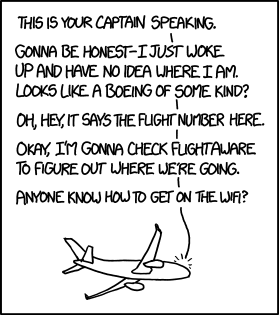
My favourite part was this cartoon, mostly because I looked at the picture, thought "okay, airliner" and then looked for the joke in the caption, before realizing that the picture is the joke, and the name of the airliner just echoes it.

Oh and the AME at the FBO calls to confirm receipt of the airplane and the work order, and to ask if I happened to notice if the NDB antenna was standing when I arrived. Apparently it blew down. So I guess it was windy enough to be worth tying down the plane.

Also, not local, but way too bizarre not to post, is this story of two eagles crashing into a snowbank while engaged in an aerial mating dance. The male was killed and the female may have a head injury and permanent ligament damage. These birds need to practise safer sex.

Friday, January 22, 2010

Hotel Hallway Guarantee

I get up and do my 5BX exercises, still really simple to do in half the allotted time, but they say not to skip any levels. Then I have paperwork to do.

Naturally I left some of the information I need for my weekly report in the plane yesterday, so I had to go back out to the airport and get it. I meant to get it while shovelling off the airplane, but didn't. I swear I should have a checklist for getting out of bed in the morning.

  • 1. Consciousness -- ENGAGED
  • 2. Left leg -- OUT OF COVERS
  • 3. Left foot -- ON FLOOR
  • Repeat steps 2-3 on RIGHT.
  • ... and so on.

It would have to be Transport Canada approved, of course, which might in the end require me to have an extra leg. By the time it went through the approval process I'd be retired, anyway. Nah, TC isn't really that bad. It's just traditional to pretend they are.

Documents retrieved, it's now paperwork time. I should do this every night, but then it's actually quicker to get the forms out once and do it rapidly all at once. Date, client name, aircraft ident, aircraft type, airport of operations, province of operations, forestry department work order number, hotel name, hotel city, hotel cost, hourly billing, pilot names, pilot base, contact numbers ... I swear I don't even know what all the blanks are for. I don't have to fill all of them out every time; I just have to remember which ones I have to fill out. Occasionally I try to get ahead, but that guarantees that whatever I fill out in advance will be wrong. We'll move to another airport, yank the plane and send in a new one, or send me to a different client. My name will end up legally changed or they'll redo the calendar and skip February. And then I scan the pages and all the receipts, PDFize the result and e-mail them to the boss.

This is much easier than the old days when I had to photocopy and fax all the receipts, often requiring me to either convince hotel staff to copy them or to let me behind the desk to copy them myself. Nowadays the only copying I have to do is a logbook page, because I can't shove the whole logbook in a miniscanner. Usually it's no problem having the front desk make a copy. This time the desk clerk wants 25 cents for the copy. I manage not to roll my eyes, and go back to my room for the quarter. I don't even retaliate by asking for a receipt.

Paperwork complete, I do pilot in hotel room things. Write postcards, read blogs, write e-mail, watch TV, work out some more. All kind of at once. I've completely lost the ability to do one thing at a time. (For example, I'm currently cooking, watching TV, writing this blog entry and reading webcomics. That's right, I'm switching back and forth. I have to switch between this window and the one with my notes in it anyway, so what's another step on the way?)

After the workout I decide I need something out of the vending machine, so I grab my hotel key and my change pouch and walk two rooms down the hall to the vending machine. There is nothing in the machine that I want. I should have figured that in the first place. But you see this is just the set up for the one thing that is guaranteed to happen when you leave a hotel room in your underwear. Okay, it's not underwear exactly: it's a pink Nike workout bra and shorts, but they are shorts that emphasize freedom of movement, not coverage. And everyone who has ever lived in a hotel knows what happens when I put my key in the hotel lock. The red light goes on. The lock does not open.

So now I have to go down two flights of stairs to the lobby and wait at the reception desk while new arrivals are assigned rooms and the clerk reprograms my key.

Yeah, sorry, my day was less exciting than yours. It's also close to minus thirty out there at the end of the day. I guess this is a 'love your office job' post.

Friday, September 18, 2009

Message from the Past

I've often thought about advice that I would give to my past self, but not long ago Irregular Webcomic asked "What would your younger self say if they could see you now?" That inspired me to think about it.

I think the strongest thing she would say was "I thought you were going to accomplish more." And she might not have the tact yet to avoid saying straight out, "I was better than this in school. What happened to make you so ordinary? How come you've forgotten so much?" She'd surmise "So I guess science wasn't all it's cracked up to be?"

She wouldn't mention the physical shape I'm in, because she had plans to get stronger, and it hadn't occurred to her back then that she wouldn't succeed or that it it would be any effort to maintain fitness. I think she'd compliment me on my hair. It looked terrible back then, and if she hung out for a while I'd probably make her ask "How do you do that?" a few times.

She's disapprove of lots of things, in her naïve idealistic way. She would want to put me back on track. I can remember her helping mentally ill people with resumés and job searches, just because they needed a hand and she was confident in her knowledge. "Let me help you make a plan," she'd say. And she'd know me too well to be fooled by my excuses.

Maybe I'd give her plan a try for a while. But I'm tired of trying to succeed.

Wednesday, September 02, 2009

Ninjerks

I read way too many webcomics. This one is about ninjas who use their stealth and guile to excel at being jerks. It sounds pretty stupid, but the drawing style is simple and fun and I'm enjoying looking at it. Here's an aviation themed one, a salute to Captain Sullenberger, for a sample.

Via Cakewrecks.

Saturday, June 13, 2009

When Is a Tower Not a Tower?

I've been getting some questions in comments lately about airport control towers. This post is about air traffic services at Canadian airports, from a pilot's perspective. The controllers and specialists themselves might describe it differently.

First off, the ultimate authority regarding runway selection, wake turbulence separation, altitude of flight and everything else about the flight rests with me, the pilot. I am required to follow any air traffic control instructions which I accept, but if an air traffic controller clears me to do something illegal, and I do it, I still get in trouble for it. If a controller instructs me to do something dangerous and I do it, I still die. Next, any pilot is capable of navigating from any airport to any airport without the assistance of air traffic control. Any pilot, from the student pilot on his first solo, right up to crew of an Air Canada jet coming across the Pacific from Japan, knows how to safely finish a flight with no radio at all. Many flights are conducted every day in Canada in aircraft that are not radio-equipped. Air traffic services greatly increase the safety and efficiency of air travel, in much the same way that traffic lights increase the safety and efficiency of the highways.

Look up any Canadian aerodrome in the Canada Flight Supplement (CFS) and you will find at least one of the following. (You could find more than one if for example the control tower closed at night leaving either an FSS or a MF).

  • a tower
  • a flight services station (FSS)
  • a mandatory frequency (MF)
  • an aerodrome traffic frequency (ATF)
  • the aerodrome is not listed at all

If there is a tower frequency listed in the CFS, there is probably also an ATIS and ground frequency and could be more frequencies for clearance delivery, outer tower, different areas of the ground, and so on. Call any of these frequencies and you are speaking to someone sitting in a physical tower overlooking the airport. They may not have a clear view of the whole thing. They may be 1/8 SM in fog and see nothing out the window. It could be one person operating both the tower and ground frequencies. (I think in that case there would someone else in the break room getting a coffee, and that at a Nav Canada tower no one works a solo shift, but I could be wrong).

If there is a tower, as there are at about forty Canadian airports, then a pilot starting up at that airport will request permission to taxi up to the edge of the runway and then report ready and wait for clearance to enter the runway and take off.

Fort McMurray Ground, GABC on the east apron, request taxi for VFR to Grande Prairie, six thousand five hundred.

GABC, McMurray Ground. Taxi runway 25 via alfa, call tower holding short of 25.

I acknowledge that, trundle up taxiway A to the line marking the edge of the runway and finish my checks before calling...

McMurray Tower, GABC ready 25 on alfa

GABC, cleared takeoff 25

I acknowledge that, and take off, if everything looks safe to me.

I left out some other things we would probably tell each other, but the basics are there. I ask for what I want, they give me instructions and clearances.

About fifty Canadian airports have an FSS but no tower. There may actually exist a raised structure with a good view of the field, and the flight services specialist may indeed sit inside it and look out at the airplanes going by, but when we say there is or is not a tower, we are referring to a tower frequency and the requirement to obtain clearances for movement. The reason I said "about forty" and "about fifty" is that towers and FSSes open and close according to need, so a tower that was occupied by air traffic controllers last year houses an FSS this year. Some FSSes don't have towers, just regular buildings, or even portables. If I want to go somewhere at a field with an FSS but no tower (even if the FSS guys are in a tall skinny building that used to be called a tower) I call the FSS and tell the specialist what I am about to do. An FSS is addressed with the call sign "Radio."

Grande Prairie Radio, GABC on the east apron, taxiing for VFR to Fort McMurray, five thousand five hundred.

GABC, Grande Prairie Radio. Active runway is 12. Traffic is a King Air landing 12 in two minutes.

I see the King Air touch down and go past the intersection. Everything looks safe, so I call..

ABC rolling 25.

Again I left out the FSS giving me the wind and altimeter setting. The difference is that the tower tells me what to do, and I decide if it's safe, while the FSS gives me information and I make a decision based on that. The line blurs of course, because the tower may offer me a choice and the FSS may give me a recommendation, but in the end I ask the tower but I tell the FSS. If I'm departing IFR into controlled airspace, the FSS gives me my IFR clearance.

At all the other airport, some of which may have tower like structures that used to house an FSS or control tower, but are now unoccupied, or used to store paint and frangible taxiway lights, I make calls to traffic. I make calls just like the ones I made to the FSS, but now I talk to "traffic" instead of "radio". There may or may not be anyone else listening to the traffic frequency. If there is, they will tell me if i pose a conflict. If the airport has an MF, then I have to have a radio, listen on the frequency and make appropriate calls. If the published frequency is just an ATF then if I have a radio I should make the MF-style calls, but aircraft using that aerodrome are not obliged to have or use a radio. And if the aerodrome is just a lake somewhere or someone's hayfield then I don't have to make calls, but I can, using the the standard aerodrome frequency of 123.2. In any of these cases there may be someone on the frequency who will give me information. The people who run the fuel truck may reply, e.g. giving me the wind direction and telling me that there's a NORDO ultralight doing left hand circuits on 34.

Whichever kind of airport you depart from, you can enter airspace controlled by terminal or centre controllers. They usually work in darkened rooms, sometimes in the same facility as a tower, so they can share infrastructure like maintenance and backup power. If I have an emergency I can report it to any ATC or FSS I am speaking to, and they will help me coordinate with other facilities to get vectors, firetrucks, whatever I need. Canada has excellent air traffic services, and they are hiring.

And for the pilot geeks: User Friendly. My cockpit overhead light isn't working, but I didn't ground the airplane, because it's light out enough all the time that I dont' need it.

Monday, June 08, 2009

Will She Fly or Will She Sleep?

Seven a.m. came too soon after getting to sleep after having a four hour nap in the middle of the day, but I got up. Ate breakfast with company and two chainsaw replacement chain salesmen from Portland, Oregon. Raisin french toast with bacon.

Go to plane. I load and secure baggage while she checks weather. "We're not going high, but we're going," she says. Fine with me. I set the radios and the GPS, bookmark origin and destination in the CFS, tell her what I've done and then pick up my crossword puzzle. I'm not sure, but I think there's a possibility that half-assed two-crew procedures when it's legally a single-pilot operation are worse than single pilot with someone who is also qualified but is clearly not doing anything to contribute to the flight. Today I'm working on that theory. She'll assign me duty if she wants help. "I expect you to have that crossword puzzle finished before we arrive," she warns. So I have my flight duty. Also I may have to fly to the end of my duty day tonight, so I should relax now.

Winds favour 07 or 12, but the aprons and taxiways are only set up so that one can easily get to 25 or 30. My reply to her possibly rhetorical question about the best way to get there is "let's just call the FSS and ask which way they recommend."

We don't even have to ask. When she calls to taxi they recommend "alfa, bravo, backtrack 07." She's at the B-12/30 intersection before she says, "Wait a sec, how am I supposed to backtrack 07 from here? Runway 07 crosses at the other end of this runway." They meant backtrack 12, which we do. Meanwhile Jazz calls up and asks to depart off 30. The FSS points out that it's NOTAMed closed for work that isn't currently being done, but it's still closed, so the CRJ will have to backtrack 12 as well. We take off. Gear comes up and gear handle clunks back to the up-neutral position, as it's supposed to. It's more obvious from this seat.

"I guess I should make a quick turn to get out of their way," she says, referring to the Jazz flight.

I can see them out of my window. "Nah, they're just starting their backtrack. Take your time," I say. We loop lazily over the airport and en route. I'm stumped for a while on a clue that asks for a zoology word for permanently attached. I'm thinking that arms, legs, tails, most zoological bits are more-or-less permanently attached, and that the exception like the skink's sheddable tail is more deserving of a special name. And then I work out the crossword theme of NINE to FIVE and fill in a few more words, giving me a couple of letters and the now obvious SESSILE. I'm soon down to three clues. I need a "Fighting" team that fits IL_INI, a simple sugar that fits HE_OSE and "Holly" across with I_E_. The team could be anything, because lots of letters are pronounceable there, but none is recognizable. The holly is probably a Latin name. I run the alphabet on the sugar and decide that HEXOSE sounds like a nice name for a sugar, and as IBEX is fauna not flora I go with ICEX for the holly. It's almost definitely not correct in the crossword, but I don't know the holly or the team, and ICEX is a liquid you use to treat the surfaces of deicing boots to make it easier for them to shed ice. (If you're cheap you use Armor-All, but the latter leaves black streaks on your wings.) The same section of the paper yields another, easier crossword puzzle, a word find, a jumble, comics, descriptions of the top ten new reality shows, and a scrabble puzzle. And that's about how long the flight was. There may have been scenery outside, but I doubt it.

I've been here before so I direct her to where we parked then. It's busy, with three commuters at the terminal, a row of little jets lined up along the back of the apron, and people all over the place. We dodged between a Dash-8 just shutting down and a helicopter just starting up to squeeze into our spot beside a hangar.

I go to the FBO to arrange our stay. There's a pilot on the phone to flight services, making "sorry, I'll be right done gestures." I smile and point at the FBO attendant, who is on a different phone. I'm waiting for him. Another pilot is also waiting.

"Are you the Dash-8?" I ask him.

"Oh no," he says, in an accent that's four or five thousand kilometres southeast of here, "much too slow for me." He's one of the jets.

"Something going on in town?" I ask, still wondering what's brought all the traffic. But it turns out that his accent is from much further south than his passengers. He's based in Calgary, just doing a crew change. Apparently Thursday is a big crew change day here.

It's raining. We go to the hotel. Lunch at Boston Pizza. The rest of the day is overdue paperwork, which is why some of this entry is not fully expanded from the terse notes that begat it.

Wednesday, April 08, 2009

Getting On and Off in Texas

Heading out for some time out, I once again have to drive to the nearest major airport and do a handover with a replacement pilot. The airplane is in for scheduled maintenance and will be at least a couple of days, so this time I'm dropping off the car and flying out this afternoon, and then my replacement will pick up the car and drive back to the worksite when he arrives.

The USA has great highways. They are usually well-paved, with yellow lines in the middle, clear lane markings and white lines along the edge so you don't drive off the road. They usually have lots of bright reflective cateyes while Canada typically has only the glue marks left behind after the snowplough scraped the cateyes off the pavement. Some amazing engineering goes into the urban highway ramps. Some places they are stacked five or six layers deep. I'm sure there are dozens of advanced textbooks and hundreds of engineering theses on how to curve and bank an exit ramp, how long to make an exit or entrance lane, and where to put signs such that drivers can interpret them in time to make lane changes.

There are national, state and possibly also county highways and they have different formats. So one sign might direct you to 131 North, 23 South and East Loop. And the signs can be on the same pole so you see "East Loop 131 North 23 South." And then you're looking for 23 North and you see "North 23" and you go for it, realizing as you're committed to the ramp that that's 131 North and 23 South. So you're going the wrong way. Fortunately it's usually simple to exit, cross under the highway and get back on going in the proper direction. Okay, further evidence that Aviatrix can't drive. What else is new.

Texas on ramps: Some of them live up to that state of the art engineering picture. And some of them appear to have been built by the Dukes of Hazzard as a one-off. I guess the highway goes through all kinds of towns, and all of them want access. I have literally missed highway entrances to I-20 because I thought the ramp concerned was one of those dirt roads that cops use to do U-turns rather than a legitimate highway entrance. After a time I came to realize that while the interstate has a dependable consistency from Shreveport to Fort Worth and on to California, the entrance ramps aren't necessarily paved. It lends the interstate an exotic flavour, like The Road in Zelazny's Roadmarks.

Oh, and an airplane cartoon, just so I don't have to put the non-aviation tag on this.

Wednesday, February 11, 2009

The Dancing Car

In which Aviatrix is frightened by shock absorbers and by a medium pizza

The next day I explore my new environment. The hotel is on a busy boulevard with a high school just down the block and across the street. There's also a restaurant over there, so I'm crossing the road to see if it is anything I want for dinner. There's no sidewalk, but there's a pedestrian light. The traffic in the lane in front of me stops and while I'm waiting for the opposite left turning traffic to stop so I can cross, one of the cars does something very strange.

It's an orange car, not the old 1970s kind of orange, but a new metallic orange. It's the first car in line at the light and I suddenly notice movement, but it hasn't moved forward or backwards. I'm not immediately sure what movement I have seen, but then it moves again. The back right corner of the car suddenly lowers.

Now when I land an airplane, if I land it gently and it isn't heavily loaded, often the main gear oleos will not compress all the way. The airplane will be slightly jacked up. But when I taxi around a corner, one oleo may suddenly compress, making the airplane lopsided until something similar makes the other one compress, too. I had this in mind as I considered what I saw in the car.

As it stopped at the light, presumably it was abrupt, and its weight shifted forward, uncompressing the rear shock absorbers, making the rear end look lifted. Then perhaps a passenger in the back moved around, compressing first one and then the other rear shock absorber.

Good theory, but it didn't hold up. As I stared at the car, the front end popped up. Then the rear. Then it went down on one side. And down on the other side. The car was dancing. I'm staring open-mouthed at this thing. I'm sure everyone in the car was busting a gut laughing at me. But it was insane. Who would want deliberate control over the shock absorbers? Does it have a use other than astonishing Canadian yokels? It wasn't high enough to work like this comic. What do the controls look like inside the car?

I was so busy staring at the car that I didn't make it all the way across the road at the light, and had to wait on the central divider for another cycle of the traffic lights. A lot of cars were coming out of the high school, and while I was watching them I noticed that they were almost all newer cars, made in the last five years and almost all contained a single teenaged occupant. I did see one schoolbus, too. It wasn't until later that I realized that I had just watched school get out and saw not one single student leave on foot or by bicycle. It's only about 3 km from the centre of town, and there are residential areas within a kilometre. I don't know if this is a discovery about how rich the kids are in town, how lazy they are, or how behind the times I am. Maybe all the kids in Canada drive to school now, too. I do know lots of university students who walk or bike to school, but perhaps my friends are poorer or more active than the norm. It's also possible that the local kids who walk or bike used a multi-use path I didn't know about, in order to avoid the busy street.

The restaurant turned out to be an all-you-can-eat fast food buffet. That's not good value for money for me, and I wasn't feeling anthropological enough to want to watch the people who would go to a place like that, so I crossed back to the hotel and surrendered to pizza. In Texas, it turns out, you just can't get away with eating a little bit. The small pizza cost considerably more than the medium, so I ordered a medium. The guy at the counter couldn't explain the price discrepancy, but did recognize it as illogical.

I'm suspecting that no one in town walks anywhere. More evidence supporting that theory in a later blog entry.

Sunday, August 24, 2008

Life Quest

I wasn't going to blog today, but instead decided to pass you this chicken cartoon. Even advanced self-awareness has its downside.

Tuesday, April 08, 2008

Jay Jay the Jet Plane

When you keyword search the TV Guide on "airplanes" you get some weird selections. I will subject you to my latest. Jay Jay the Jet Plane (caution: web page plays voices) is a television programme intended for very young children. Like any kids' show it features bright colours, forcibly cheerful overacting, and simple morals. This one features anthropomorphic aircraft (no pilots, just self-aware airplanes) and little "science and nature moments."

The airplanes look very weird at first, as each has a human face grafted onto the front such that the nose is the radome. The single-engine prop planes even have their propellers right on their noses. The facial features move as the airplanes speak, and even twist a little from side to side. They're almost all conventional fixed gear airplanes, which I suppose is to make their faces turn up as they sit around in the hangar and chat. There's also a little helicopter, a retractable prop twin, and a few others that come to visit from time to time.

My first point of fascination is trying to identify what inspired the features on the various airplanes. The designers obviously had some pictures to work from, but didn't necessarily know what the features they were drawing were. For example, Savanna is a delta wing supersonic jet. She has one engine, mounted in the vertical stabilizer like on a DC10. And she has a little engine-like pod just over where her left ear would be, if she had ears. At first I thought it was an oddly situated APU, and then I noticed that all the airplanes have some sort of vent in that position. (In the cast pictures page sometimes it appears to be over the right side, but they're always on the left in the show: the website designers appear to have flipped the pictures left to right in some places). On the old biplane, and the pink twin jet it's clearly a venturi.

Once the weirdness of the airplanes wears off, you can get to the drinking game. It only needs two rules: drink every time they violate a new air law, or violate the laws of physics during a "science moment."

For example, one of the jet planes, Tracy, decides to go and practice fast flying, to see if she can make a sonic boom. She explicitly selects for this purpose to overfly a national park. The fast flying goes well, until she encounters a tailwind which pushes her supersonic, at which point she tumbles from the sky and ends up stuck on her back like a turtle. No one knows where she's gone, but when they realize no one has seen her in a while, and she doesn't answer the radio, they split up and go to look for her. The supersonic jet is the one who spots her, so elects to make a low pass over the park, such that her sonic boom flips Tracy right side up. Tracy flies home and the mechanic polishes her up good as new.

Are you drunk yet?