Showing posts with label teaching. Show all posts

Saturday, February 05, 2022

Missing? Search Again!

 As well as training pilots, I train flight followers, the people responsible for, in the words of the legislation ...

CARS 722.12 (2) Flight Following

Flight Following for a Type D system is the monitoring of a flight's progress and the notification of appropriate air operator and search and rescue authorities if the flight is overdue or missing.

Naturally if I train people to notify the authorities when a flight is missing, they have to know what that means, so I looked it up. First hit was on Wikipedia ...

According to Annex 13 of the International Civil Aviation Organization, an aircraft is considered to be missing "when the official search has been terminated and the wreckage has not been located"

That doesn't make any sense, but it wouldn't be the first time Wikipedia was wrong or that Canada had a different definition than the international one. I find a Transport Canada source.

Advisory Circular (AC) No. 100-001 Subject: Glossary for Pilots and Air Traffic Services Personnel

An aircraft is considered to be missing when the official search has been terminated and the wreckage has not been located.

So, according to Transport Canada, I am to train the flight followers to report an overdue aircraft promptly to SAR, and then, weeks later when the search and rescue experts have failed to locate the aircraft and advise that they are discontinuing the search, to report the missing aircraft once again to SAR. At least I won't have to look very hard for relevant humour to spice up this part of the instruction.

Friday, March 14, 2014

Roger That

There are a number of contexts in aviation where it's very important to verify that another person has heard and understood you, but it's often not a good time or place to have an extended conversation about the information that has been conveyed. When given a clearance on an IFR flight plan, the pilot reads back the entire clearance. It may be in slightly different words, but the words won't change much because they still have to comply with aviation terminology. The controller listens to the repeated clearance, called the readback and acknowledges or corrects it. If there is an error, the pilot has to read back the corrected portion until it is all worthy of the response, "readback correct."

When the flight is VFR, the pilot need only acknowledge the clearance, usually by repeating her callsign. So the controller says, "Alpha Bravo Charlie cleared direct SPOTT," and the pilot says "Alpha Brav Charlie." The message, "I hear and obey o great air traffic controller" is implied. There are exceptions both ways: sometimes in very busy airspace, like Oshkosh airshow arrivals, the controllers just talk and pilots acknowledge by obeying. Sometimes VFR pilots working in complex airspace where the bulk of the traffic is IFR will read back instructions. It's okay to do so any time the pilot wants to double check that what they heard is what the controller said.

Between pilots in the cockpit one may give the other information, information as simple as "Edmonton's on zulu, it's on the clipboard." That means that non-flying pilot listened to the recorded terminal information message on a dedicated frequency broadcast by the tower at Edmonton International Airport (insert sadness here as I miss the late Edmonton City Centre), wrote down the reported airport conditions, including the fact that the identifying letter for the latest recording is "Z" and presumably put the clipboard where the flying pilot could see it. The flying pilot will probably say "Check." Ah, half the time if the cockpit and radio are quiet she'll probably say "thanks" but the meaning is the same, roughly, "I acknowledge that, and I'll deal with it when I need to." It isn't really a favour one pilot does for the other, just both working as a team.

"Approach flaps"

"Flap 15 selected and transiting ... approach flap set."

"Check"

The word "roger" also means the same thing. It's an aviator's way of saying "Gotcha" or "Cool" or "OK." Another old word with a similar meaning is "Wilco", short for "will comply".

Here's what prompted this post. My dentist e-mails me with an instruction. She knows I'm a pilot, because somewhere in the regulations it says I'm supposed to let medical professionals who treat me know that, but the instruction has nothing whatsoever to do with aviation. I don't have to give her any information, just let her know I received the e-mail. I type "check" because it's really the first thing that springs to mind when I want to be perfectly clear about having received an instruction. That reminds me of a story though.

A student pilot was flying in a busy circuit and before she got a word in on the radio to report that she was on the downwind leg (ready for sequencing instructions) the controller pre-empted her call by saying, "Check you're downwind, number three" meaning, "I see you're on downwind, follow the two airplanes ahead of you." The student wasn't familiar with that use of check so interpreted it as a command "check your downwind," that is "do something to your downwind." The student was sure that she was flying in the right place at the right speed so didn't change anything, just asked her instructor about it afterwards. I'm the instructor in that story, and I didn't want my dentist to think I was telling her to check something, so I backspaced over it and started to type "wilco." But that's even more jargon-y. Roger? I ended up with "Sure thing!" Overthinking it perhaps but I offended a medical professional once with a terse automatic aviation-style reply, and I don't want to do that again.

Monday, August 29, 2011

Special Thunderstorms

A probably not so recent anymore AIM update identified two changes in the publication for which I wanted to look up the details.

The following airports have been identified for SPECI criteria for significant temperature changes between hourly reports: about half of Canadian airports

It then lists almost half of Canadian airports, the biggest ones. Normally an aerodrome observation, called a METAR is published once an hour, but if one of a number of specific significant changes occur, like precipitation starts or ends, or the ceiling or visibility changes past a specific limitation, they issue a special update observation called a SPECI. It's pretty clear from the descriptions that they are aimed at given a pilot the best chance of making the right decision about whether or not she can land there with her equipment and training.

It doesn't say why they have added temperature to the criteria. Temperature in and of itself doesn't offer the same impediment to landing as fog, hail, or thunderstorms, but a sudden change in temperature indicates the passage of a front, which could mean an abrupt change in weather, or sometimes freezing rain.

The second change is to Met 3.13 and I was curious when I looked at it what they had changed.

(a) active thunderstorms–the cumulonimbus (CB) symbol is used when thunderstorms occur, or are forecast to occur, over a widespread area, along a line, embedded in other cloud layers, or when concealed by a hazard. The amounts and the spatial coverage (in brackets) are indicated as:

ISOLD (isolated) – for individual CBs (less than 25%)
OCNL (occasional) – for well­separated CBs (25 – 50% inclusive)
NMRS (numerous) – for CBs with little or no separation (greater than 50%)

It looked the same as I remembered. As an instructor I used to teach students to match ISOLD to FEW (1-2 octas), OCNL to SCT (3-4 octas) and NMRS to BKN (>4 octas), where an octa, or maybe it's an okta--damn you really forget this stuff when you're not lecturing someone on it every day--is a one-eighth proportion of the sky. I houled out an older paper copy of the AIM and looked up what it used to be, and the old version omits the bits that are in parentheses in the lines quoted above. I wonder how I knew it, then. I guess it was in the old, old version, the AIP and somehow didn't get added to the new AIM until recently.

That's exactly how lore is created, but someone added it back in, so now it's information again. I love lore. Especially when it's incorrect but it can be traced back to a loopily logical origin.

Sunday, October 31, 2010

Knowledge is not a Democratic Principle

I wanted to write a post about something scary for Hallowe'en, and I think I just found it. I came across this Answers.com question and answer. The asker wants to know if he can use the Archimedes principle to weigh an airplane without a scale. And he knows that Archimedes developed this principle to determine whether a crown purported to be solid gold was indeed solid gold.

Several people tried to answer this question. Two suggested that the way to do this would be to completely submerge the airplane, evacuating all air. One concluded that this would work, assuming one knew the density and composition of the materials from which the airplane was made ("measure the volume of water displaced and multiply it by the mean average density of the plane to get the weight") and the other, citing "I'm a vampire blur" as sources concluded that such calculations were not possible, "so neh." Three suggested floating the aircraft and one didn't read the question properly, so suggested weighing the airplane on scales, using more or less the methodology cited by the asker in the original question.

The Archimedes principle is this:

"When a body is wholly or partially immersed in water, the upthrust, or loss of weight is equal to the weight of the water displaced."

One of the people who gave me my start in science and mathematics had come from an educational tradition where students learned things by rote memorization and demonstrated their knowledge by standing next to their desks and reciting them. A generation or so earlier they probably had to say it in the original Greek. That was never demanded of me, in any language, but when learned snippets of natural philosophy are recited by someone you respect, they stick anyway. I never have to look that up. Rote memorization is obviously not sufficient for understanding and application, but it's an anchor for the knowledge.

An airplane could be weighed by the water displacement method if you put it on a floating platform in a tank of water, and noted the water level in the tank. Then you hoist the airplane off the platform and measure how much water you must pump in to fill the tank back to the identical water level. That is the amount of water the weight of the airplane displaced, and by multiplying its volume (which you measured while pumping) by its density at that temperature, you have the weight of the airplane. That's easier than filling the tank to the brim without the airplane then collecting and weighing the water that spills over the top when you add the airplane, but it's functionally identical.

But because this is the way the world works now, on Answers.com people voted on which was the correct answer. The vampire blur who wanted to sink the airplane "won." I know this is by no means the nadir of stupidity in online question and answer polls. You might tell me not to get too upset about this because he only received two votes and one of the floaters received one, but it's a second risk of the democratization of knowledge: not only has popularity become the definition of truth, but low voter turnout makes it easy to influence "truth."

Once upon a time in some parts of human history, when people didn't know things and they couldn't easily test them for themselves, they went to people who were wise, or powerful or lucky and asked them for the truth. What they said was accepted as the truth, even in the face of meticulous contradictory observations. Then came the scientific revolution. It wasn't about new knowledge. It was about how we know knowledge. We test it in a way that anyone can reproduce, and experience as truth instead of being told. That's the purpose of laboratory science training in schools, to show students that what they are learning is real and discoverable, not rote and on faith. Scientists worked in Latin and Greek not to be obscure and elitist, but to communicate. The Greeks and the Romans had the first literate engineers in the western world, and theirs became the tradition for communication. Newton reported on some of his discoveries in English, and despite a few centuries of language change, it's some of the most clear readable reporting of primary scientific results you'll ever read. It's not laden with jargon, just uses and defines existing terminology for the phenomena.

Since then knowledge has become more esoteric, experiments more expensive, scientific language more obscure, and people have to rely not only on others to do their experiments for them, but on others to read the results and filter them. We've gone back to individuals choosing which wise man they will turn to, and we've lost the distinction between philosophy and experimental knowledge. There's nothing wrong with turning to someone whose experience, subject knowledge and capacity for thought is greater than yours and asking for help understanding the world. There's nothing wrong with taking ones own knowledge of the world and trying to share it with others (at least there had better not be, because I do it all the time). But it results in a breakdown in the distinction between what is empirical fact and what is opinion. There is very little real historical fact. Some bones, some photographs, some rusted swords, are all. We assume that when numerous sources close in time and space to the occurrence agree with each other and with the physical evidence that we have historical fact, but we have to be open to the possibility of collusion by the only people who knew the truth. Wikipedia has rapidly become a major source of information for individuals and for the media we depend on to give us a broader view. Wikipedia is kind of a shoutocracy. When the only version of events that anyone looks at is the one laid down by he who shouts loudest, then did anything else really happen. Ethics have no empirical truth, and all we can do to determine which are right is to consult our wise people, our consciences, and the norms of our society. But some things are either real or not, and when there is a conflict among voices on determinable facts, but the "winner" is determined by volume1, popularity, tenacity, intimidation, tradition or apathy, that is very scary. Happy Hallowe'en.

1. Not by immersion in water, but that might be nice, in certain cases, incidentally settling the matter of who is a witch, just in time for Hallowe'en.

Sunday, April 11, 2010

What Feels Good

A reader of this blog works with teenage refugees. Think about teenage refugees for a moment. Being a teenager is bad enough. Now imagine you're a teenager and you have to move and leave not only all your friends but your whole country. And you can hardly take anything with you, and you're leaving because you or your parents are persecuted or in an area destroyed by war or natural disaster. So you have to learn a new language, a new culture, and fit in to a new group at a time of life where people in their own culture are feeling like misfits, and you have to get on with the usual figuring out who and what you are going to be when you grow up, even though the rules of the game may be radically different from where you came from.

One of these young people expressed interest in becoming a pilot. Another kid in the group told him he couldn't be an airline pilot because his name and appearance was obviously Arab. My reader turned to me to find out whether this was a problem, and how he could find out more about what was required to meet this kid's goal. I answered from my own knowledge, but then remembered an airline pilot reader in that same city. I connected the two people, in the hopes that information and maybe some stickers and postcards would be exchanged, and felt happy to have maybe helped.

Then a couple of weeks later I received an e-mail that leaped into ALL CAPS in its inability to to contain the writer's squealing delight. The airline pilot had set up a full tour of the operations center and maintenance hangar, including a chance to sit in the cockpit of a CRJ. The young prospective pilot received inspiration, and his outreach worker says he now looks to his supervisor and coworkers like a genius who can set up any kind of job experience in a moment's notice. And I who just sent a couple of e-mails feel fantastic. It felt as good as a perfect squeaker landing with the owner and the chief pilot on board. It's as delicious as chocolate macaroons. Feeling good about helping others does appear to be something that is encoded in our psychology/physiology. Thank you to all involved for today's high. And it's non-fattening, too.

Tuesday, March 23, 2010

Peter Shewring

I was flying part time for two different companies, just starting out my aviation career and had a little over five hundred hours in my logbook. That was almost enough to take the SAMRA and SARON, two exams that make up part of the qualifications for the Canadian Airline Pilot Transport Licence. I told a mentor I was just going to study for it on my own because I had lots of study materials and was an experienced student. He laughed at me and said, "You don't take this course to learn the material. You take this course to make contacts." So I pulled out my credit card and signed up for the course he recommended.

I was never a very skilled schmoozer, so I can't say I have exchanged job tips with or remember any of my fellow students ever after, but the teacher was terrific. He kept everyone involved and motivated, made the material interesting and kept people learning whether they thought they were lost or thought they knew it all. During a break on the last day of the three-day course, I got a desperate call from one of my companies. I had taken the day off, which they had assured me was no problem, but the pilot rostered for that afternoon had forgotten to renew his medical certificate and the pilot who was supposed to be his back up said he was sick. So instead of going back to class after the break, I had to go to to work.

The instructor, Peter Shewring, was very understanding and promised me I could sit in on the next class, next time he was in my city, any time I wanted. I went to that course, and aced the exams. He wanted students to tell him about any tricky exam questions, and I tend to remember questions quite well so I sent him a list. And then I e-mailed him from time to time for no reason, just because something I had encountered that day was something his course had prepared me for. Funny thing is, it's regarded as a cram course, with the syllabus matched to the exam, but he taught useful material, little tips and tricks in a way that made the on-the-exam stuff easier to remember and the real life stuff easier to do. He encouraged me and said he wanted to do my next IFR ride (he was an examiner too). And I always meant to call him for one, but political reasons determined the next one and then I was in the wrong city, and then I was doing PPC rides instead. I went back to the same course again, years after the first one, for a refresher and Peter remembered me.

I'm not an easy student to have in a class. If the material is interesting and new I become engrossed and ask challenging questions or answer rhetorical ones, which may interfere with the flow of the class. I'm overly helpful and I have been known to unintentionally trample egos in pursuit of knowledge and correct information. Peter kept me interested and channelled my enthusiasm into actually helping others in the class. He even suggested that I might join his team of instructors. High praise indeed. The timing wasn't right then, but just the other day I was thinking I should call him back and see if I could help out anywhere.

And then today I learned that he has died. I don't know the specifics, but I know I'm not the only one who will miss him. There's a thread on AvCanada full of stories from people who feel the way I do.

Update: An obituary.

Friday, February 12, 2010

Flimsy?

While looking for something else on Google I came across this question from a nervous private pilot student expressing concern that his Cessna 172 training airplane was "flimsy."

Flimsy? It's certainly not sexy, and it's definitely tiny and low performance compared to a triple seven, but I don't consider it more fragile. You can stall a C172 onto the runway from high enough to hurt your butt without bending the gear or wrinkling the fuselage. You can fly it through a tree, buckling a wing strut and half tearing and twisting a significant portion of the horizontal stabilizer, yet still fly it home. You can land it on the nose so hard that the fuselage does buckle, the ends of the propellers turned back like hooks, and the poor thing will still fly a circuit and return for a safe landing. An insurance adjuster once told me that in all the claims he has investigated, the only ones where there were deaths were where the pilot had stalled or spun the airplane. The ones who flew it through trees survived. The airplane will tolerate errors of about 30 percent in approach or climbout speeds, and you can fully deflect the rudder at cruise speed without damage.

I believe the aluminum skin of the triple seven is thicker than that of the C172, but not by a lot. All aircraft are built as lightly as their designers dare to maintain the necessary strength, but honestly if I had to choose between "flimsy" and "robust" for the C172, I'd choose the latter.

The student got some good responses and some not-so-good ones, as other misinformed students chime in. I like this description of a landing approach in which a student feels he nearly died: "the instructor flew very low over some trees in a fierce wind, dropping the aircraft onto one side and heading for the ground." It's a pretty good description of a correctly executed crosswind landing. The crosswind technique in a Cessna 172 requires you to bank the airplane into the wind and apply opposite rudder in a way that makes the airplane feel off balance. And of course if you want to land, heading for the ground is an excellent plan. You might be surprised at how many students are nervous about descending low enough to actually land at the airport. Getting them to put the nose down and leave it there until the flare is sometimes a bit of a battle.

Of course I wasn't present as the maligned instructor performed that particular landing, but it's likely that his only error was in not briefing the student on what to expect in a crosswind landing situation. The first lesson is too early to treat a crosswind landing as a full-on demonstration, but any student, or even a passenger, deserves a simple heads up such as, "We will be landing tilted into the wind. This is normal. I'll put the left wheel down after we're on the runway." It turns what can be a scary situation into one where the passengers are impressed by your control because you put the wheels exactly where you said you would.

For anyone operating small aircraft, the whole thread should be a lesson in what students or passengers see and feel that frightens them if the instructor doesn't explain. I had a passenger in a C172 endure fifteen minutes of silent terror through not identifying a banging sound as rain until I happened to say "isn't it cool the way the rain streams off the windshield without any windshield wipers?" If you fly airplanes, and there is something in your work environment that looks bad and that you can't comfortably explain, find out the explanation and/or get it fixed, even if your flight instructor didn't.

Tuesday, September 09, 2008

Two Ways to Get Fuel

Wednesday morning the hotel clerk does not have as dire a view of the town's one cab as the airport manager, so to avoid having to impose on airport staff to pick us up, Lite Flyer calls him. The cab is clean and the driver is prompt and friendly. If you're ever in Union, SC, call Alpha & Omega Taxi Service on my recommendation. Service after 6 p.m. is only by special request, but he said he would have picked us up, no problem.

A flock of large birds is grazing (do bird graze?) on the grass by the apron when we arrive. We look and point and they run away. I speculate that they are wild turkeys, like the bourbon. The airport manager later verifies that they were, by our description. They're not in season right now, and they're very wily when they are. They seem to know, apparently.

The airport manager is also the manager of the local football stadium, and they are moving some games up to get them played before the hurricane hits. He has some preparation to do, but is generously offering his work crew to help with the fuelling operation. His work crew wears bright orange jumpsuits with the name of the county correctional facility on the back. He says they mostly pick up trash and do other cleaning at the stadium. Use of convict labour is quite common in the south, and I found a list of rules for working with them, on a bulletin board. Lite Flyer goes with the manager and crew to get gasoline while I do flight planning and check weather. The light mist in the vicinity of this airport is echoed to the north with IFR conditions in fog, forecast to persist for a couple of hours, so there's no great urgency to get anything done here. I chat to the airport manager's secretary and to another of the orange-jumpsuited work crew. I wasn't quite quick enough to get a photograph of Lite Flyer directing fuelling, outnumbered by convicts, but the image persists in my mind.

With the airplane fuelled and ready to go, we sit under the wings for a while with our respective computers, trying to get up-to-date on our blogging, and waiting for the weather to improve. Ordinarily I would have left here on the expectation of the fog clearing on schedule, and the knowledge that I could outfly the region of fog if necessary. But with an ultralight and a brand new engine--and only one engine--I'm treating every moment in the air as the one before the engine fails. It's almost a superstition. If I say, "it will be alright," I'm tempting fate.

Eventually the fog clears and we're good to go. Lite Flyer does the take-off and she does it beautifully, raising the tail to just the right attitude with just the right timing and then flying off the runway at a perfect 65 miles per hour. I don't have to say a word. Of course she's had eight hours of training before I met her, and that was also on a tailwheel, so I shouldn't be so surprised, nor take credit for setting a good example. I lavish praise and direct her through the on course turn.

I'm not worried about the late start this morning, because we have an ace up our sleeves. Our next point of landing has Mogas on the field, a fact that I've verified with a telephone call. We'll be able to fuel up and hop back in the air without messing with gas cans and borrowed cars. We have a list of US airports that supposedly have Mogas, but this is the first one that has worked with our route schedule.

South Carolina gives way to North Carolina, which looks exactly the same. I always wonder about the pairs of states with the same names. Did they divide an existing state for political reasons, or were they not original enough to come up with separate names for already separate jurisdictions. The green fields of North Carolina give way in turn to forests and fields of Virginia. There are a few more lakes here, some of which tempt me to do a touch and go, just because I can, and a higher tree to grass ratio. The land is more rolling too. There are still plenty of available fields. I choose uphill emergency landing sites as I watch out the window.

We've descended to circuit height and are both watching for our destination airport but we're almost on top of it before I spot it, and direct Lite Flyer to teardrop out in order to have room to establish a base and final. Boost pumps on, flaps set, gear confirmed down. We've been leaving it down because the difference in drag between up and down is negligible, and by leaving it extended we don't need to worry about any faults in the retraction/extension system. I worry a little bit about primacy for Lite Flyer not acquiring the habit of ensuring the gear is in the correct position, but we do use the checklists and she seems diligent at confirming both the green light and the visual gear position before landing.

I bully her through the circuit pattern, feeling badly that I've never sat down with pen and paper and explained the steps we're taking here. It's just that when we're not flying, it's always a higher priority to get food, fuel or sleep. She's picking it up anyway and has been flying fine approaches and handing it over to me for mediocre landings. She would probably do better landings herself, without the burden of knowing how to land dozens of other aircraft interfering with the low, low, flare that feels like landing on your butt and what would be the tips of your propellers in another airplane.

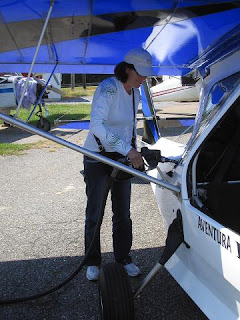
I don't remember if I had her remain on the controls for this particular landing, just that we rolled out on the narrow uphill runway and turned off at the apron. There were lots of people around and lots of airplanes, few of which were much bigger than ours and all of which were much older than ours. We parked near the pumps then checked them out and ground handled (i.e. dragged and pushed) the airplane close enough to fuel. There were two pumps, one avgas and one regular. The pumps themselves were old enough that the mechanical totalizers couldn't display the price of fuel sold at today's prices, so the price per gallon was written on a piece of paper taped to the front of the pump, and then there was a calculator there to work out the total owing based on the gallons pumped. A box was available to accept cash payment, just in case you came in when there was no one around.
We got a ride to an interesting Fast Food place just down the road. It was a chain that our host said was 'everywhere' but it was a first for us. The name, Sheetz, didn't make much sense to me, but it had pretty good food. The gimmick was that you ordered entirely from a touch screen, specifying your toppings and condiments by touching their pictures. I had a fajita and a fruit blend drink and Lite Flyer had a hamburger of some sort on a whole wheat bun. We took them back to the airport to eat, and learned a little about the character of the place. First off, it wasn't just an airport, it was an "Airport and Drag Strip," closed to aircraft two Sundays a month for car racing. it had been conceived and founded that way about 50 years previously, as the auto racing helps to pay the bills.

The guy whose name was on the flight school and repair facility was turning 85 within the month. They had some publicity posters up from some years earlier when he had flown around the circumference of the United States in a little Piper. It took him 28 days, and he had a chase van to help him get to hotels and food and the like at each stop. We wow respectfully at te feat, but I hope Lite Flyer is beginning to see what we're doing, in a slower, less robust airplane, trying to go from Florida--a state his trip skipped, right up to Halifax in only four and a half days, with no ground crew but the kindness of strangers. Fortunately, our route has no shortage of kind strangers. If we have any mechanical problems, I hope we end up at a place like this one. A place with experienced mechanics who are comfortable with the fix it yourself with whatever is at hand status of our little airplane. They look well equipped for major repairs. There are hoists and lots of tools and an airplane in the hangar for what I'll call extensive touch up paint. The whole place and all the people we met had a lot of character. I definitely would stop at W90 again. They only have Avgas and Mogas, no Jet, and the apron was pretty small, but if you're flying a small piston and want an interesting stop, go say hello.

I had been concerned for a couple of legs about contact between the left rudder cable and the rear of the fuselage. The fiberglass-kevlar hull had already clearly been cut and adjusted to accommodate the flying wires and the tailwheel retraction mechanism, so I didn't see any reason not to do another adjustment. I had mentioned it to Lite Flyer and spoken to the manufacturer about it and here was an environment where they would understand the occasional need to modify your airplane as you went along. They happily lent me a few sorts of cutters to see what kind would work best. I was lying on the pavement with the snippers poised to take a chunk out of the hull before it occurred to me, "Lite Flyer," I asked, using her real name of course, "Are you okay with me cutting a piece off your airplane? Would you rather do this yourself?"

She confirmed that the surgery was approved, but that she didn't want to do it, and I made a few snips. It didn't take much, and at some time in the future she might have access to something like a skill saw to make a more pleasing and symmetrical curve along the rear of the fuselage, but for now it would do the job. Cables shouldn't rub on anything. The splashguard persists in its attachment and all the fabric panels remain secure. I can't find anything else wrong, so we're good to go.

We start up on the apron at about the same time as an old Aztec that came in for fuel. I notice them still sitting there running while Lite Flyer carefully follows checklists. I can't see their tail number to address them, but I just key the mike and ask, "Is there room for you to squeeze by the amphib?" They confirm that there is, they were just waiting, not wanting to cut us off. We take our time to let everything warm up slowly, so we let them go first and then taxi uphill to the end of the runway.

I do the takeoff because the brakes don't hold all that well and the runway is narrow, so it might be a little tricky for Lite Flyer to get lined up and take off in one go, and still be confident of holding the centreline. Airborne, I admit to Lite Flyer that I'm glad I did a good takeoff because I didn't want to screw up in front of our new friends. And it turns out she was thinking the exact same thing. I give her control and we again turn north as we climb.

Monday, September 08, 2008

Why Are We Here?

The low cloud that dogged us on the Florida coast is gone, and we can get slightly better winds at a higher altitude, but I have to sell the higher altitude to Lite Flyer. The demo flights she took were all below a thousand feet, probably a combination of cloud avoidance, economy of time, and the manufacturers' desire to make the airplane seem faster. The lower you are to the ground, the faster it seems to go by. In the immediate vicinity of the factory, the demo pilot knows the terrain well, knows where all the wires and towers are and mainly wants to show the customer that she can land on the swamps as well as the runway. Apparently during Lite Flyer's checkout they buzzed a row of alligators sunning themselves by the swamp. When we add a few thousand feet, we can see further, but that visibility tapers off in the distance that wasn't there from low down, and in some places there is a bit of a haze layer. It gives her the impression that she doesn't have proper visibility. A low hours student pilot is very sensitive to the quality of the visible horizon. I respect that, and I don't want to break her most excellent habit of not flying unless she can see well. If this were purely a flight lesson I would not fly when the horizon was not sufficient for her comfort. But job number one is getting the airplane home, so I'm pushing her in ways I wouldn't normally push a student. I keep feeling the voice inside me saying "bad instructor!"

I'm hoping we can get to North Carolina on this leg, but we'll get there when we get there. She has an ambitious schedule, hoping to clear customs on Friday, when the person she has been dealing with over the import paperwork will be in the office. She has verified that we can still import the airplane on the weekend, and I expect that may happen. That cold front is still marching across the continent, still easily visible just from the precipitation and convective activity maps. We'll lose half a day to its passage. The weather should be clear behind it but there is also a low off the maritime coast (isn't there always?) and Hanna is still going strong. Everything has to go right for us to make this trip work.

Lite Flyer has another instructor who can fly the airplane, but he once ferried an airplane that was found to contain contraband, and is no longer allowed to enter the United States. There's an aspect of the preflight inspection that not every pilot thinks of. If we can get this critter across the Canadian border, then even if the worst case weather arrives and it has to be shut in a shed for two weeks, she can her husband to drive her and that flight instructor to the aircraft and eventually get it home. My goal is to get it across the border, with all else being gravy. But not that weird Georgia gravy.

We cross over an area of the chart that is marked "For Reasons of National Security, Pilots are Advised to Avoid Flight Below 2000' MSL" Interesting. Low flight is not explicitly prohibited, we're just 'advised.' We take the advice. I guess it's an area of nuclear power plants, as we see lots of cooling towers. We cross the border into South Carolina and exchange high-fives, establishing a border-crossing tradition. South Carolina looks pretty much like Georgia, Commenting on the physical similarity of one jurisdiction to the next seems to be almost an aviation tradition. I understand that the astronauts take it one further, as they can see half the globe at one and observe that there are no red lines on the globe, just one precious planet we all need to work towards keeping hospitable.

The engine runs smoothly, with all the gauges steady at numbers they established shortly after level-off. I teach Lite Flyer to pay attention to what those numbers are so she can recognize changes before they represent imminent engine failure. I also teach her to look around at the airplane during flight, to make sure that nothing she can see is torn, flapping, working it's way loose or otherwise damaging itself. The fabric of the wings is stitched and the stitched panels are held on by velcro. My inspections so far haven't shown anything that concerns me, but if something lets go half an hour after takeoff, I don't want it to flap in the wind for three hours before we notice it. This isn't anything special to ultralights. Any pilot who can see working parts of his or her airplane will check them visually in flight. It's nice to know before the sun goes down that the engine cowlings are not spewing oil.

This will be the longest leg we've flown so far, and we're still getting used to the correspondence between the fuel gauge, the fuel visible in the fuel tank, and the actual fuel on board. It would be three and a half hours flight time to our planned destination in North Carolina, equal to the total of the two flights we did this morning, but this one had more climbing and less low power maneuvering. I don't yet know the relative fuel burn of various power settings, so we decide to land short, in South Carolina. I call this game, "Eeny Meeny Miney Airport." We don't really know much about the airports other than safety information and whether they sell avgas, which we don't care about anyway. We pick one, I call flight services to check NOTAMs, just in case this airport is closed for resurfacing or something. It's not. We tune the Unicom and there is another experimental preparing for departure, a hopeful sign that it will be hospitable to our needs. We join and land. As we taxi off, the other "experimental" aircraft turns out to be a Cessna, presumably with some modification that hasn't been STCed. We wave cockpit to cockpit as we pass on the apron. There is a Skymaster and a Piper single also parked on the ramp, but we go over to a corner where there are tie-down ropes we can use.

We shut down and our routine has been established: I start the postflight inspection while Lite Flyer looks for transportation. I've only just checked the oil (down a bit) when she returns from the rather drab-looking airport building. She hands up the oil bottle and holds the oil cap while I top up the reservoir. "There's no courtesy car, nothing here, and no one around," she tells me.

"Maybe that experimental who took off will come back and we can mooch a ride," I suggest.

"There are no cars at all," she clarifies.

I put off making any progress in the "where do we sleep or eat?" question while I continue poking at bits of the airplane, making sure there is nothing untoward happening with the control rods and cables, and that nothing is working loose. The splashguards on the vertical stabilizer have not popped any more rivets. As I check over the fabric something strikes me. Or rather something has completely failed to strike me. We have flown today over Florida and Georgia, at some low altitudes in convective weather and we have not one bugstrike. The windshield is as clean as when we left the factory, and the leading edges of our wings are uncontaminated. I guess we're going so slowly the bugs can see us coming and get out of the way. I check the trailing edges of the ailerons to see if overtaking bugs have piled up there, instead. Lite Flyer has nicknamed her little raft "Bug," so perhaps the lack of splatters is a professional courtesy. There are a couple of other minor issues, very light scratches on an aileron push rod show that it is occasionally contacting the bolt in a strut. The latter will have to be filed down a bit. I'd like to re-lubricate some of the control surfaces, so well look for some lithium grease. "I hope this town has a Wal-Mart," I say. I know WalMart may be evil, but when you're in a strange town it's awfully nice to have all the aisles lined up just the way they are in every other town, and be able to buy the cheapest kind of anything that humans can make.

I come and try to help with the getting us out of here task. There's some 1-800 number you can call anywhere that's supposed to connect you to a local taxi company but one I don't recall the number right now and two this isn't the sort of town that would probably be part of such a service. I try a door on the off chance that it leads to a pilot room that might have a taxi number or a phone book inside. The door is locked, but as I try the doorknob I put my other had against the wall and it was occupied. I yell, "Ouch!" or something similar and Lite Flyer very quickly dispatches the large insect responsible for my cry of pain. On inspection of the insect and the wound we decide it is probably a giant South Carolina wasp of some sort and not deadly poisonous. But damn, that hurt. The airport manager's number is displayed in a window, without an area code, but there's another number for hangar rental inquiries that does have an area code, so I use the hangar rental area code and the manager's number and reach him just as he's coming in the door. I grovel that I know this is not his job, but we've just landed and are trying to get into town. Does he know the number of a taxi service?

He says there is a cab, but you don't want to take that cab, he'll come and get us. He gives us a tour of the town (i.e. the street). It includes some restaurants, a Wal-Mart and a Super-8, so we're set for the evening. He says his work crew will be in at 7:30 tomorrow and that he'll be able to help us get Mogas, too. We eat at a Chinese restaurant and my fortune tells me to be aware of gains and losses but not be too greedy and everything will work out. Headwinds, tailwinds, it all comes out in the wash. Wal-Mart doesn't have white grease, but we buy some window cleaner because we have some greasy fingerprints on our bugfree windows.

Everyone we speak to is friendly, curious, and wants to know, "Why are you here?" And then they ask us if we know there is a hurricane coming. It's supposed to be here on Thursday now, which gives us another day before it hits. That is, when we finally sleep, this is the end of Tuesday, the second day of our journey.

Friday, August 22, 2008

Second Class Citizen

So, having passed the portion of the flight test that takes place on the ground, I head out to the airplane. You don't go flying unless you pass on the ground.

When we get to the airplane, the examiner surprises me by pointing to parts of the airplane and asking me questions about them. Not that I mind, I know the systems well; it surprises me that he thought there was a reasonable chance of an instructor candidate not being able to identify and describe the function of a wing root cabin air intake, the filtered air intake, the alternator belt and the underwing fuel tank vent. He is satisfied with my answers, although I have to think a moment about whether the overvoltage light will go on in this aircraft in the case of a broken alternator belt. I hold his door for him, let him know the seat is adjusted full aft, and start to explain how to get in, as if he were a student. That's okay, he says, just get in. "I take it you decline the passenger briefing?" I ask.

"Offered and declined," he says, a mental tick in a box. "I want to spend as little time as possible in these things."

I start up, get taxi clearance and taxi out. He asks for a soft field takeoff, my favourite, and I demonstrate one. Next he wants me to teach him straight and level flight. I show him how to use the trim, and chastise him for looking inside the cabin for it. He makes it easy to pretend he is really a student, as he's a good roleplayer, so I just relax and do what I am good at. He asks me to demonstrate some maneuvers, teach others and evaluate others as he does them. He demonstrates a beautiful perfect steep turn and I tell him he would get a four out of four for it on a flight test. steep turn pretty much perfect, Mine was not as good. I am hamfooted, if that's a word: hamfisted with my feet. The airplanes I fly for work need bootsful of rudder, whereas this little airplane needs me to merely think about the rudder for it to be too much rudder.

As we approached the airport he said that he would do the landing and that I should assess him, as I would before a first solo to see if he was ready to go on his own. I give him control and see that he is set up very high for the field. I ask him matter-of-factly (not with the "you might want to think about this" edge in my voice that an instructor uses when hinting) what flap setting he plans to land with, and what he planned touchdown point is. He says twenty degrees flap, and the beginning of the third centreline stripe. Both are reasonable choices, although I don't usually teach a student to land with more than ten degrees flap until after first solo. I look at his eyes to make sure he keeps a proper lookout, He keeps his hand on the throttle and makes small, necessary corrections around all three axes of movement and with the power. He is on track for a for a flawless landing. He carries it to the runway like that and at the last moment I realize what he is going to do. I brace and put my hand ready to grab the yoke, even though I know that he won't carry through and do what a student might do.

The airplane rounds out sightly and then meets the runway smack!. The nosewheel comes down at the same moment as the mains. It's a perfectly calculated bad landing. I'm not sure I could do a bad landing so well. I say nothing until we have taxied clear of the runway, then I take control and debrief him, praising him for setting up a perfect approach and telling him--as the student--that he will be rewarded for all his good work on the approach if he just holds the airplane off the ground a little longer. I tell him as the examiner that if I were supervising a new instructor with this student I would tell her that she could solo him as soon as he was holding the nosewheel off right through touchdown, and that if that was achieved in the next three lessons, I did not need to fly with the student again.

In the real debrief he tells me that when he does that stunt, many candidates will criticize him for landing long on that exercise. He always responds with "you didn't tell me where to land." So I have scored points for determining where the student planned to put the airplane. I criticize myself for my poor rudder work, and he agrees that that is the worst thing. I am praised for being articulate, adaptable, and am criticized for using trigonometry during the briefing. I admit that I put in the trig because he was pretending to be an instructor and am surprised when he says that knowledge is not necessary, even for an instructor. Not everyone agrees that trigonometry is a beautiful thing and should be exercised whenever possible.

It was one of the most enjoyable flight tests I've ever done, and despite my propensity for overusage of both rudder and trigonometry, I am once again qualified to be paid to tell you how to fly. According to Transport Canada statistics, as of March 2008 there were 302 valid class 2 instructors for aeroplanes in Canada. I wonder how many of them work as instructors.

Thursday, August 21, 2008

Ground Grilling

I recovered from food poisoning, got a practice session in and prepared my notes for the flight test. That morning I arrived at the flying school just after it opened, so I had lots of time to get the weather, preflight the airplane and be ready for the examiner's arrival. That done, I sat down and read ten year old aviation magazines, featuring airplanes still too new for me to have ever flown them, and avionics I would still love to get my hands on.

Eventually a guy in a Transport Canada windbreaker came in. He expressed a desire for a cup of coffee, and knew where it was, but as he poured his cup I didn't recall seeing anyone make coffee that morning, and remember I arrived as they opened. I checked with the dispatcher, and warned him just in time that he was lifting a cup of yesterday's coffee. "Here," I offered, "I'll make you a fresh pot." I should have thought to do that while I was waiting, shouldn't I have. He decided, however, that it was enough to reheat the old coffee in the microwave. Yikes.

We went to a briefing room for the examination. The first part of the test is administrative, like every other Transport Canada test. I hand over money, my licences and medical and he gives me a receipt and copies my information onto a form. Next he gave me an excellent, patient explanation of the whole process of the exam, even though he knows from my record that I've been through this many times before. He was really quite expert at putting me at ease.

Next he asks me questions designed to determine my knowledge and judgement level for running a flight school. The instructor rating I wish to renew qualifies me to do that, so he has to test me for it. He isn't too impressed with that. He thinks that it should be a separate test, such as the test to be a chief pilot or a person responsible for maintenance, so that the flight instructor test can concentrate on instructional ability. I knew I wasn't going to be able to have all the regulations he could ask about at the figurative fingertips of my brain, so I have brought in a printout of the parts of the CARs applicable to flight training, and answer his questions by looking them up and reading them to him. He asks me some questions to be sure I understand what I am reading and is satisfied.

He has printouts of the flight test records of my most recent students, years ago. I'm embarrassed not to remember all of them. (Their names are not on the printouts, but I should remember who failed the 180 power off landing, and have no recollection of that happening. Perhaps it was someone I signed off to take a flight test before I left the school, and I never found out how he or she did.) I'm also embarrassed that there are a few poor flight tests. I start to explain that towards the end of my time as a flight instructor I worked at a big school where I was the troubleshooter and the patron saint of lost causes. When a student was doing well, I handed them off to a less experienced instructor, in exchange for one who needed my skills and attention. He understands completely and isn't holding the record against me.

My rating also qualifies me to supervise brand new instructors, so he asks me about the minimum supervision required of a class four instructor. I tell him succinctly that I must fly with the student prior to solo and prior to flight test, and then start off on a long winded explanation of my philosophy of when to do what with whom. I rein myself in when I realize I'm answering more than he asked, but he asks me to continue. He wants to see that I understand and take responsibility and I do, so this part is truly just relax and be myself. he asks me if I have to see all flight test items in my preflight check. "Yes," I say. "I have to sign a form that certifies that ..." I scrabble in my papers for the form. He suggests that I am countersigning the form for the class four instructor who certifies that she has seen all flight test items. I'm just certifying that I don't think she's lying. I look at him dubiously and he admits that he agrees with me, but that the other interpretation is accepted in some quarters.

Next he wants to see me teach a lesson on the ground. He asks me to brief him on spiral dives and slips, and then left the room to allow me to prepare. This is standard for flight tests, even though in real life students just arrive and you may have someone else's student to fly with at the last moment with no time to prepare. I read over the Transport Canada lesson plan and my own notes and am ready to begins. The scenario he asked for is that of a new inexperienced instructor who is having trouble with this briefing and has asked for a perfect demonstration. It's a set up that is sort of grooming me towards the next level of instructor rating, which would qualify me to teach others to be instructors. There are only 467 people in Canada who are qualified to do that, and many of them are working as examiners, like this guy, or have moved on to the airlines and their ratings just haven't expired yet. I was encouraged even at my initial class two exam to think about a class one rating, so it's not surprising to have this intermediate scenario.

I set up the whiteboard and when he returns I explain that there is no such thing as a perfect presentation that I could give so he could watch, memorize and regurgitate. if that were so, Transport Canada would produce them and distribute them on DVD. You would show them to the student, see if they had any questions, and then go flying. No, the reason this briefing is one-on-one is that it is adapted to the particular student and it is as fully interactive as you can make it. I then elicit the topic and the definition from the student and develop the lesson by asking him questions all the way through, so that it is built out of what he knows and understands, using words and concepts he can identify with. This can be awkward when the 'student' knows the material well, but I have confidence in my knowledge and know that as well as assessing me he is looking for useful techniques he can steal, so I show my stuff. He's happy. We go flying. I'll describe the flight tomorrow.

Saturday, August 16, 2008

Rental Checkout

I arrived home and the next day turned up for a rental checkout in the small airplane I would take my instructor renewal test in. A rental checkout is like a little mini flight test, just to ensure that a pilot is familiar with the area and can operate the airplane safely. It's for the club renting me the airplane, and for their insurance company. I have flown with this instructor before, back when she was a student pilot. Now she is a assessing me. This is a pretty normal thing in aviation.

I ask to sit in the right seat, the instructor's side, and I demonstrate the maneuvers she asks for. She closes the throttle to simulate an engine failure. I choose a field and set up to land in it, and then realize that at idle power the airplane floats a lot better than my regular ride. I have to sideslip aggressively and do S-turns so as not to overshoot the field. Everything was good enough to demonstrate competence for the rental checkout, and the instructor gave me full marks, but not everything was good enough for a "perfect demonstration" to introduce a student to the maneuver. The instructor thought I was ready to go and retest, but I will come back and practice. I want to get the landings better, too.

This being my time off I have a number of social events and other obligations crammed into the days I have home. One of them is an outdoor concert, with performers that were big when I was in high school. I thought when I said I'd be home for it that it was an evening concert, that I could go to after a practice session, but it starts in the early afternoon. I call the Transport Canada examiner and beg out of the flight test that booked the day after the concert. He offers and I accept a later date for the test. Wait, wow! I have a life! And I'm putting something of it before aviation! This is an important occasion for me.

Wednesday, August 06, 2008

Oshkosh Wrap Up

Oshkosh was a lot of different things. For the price of admission you could get your money's worth in many ways, each of which ignored the bulk of the event. And you really have to choose your own Airventure, or you get overwhelmed by all of it and feel frustrated.

Every day included an airshow of a calibre that on its own might elsewhere command the entire daily admission price. There was a helicopter that rolled upside-down and back right side up again: the latter half of the stunt was recently considered impossible. There were modern military aircraft, vintage warbirds (military aircraft over 50 years old become "warbirds" instead of war planes, not sure why), aerobatic stunt planes, trick flying, airborne pyrotechnics and a stunt that had its own t-shirt for sale, the Wall of Fire.

You could spend most of a week just walking the flight lines. Some of the airplanes are there just because that's how the owners got there, and some are also there on display to compete for prizes, or maybe just recognition. You know how at a typical GA airport you can walk down the flight lines and see a lot of Cessnas and Pipers and a handful of RVs, maybe a Sea Bee or a Taylorcraft and a few more, "Hey, do you know what this is?" airplanes. Well at Oshkosh it doesn't seem to matter what you fly in, there's a whole row, or even a whole field of them. I don't think I'd ever seen a C195 before. Here they had their own section. And I'm told that numbers were down, and that many had already left. The only airplane in the parking section I noticed that was the only representative of its type was a South African registered DC-3. Not the same one I saw in the north, but probably owned by the De Beers Company, too.

All the major GA manufacturers were there, showing off their line of aircraft, and I'm sure making serious sales. I walked by a Mooney that I was no way going to buy, but I was curious about a really irritating looking rear cargo hatch. It was located such that you would have to lift bags to chest height to get them over the lip of the cargo hold, and then drop them in. The opening itself wasn't big enough to admit the 50 lb suitcase that I normally carry for work. And I'd rather load cargo at floor level. I asked if it needed to be located there for structural strength or something. The salesman said yes about the need for a small, carefully positioned door for strength, and described the gunmetal--he was not talking about colour--roll cage of the airplane. He told me it smelled like a gun barrel, and emphasized that there has never been an inflight breakup of a Mooney. And then he argued for the top opening so you could stack cases one on top the other without having to "upload." I was skeptical about how high you were going to stack things in a cargo hold that only holds 120 lbs. I pointed out that I weighed more than that, and the top of me would be well below the lip if I curled up in the bottom. He seemed to think that the typical item loaded in a Mooney is less dense than an Aviatrix. I guess Mooney loads are all chips and no pop.

There was a whole section of classrooms for seminars, on topics including building with composites, test flying your ultralight, and aviation in China. At any one time there were perhaps ten or even twenty different seminars to go to. You could easily spend the whole show attending related seminars, and treating the event like a course in building an ultralight.

One thing that was noticeable was that anyone who was anyone was there. For example if I think of US flight instruction products, I think of a series of books and videos from Rod Machado and another from the Kings, a couple who between them hold every possible aviation licence. I'd expect to see their books for sale at the show, and then when I grasped the everyone who is anyone nature of Oshkosh I realized that they were there. You don't send your second string to Oshkosh. The people there were the owners and the CEOs of the companies. I was chatting with someone at an FAA booth about a video they were giving away and he used the first person with respect to the production. He had produced the video. I'll tell you about it when I get a chance to see it.

Over all, there were too many details to take in, too much to see and too much information. Trying to get a handle on it all, I found myself looking at the infrastructure supporting it all. And that was praiseworthy. There were a lot of people there, but there were not waits for washrooms, and they were reasonably clean, considering that they were portables. There were enough and large enough garbage containers with regular pickup. There was free and simple transportation not only between the venues, but from the show to the mall, the museum, the campgrounds and other places people might want to go. The parking was well organized, with armies of people in reflective vests marshalling both the winged and the automotive traffic into wel organized parking areas. You could see features that were probably there to rectify problems from previous years, such as the person with a microphone who perched on the back of each tram to tell the tractr driver at the front when it was safe to pull out. This was the first year they had internet, and I suspect that next yeat they will have servers that can better handle the load.

I have more to write about the show, but I'm now back at work with my brochures and goodies all packed away at home, so I'll get back to them at some theoretical future time when I have nothing else to write about. I hope everyone else who went had a good time and I welcome your comments about what you saw and liked.