Showing posts with label clothing. Show all posts

Thursday, October 29, 2015

The Wrong Trousers

On my first job with a uniform, I was required to wear black pants and a white pilot shirt. That's a pretty standard outfit, and a lot of companies just leave it to the pilot to obtain those articles of clothing. That first company didn't pay much, so I just wore whatever black pants kind of fit me at the second-hand store. Another company sent me to Mark's Work Wearhouse to buy a particular style. I think they wanted beige, but the style number was a men's style, so I spent half an hour or so trying to find the women's style that looked the most like the men's style, yet still fit me. I don't remember how that worked out. At a later company I actually did wear a men's style because I could get far better quality for the same price, and while the fit at the hips was not stellar, at least the legs were long enough, the pockets actually able to hold things, and they didn't have little cutesy buckles or offer tummy control or butt enhancement. Seriously, if you've never bought women's pants, you'd be amazed by what they claim to do. Stupid things had to be dry-cleaned though, and I'm pretty sure they were flammable.

In my job I have to crawl, literally crawl on my hands and knees, under aircraft. I have to lug things against my legs. I sometimes wipe oily hands on my pants (not my underwear, British readers). I sit on my butt for five or six hours at a time. I occasionally need to wear thermal underwear under my clothes. I want pants that are black, cotton, durable, and machine washable. They need to be comfortable, not too tight, but not so loose that you're going to see my underwear as I crawl under the plane. Not that I care all that much about that last one. I always figure if you're hard up enough that seeing a pilot's underwear is going to do it for you, then I can throw you that one for free.

After a while I settled on a style at Mark's Work Wearhouse. I would buy several pairs at a time, making them ship extra ones in from elsewhere to fulfill my order. A couple of years ago they stopped selling them. It wasn't just that they'd changed the style, they no longer sold a medium duty woman's work pant. They had the really heavy duty ones, not something I wanted to sit for hours wearing, and they had yoga pants and dress pants. So last year I carefully measured myself according to the instructions on the website, and ordered a few different styles from Dickies, all of which arrived big enough for two of me. I sent them back and ordered four more that fit me about as well as the ones from the second-hand store, but by this point the old ones that fit me well all had patches on them, so I kept and wore the ill-fitting ones. Now I have a collection of badly-fitting black pants some of which have holes in them.

Today I tried to buy more pants. I finally gave up when a link for women's work pants took me to a page where not only were all the pants too short for the actual models, but the models were all wearing high heels. I guess "working women" need work pants too. I'll have to go back to men's styles.

Saturday, October 04, 2014

Female Problems

Don't worry, this post isn't about instrument air filters or the lack thereof. But for the "problems men don't have" category I submit:

Attend aviation conference before work. Bring flight clothes to change into. Forget shoes. Do six hour flight wearing really cute little ankle boots, colour coordinated with your camisole.

Could have been worse. At least I wasn't wearing stiletto heels. I might have punctured the aircraft.

Tuesday, April 08, 2014

Fireproof Clothing One Can Pee Out Of

Fireproof clothing that doesn't need to be removed before urinating: is that too much to ask? I have asked this question before on this blog, but then it was more rhetorical, Now I'm actually in the market for Nomex flightsuits compatible with in-flight urination. Preferably in company colours. (Protip: if you want to save money on flightsuits in company colours, make your company colours navy blue or khaki). So I turn to the first resort of anyone in the 21st century looking for anything: Google (because my phone isn't new enough to have Siri).

Try and guess what the entire first page of Google returns for "flight suit reviews" consists of. Just try.

Unless you guessed diapers for pet birds, you guessed wrong. You'd be close if you guessed Halloween costumes, like this one, that comes complete with Top Gun patches and aviator sunglasses. Or the kid-sized replica of the NASA Advanced Crew Escape Suit the author of this blog entry started out reviewing, before she got distracted by thinking about what it would really be like to be an astronaut's mother. And then there are the ones that don't seem to be costumes, but marketed like costumes, as though their primary customer just wants to look like a pilot. They sell a women's flight suit, at about a hundred and fifty dollars more than the typical men's price I've seen, but I'm not sure whether the mark-up is for the smaller woman's market, or because this is for people who want "genuine, authentic flight suits like real pilots wear," as opposed to those who want to put genuine fireproof clothing on real pilots. I'm also wary of ordering a "women's flight suit" that is only available in men's sizes, and is sold on a page with the html title "MENS POLYCOTTON FLIGHTSUIT".

When I do find women's suits listed, and this one looks pretty good, it is sometimes difficult to determine which is the corresponding men's suit. I don't object to the men having a much greater selection of styles nor to the women's ones often being more expensive: I do understand economies of scale. I just want there to be a corresponding men's suit to the one women's suit on offer. These are, after all, intended as a uniform. I want male and female crew members to have the same pocket layout and styling, for the overall look even if what's underneath our zippers is a little different.

Because of the difference under the zipper, I'm looking closely at the styling, trying to work out how I pee in there. If the zipper went far enough down, I could get a portable urinal in there. If there's lots of extra room in the legs, I guess I could get the bag to hang down one leg while I used it. Some of the pictures don't even look like they would make it convenient for the males to engage their equipment with a relief tube. Zippers are men's natural enemies, right? And I'm still not finding reviews of flight suits intended for those without cloacae. If you wear or have worn one, and are not an incontinent bird, let me know what you think of yours, what features you like or wish it has, and whether you can pee in it without, you know, peeing IN it.

I hope I can find a better solution than this style, although I do appreciate the fact that the vendor charges less for the women's version, in light of the reduction in fabric required. I'm seriously tempted to buy that last one and show up in it on Halloween.

Friday, July 29, 2011

Hey, Swimsuits!

I wasn't going to post anything today, so if women in swimsuits and inappropriate-for-the-beach shoes is not your thing, wait until tomorrow and you're not missing anything. If you like to look at pictures of scantily-clad women, then click over here and check out the parade of women with absolutely no bruises or scars. Can you imagine if your job depended on being that flawless? I worry about being in the field scheduled to work and getting diarrhea or coming down with a fever. With a little plastic surgery my belly button could look that perfect. (Ladies, when choosing an obstetrician, ask them to demonstrate their knot-tying skills. I mean honestly how does page three there get that neat perfect dimple in the middle of her belly, when my mother's obstetrician was evidently practising his sheepshank?) But forget belly button envy, I am never going to spend a day with no bruises or scratches anywhere on my body as revealed by a swimsuit.

They're pretty to look at though. I've got a suit kind of like page seven, plus the sense not to wear orange eyeshadow, so I'm way ahead. I'm also glad my job doesn't involve being photographed at the angle shown in number twelve. If you're tall and naturally skinny, go ahead and be a fashion model for a few years. You can use the money to pay for flight school which will allow you to wear more comfortable shoes for your job. You'll still get groped at work, but at least you won't be wearing a bathing suit that's too small and mess of faux pearls.

No actual nudity or toplessness there, but if your workplace is worried about that sort of thing, they might not like swimsuit models either.

Thursday, March 24, 2011

And Another One

Okay that whole "keep the early morning momentum going" thing didn't work out too well. I don't think they will call back. If they liked me and were as busy as they clearly were, they would have trained an extra captain to get ahead of the curve. I'm back to the mode of no great thing in sight, so why should I do anything now. The place was littered with study materials, abandoned after the news that my new familiarity with the Screaming Whippet wasn't going to help anyone, and their presence wasn't improving my mood any. I wanted to put them in a pile and burn them, along with my licence, but sense prevailed. Besides, hey, free books! I put them away, with a huge pile of other manuals of airplanes I have flown, wished I'd flown, had friends that have flown or just acquired because it seemed cool at the time.

I checked into that whole chicken thing. My municipality has a whole packet of rules about chickens. There isn't enough room to accommodate the chickens here, not with following all the rules about the amount of indoor and outdoor space and the chicken jacuzzis and the distance from all dwellings they have to be. I'm also not allowed to hatch my own chickens, because both baby chicks and male chickens are illegal. The truth is, I probably didn't want to do that much work anyway. Chickens need a lot of looking after. How does anyone ever decide to have children? Chickens are nothing compared to kids, and if you're really fed up with them you can take them to an abattoir and then bring them home for dinner. So that means I'm apparently not properly equipped to care for a chicken. Yet they let me fly. It would be cool if they required you to get a licence and prove that you had the proper amount of space, and gave you a list of the required tasks and how much time they would all take before you were allowed to have children.

So no chickens. Maybe a rat. Do I qualify for a rat licence? It would probably bite me, anyway. Stupid rats.

I think I'll pull some of the more interesting airplane manuals out and make the groundschool thing a regular feature here. I'm going to read airplane manuals and translate them into basic silly English on the blog. But it seems like every time things go well, but the time I post blog entries about them going well, they've gone bad again. So I'm never going to tell you I have a job ever again. I'm just going to post random aircraft systems and make up stories about me flying airplanes. You'll never know if they are true or not. Maybe I've been making this all up all along.

Sigh.

Sad.

Mad.

But warm. I almost gave my old company jacket to charity last week, in anticipation of getting a new one. In that respect, if I were more organized, I'd be cold now.

Monday, December 13, 2010

Appreciation of Multiple Arms

We enjoy another great breakfast at the hotel. They don't have the noodle dish today, instead something that is labelled Chicken Porridge. Porridge to me is something principally made of mushed grains, but to this translator it is apparently anything served hot in bowls. It's chicken rice soup. Also good. And I eat vast quantities of baguettes with French butter. And juice, which I realize now is Tang. Kind of a shame with all the fresh fruit around, but Tang is actually pretty tasty. We were supposed to go today for our indoctrination at the Tabitha centre, where we would get information about the families we would be working with and to make sure we all understood cultural instructions and NGO rules. Because of the water festival however, they are short-staffed and have decided to postpone it until tomorrow, shortening the Tabitha indoctrination and combining it with our visit to a couple of historical sites necessary for understanding Cambodian history. So today is an unexpected "free day."

I tag along with a group who have similar tastes to me. The early morning tuk-tuk ride reveals piles of garbage on the street, but they are neat piles awaiting collection. Someone has swept them there, by the looks of it. Many people are sleeping on the sidewalks, or just waking up to open their sidewalk-based businesses. My roommate photographs a man sleeping on a parked motorcycle, lying back on the seat with his feet up on the handlebars. Some kids come up and wake him up, apparently to tell him she has done so. There is no social safety net in Cambodia. You work or you die. So people work, at businesses with minimal capital outlay, sitting on the street selling things other people have discarded, or that they have made themselves out of found materials. Food does grow on trees here, and someone with nothing doesn't just walk to where there is a papaya tree and eat, they collect fruit to sell. They can't profit much, because other people can walk to fruit trees too, so there is competition. You see value-added service like pineapples already peeled and scored so they come apart easily to eat. They may then be able to invest their minuscule profits in a cart or a bicycle to increase the amount of fruit they can carry. So long as they don't get sick. Here's a well-capitalized service station. The gentleman operating this has a wicker chair on which sit bottles of gasoline, a compressor for inflating tires, and a small pile of tools with which he can effect roadside repairs. I saw several people using the services of such businesses, and I'll have more pictures of them in operation later.

First we go to a store where they make custom shoes. I could feel guilty for such a luxury, but part of the rationale for us coming here and not just sending donations is to participate in the economy. Buying locally-made items is going to do more for the people here than my sanctimoniously going home and paying five times as much for a pair of ill-fitting shoes made in China. I wonder how many people they employ in the show store and factory. The store wasn't so much like a shoe store, as like a lost and found, a big jumble of shoes and boots of all kinds, displayed somewhat haphazardly. You pick out a pair that is in a style you want, then there's a big box of heels all different shapes, heights and widths, so you pick out your heel, then they have a big ring of leather samples, different colours and weights and you pick out the leather you want. It was paralyzing having so much choice. I finally ordered some strappy turquoise ankle boots and some two-tone pumps. My roommate chooses a really interesting leather for her boots, but fortunately the clerk happens to mention that it is elephant skin. Oops, we don't think we can legally import that back to Canada. She chooses a 'cow skin' sample instead. We get to pick our shoes up up in a week, after we come back from the building project and visiting Angkor Wat.

Our next stop is the National Museum downtown, fortunately still open despite the holiday. Photographs are forbidden inside the museum, so I'll show you this Ganesha statue from the garden outside, and these soldiers in front of the entrance. Hinduism was the first major religion that came to these lands, with Buddhism coming later, but Buddhism seems to leave a lot of room for worship, as I saw statues of cows and of Shiva apparently venerated in different shrines.

The first gallery in the museum is of bronze statues, generally hand-sized up to calf (my calf, not a baby cow) -sized, with a few larger ones, of various gods and goddesses. The labels were very simple, barely more than accession tags, in Khmer and French, with English also on many, probably the later acquisitions. Without knowing the story, I just had to look and imagine the relationships among these figures. Mostly they were seated in the full lotus position or cross-legged, often atop the coils of a naga snake. Some were elephant-headed Ganesha, like the one outside, some were of Buddha, but generally a slimmer Buddha than the stereotype, and some Buddhalike, but female. A common one had many faces, ethnically Khmer. One that I tried to sketch in my notebook had eleven faces and twenty-two arms. The faces were in three tiers of head, and the arms all came from the same shoulders but curved away in different ways. Try to imagine the model for this sketch as liberally bestowed with grace and beauty as it is with limbs.

There's a room dedicated to the art of Khmer dance. It's a very disciplined dance with body positions as strict as ballet. It pleases me that the French, who founded this museum, seem to have recognized this. It's also fascinating to see proof in the ancient inscriptions and artwork that this art form is over a thousand years old.

My favourite part is the history of Khmer writing. I look at the old inscriptions and try to see if the shape of the language has changed. Perhaps the old characters are longer and loopier than the modern fonts, and the old ones may have more serifs. Or perhaps that's just to do with stone inscriptions. There's a thousand-year-old tablet setting out a list of regulations and the penalties for violating them. Sometimes the rules really are written in stone. The early Khmers had a religious custom that historians should get down on their knees to give thanks for. In dedicating their temples--which admittedly did not necessarily coincide with completion of construction--they made elaborate inscriptions giving the exact positions of all the planets they knew and of other astrological features, making them extremely easy to date. They also listed the donors to the projects along with an inventory of their donations. Some things never change. The lists of what constitutes transferable property and how much of it wealthy people had available to share gives valuable information on the culture. There is a list of the names of slaves on one tablet. I like the fact that someone who worked without reward all those years ago can be thought of an honoured by name today.

The museum is not air conditioned. They just leave some windows open for a breeze. Most of the artifacts are stone, so not sensitive to minor temperature or humidity changes, but there are some later ones that are wooden, such as some royal palanquins and the cabin from a fancy boat. Nothing is in cases and many people do not respect the multilingual and pictorial signs asking visitors not to touch. Near the end of the exhibition there are some signs explaining that the museum was closed up during the Pol Pot years, and that the Australian government contributed to its restoration. I don't know what ties Australia has to Cambodia other than proximity, but thank you, Australia. I like that Australia has a hand in preserving cultural heritage at their end of the world.

We leave the museum and walk and talk through the throng of people and interesting food vendors, stopping for a snack (I had a strawberry milkshake or something resembling one). I hope it wasn't made from ice of untreated water. I haven't quite got the guts to buy a frog on a stick. Some of the street food looks like it still has the organs in it, and I don't want to eat a frog that still has the guts in.

The crowds are increasing again for the evening, and we can tell the police must be stretched fairly thin when we see boy scouts directing traffic. We have another group meal, this one at a traditional Khmer restaurant where we take off our shoes at the door and eat sitting on the floor. I take time again to appreciate the texture of the tiles. The first dish is served on a big platter with multiple little domed lids, each over a little indentation in the platter, in which is a spoonful of the dish. It's fish in some sort of sauce. Tasty. I'll later learn that the spice is called amok, and take 500g of it home with me so I can have fish amok all year. Khmer food is served like Chinese food, where you get a bunch of dishes for the table and everyone shares them. This is a set menu, so they just keep bringing food and we all eat it. Or at least I do. The people at my table are kind of squeamish, it turns out, so I get to eat everything that has tentacles or legs or any kind of unusual presentation.

And you probably thought this post was going to include a lot of information on landmine victims. I've actually noticed far fewer people than I expected with limb amputations, and hardly any young people. I hope that a combination of eradication and education is decreasing the incidence, but it's more likely that cultural and economic factors mean that few are in the streets where I am. It's possible that everything around me is so new and different that the part of my brain that processes visual information and would normally flag a person with fewer than four limbs as notable enough to pass to consciousness is just so busy looking at everything and trying to make sense of it, that it hasn't managed, especially if people have prosthetics or are otherwise masking the injury. I did buy a handbag for a friend from an organization that provides retraining and employment to landmine victims. This is an excellent short video on the landmine issue, but watch it even if you don't need any landmine education, just to see the country and the people. It's a very accurate representation of what I saw, and not preachy or gross.

Some people were going to go down to the water festival again tonight, but it was so busy last night, and we're up early in the morning so I pass.

Saturday, December 11, 2010

As Seen on the Internet

Hong Kong International airport is huge and modern, signed in Cantonese first and British English second, with Vietnamese, Japanese, Korean, and what may be Indonesian ("Perhatikan waktu Hong Kong saat mengecek jadwal keberangkatan") or Tagalog ("Mangyari po lamang na alamin ang takdang oras ng pageakay sa 'Hongkong local time'") on some signs. Surrounding the airport we can see two concentric barbed wire topped fences with about a four-metre no-man's-land gap between the two. I've never seen that level of physical security around an airport perimeter. I've seen less at some Canadian prisons. Security screening is simple, quick and polite: shoes on, belongings into little numbered baskets for which you get a laminated claim card in case of disputes about who owns what once it comes out of the scanner. Something on my person triggers the scanner to beep. I stop and hold out my arms and am told to put them down. I'm not sure if I was holding them too high for the little security officer to reach comfortably with the wand, or if assuming the position just isn't required here.

We have a tight connection, so hustle up the elevator, through the mall, down the escalator and out to the terminal transfer bus, backed in by the door. We start to walk down the right side of the bus as we would at home and are stopped with an "excuse me, this way." Oh right Hong Kong. They drive on the left, so we board the bus on the left. Signs like "please press bell before alighting" also demonstrate Hong Kong's heritage as a British possession. The bus takes us out to the airplane, where we alight. Without pressing the bell actually. It must be a repurposed city bus. The air smells like the inside of a poorly ventilated garage. We board a Dragonair A321, and once we're underway they serve us Dim Sum for breakfast. Hey, it's Saturday morning. It is Dim Sum time. eh?

My first hint that I'm actually going to Cambodia is the immigration forms that are handed around, in Khmer and English. I fill those out and then a couple of hours later we're on approach into Phnom Penh. There's no city evident at first, just a wide muddy river --it's the Tonlé Sap--with some small buildings along it, and fields laid out among tropical trees. We then spot the city. From above it looks like a cross between Paris and Spain: Paris for the star-shaped city with broad avenues and boulevards radiating from circular hubs, and Spain for the red tile roofs and tropical trees. The airplane makes an unusual number of turns for an airline approach in visual conditions, and other passengers comment on the steep bank angle. I wonder if we're maneuvering for traffic or if Phnom Penh tower doesn't have radar, and we're joining the circuit with full VFR procedures rather than just being vectored for a visual approach to the straight in. Later fellow passengers will ask my professional opinion about the landing, and I'll tell them that, without knowing the wind, runway and systems conditions that the crew were considering, I can't evaluate the choice or execution of landing technique. And I've never flown an Airbus outside of a simulator. It was a smooth touchdown and we exited the runway via a taxiway, not over the end or side, without painful deceleration, so it seemed fine to me. We're in Cambodia.

Inside the terminal we present our various completed forms, pay $25 for an embossed, shiny tourist visa and collect our bags. Signs in the airport are in Khmer and English, except for the one for the prayer room, which adds Arabic. We present our passports, newly issued visas and other paperwork and exit into Cambodia. It still looks a fair bit like an airport, an appearance that is not changed by our loading our bags and ourselves onto an air conditioned bus. Yeah, a blog entry and a half of this drivel and I still haven't told you anything about Cambodia. Travel has a big downside, doesn't it?

With our noses pressed against the windows, we join the traffic and head into town towards the hotel. Here, through the bus window, are approximately four of our fellow road users. On one small motorbike. The streets teem with vehicles, powered by engines, people or animals, overloaded to an extent I wouldn't have believed possible if I didn't read Failblog, and weaving in and out of one another's path like the RCMP musical ride. There doesn't seem to be any distinction between different sorts of road users. The backdrop is mostly tropical trees, low plastered buildings, many under construction, renovation or maybe just falling apart, and decorated walls.

As we watch the scenery and receive our first impressions of the country, one of the group leaders provides a narration, as if we would not otherwise be able to comprehend what is passing in front of our eyes. After a few minutes I tap him gently on the arm and ask, "Please, can we just experience it for ourselves?" He is a capable and very organized leader who keeps us well-informed. I had the impression that he had just left his mouth engaged after giving us the necessary information about hotel and agenda. I may have been wrong, though. He stops the play-by-play, but later another leader indicated that she thought many people appreciated the commentary. I've never been on a group tour before. Maybe it's only bloggers whose are constantly composing their own commentaries, and other people need it done for them.

After a couple of kilometres the bus turns right though a gate into a field. Just a field, with grass, and some dirt tracks and a bunch of other vehicles parked in it. I don't see a hotel. It turns out that for the Water Festival this week, they have set up traffic barricades, and vehicles over a certain size are not permitted any closer to the centre of town. I don't think it's a security measure, just a way to reduce the crush of traffic on a busy weekend, the way a downtown street in Canada might become a pedestrian mall for special events. The local officers are wearing street clothes, their badge of office is just a baseball cap with official insignia. The bus driver and one of our group participants go to negotiate with the police, and after a fair amount of handwaving a police officer wearing an entire uniform, not just a ball cap, arrives and grants us special permission to go to our hotel. I'm not sure if that included a police escort, or how exactly we got through the successive barricades. Looks like I did need the commentary after all.

What I did see was increasing amounts of traffic, vendors squatting on the sidewalks next to their wares, people smiling and waving to us from cafés and other vehicles. It is not at all intimidating. I've never been to Asia before, and I was prepared to be sickened by overwhelming poverty, frightened by an unidentifiably alien environment, or simply to have no link to the culture. But it's exciting and welcoming. I had an interview once on a Caribbean island and there was the same chaotic disrepair in the streets and buildings, and the same feeling of people everywhere selling things with minimal infrastructure. People seem better off here than in much of Nunavut, and I don't just mean the weather.

We check into the hotel, which is not a hovel. There's a shrine on the floor of the lobby, along with some clocks telling the time in six places: Hong Kong, United States, Australia, England, Australia and France. Yep, I know, but they apparently don't. Check-in is efficient and polite. The staff are amused that I can recite my room number in Khmer. I learned the numbers and some basic expressions from YouTube before I left Canada. My roommate and I go up to the room. There's a TV, a bathroom, two good sized beds with firm mattresses, mirrors, cupboards, a dresser and a fridge. There's a balcony, but when we go out on it, the outside is walled off with plastic sheets, so we can't see anything. I think it faces the back of another building, anyway. It's also clean. I've had worse hotel rooms in Saskatchewan. Also the internet doesn't work and the hotel staff say they're getting it fixed. Some things are universal.

It's only early afternoon, so I go out to stretch my legs and look around. People are friendly, even if they aren't selling anything, but there are lots of people who are selling things, probably more than usual, seeing as there's a festival underway. I still need some clothes appropriate to the climate. I buy a sunhat for a dollar. It's made out of strips of dried leaves which I assume are palm fronds, all stitched together on a sewing machine and decorated with fabric strips.

Another vendor sells me a loose fitting cotton shirt decorated with a picture of a cat and circles of letters from the Latin alphabet, all printed in reverse, and spelling nothing. She states the price as seven, I offer five (yes, I am a sucky bargainer) and she tells me in almost perfectly accented English that it's a fixed price. Turns out it's not seven dollars, but seven thousand riels, which is just under two dollars.

On another street a man asks me "parlez vous français?" I'm not too surprised, as my guidebook said that some older people might speak French, as a remnant of this region's history as "Indochine." I answer in the affirmative and in the ensuing conversation tell him I'm from Canada. He says he lives in Montréal, and I must have given him a look of complete disbelief, because he opens his wallet to produce a Canadian SIN card and a Québec permis de conduire. I sit down at his invitation for a chat. I haven't been here long enough to have many questions ready to ask. I have heard that the water festival marks the reversal of the flow of the Tonlé Sap so I ask him about that. He confuses me by saying that the festival commemorates a thousand-years-ago naval victory over Islamic forces, a victory that was facilitated by the reversal of the waters. This website says it was started by King Preah Bat Jayvarman VII as an opportunity to train and select skilled boatsmen for the navy, and other sources say it dates back to the 7th century as a thanksgiving festival. Given that under three hundred years has produced some drift in the meaning of the American thanksgiving, I'll cut the Cambodians some slack and say, hey, their river starts flowing the other way. Why not have a three day party? At any rate the experience teaches me not to make assumptions about the worldliness of the people here. Except it doesn't. I'll do it again later in the trip.

Dinner that night is all together with the group at a tourist-oriented local restaurant. Appetizers start with salted roasted peanuts with some little tiny chili pepper garnishes. Yes, one guy eats a chili pepper. For the record, the little tiny red ones are much hotter than jalapeños. While he tries to put out the fire in his mouth by guzzling water, I recommend rice, and it arrives just in time for it to make me his hero. Another appetizer plate includes bean sprouts and vegetables in a sauce that has an offensive fish odour. I try it out, and fight the gag reflex to get it down. It tastes worse than it smells. I hope the "fish Khmer style" that I ordered will be better. It is. It's a delicious curry, spiced warm not hot, with all kinds of exciting flavours going on, none of which is gag-inducing fish guts.

After dinner there is a traditional music performance, with instruments including a boatlike wooden xylophone, a long-necked stringed instrument played with a bow, and a drum. The drummer is sitting cross-legged on the floor and I can see the bottom of his foot. Before coming to Cambodia we were lectured sternly about customs, including taking off shoes in people's homes, sitting or squatting on the floor, and not displaying the bottoms of our feet to anyone. I tried to figure out a way to sit cross-legged on the floor without doing so, and couldn't, so I'm kind of pleased to see that the culture doesn't demand the physically impossible. Or for all I know the drummer thinks it's hilarious to moon the stupid tourists.

Friday, December 10, 2010

Starts Just Like Work

It still hasn't sunk in that I'm going on an exotic adventure, because for me a vacation starts just like going to work: packing suitcases and getting on an airplane. There are some differences, though. At work I have to be prepared for the arctic and Florida with the same suitcase. This time I only have to pack for three cities, and I know in advance what they will be and what weather to expect, so this should be a snap. But I get to a point where I keep opening and closing the drawers and closets without packing anything. I have a new cultural constraint. I need clothes for thirty to forty degree weather without showing too much skin. I envision long cotton skirts, loose cotton blouses, and those colorful pajama-like outfits the Pakistani women wear. No matter how many times I open and close my closet, I continue not to own these things. I have long black pants, form-fitting work-out clothing, t-shirts, a bit of beach wear, sweaters, and a wide variety of winter clothing. I pack two pairs of long black work pants for the build, a few t-shirts, and a couple of white, short-sleeved, poly-cotton shirts (with tabs for epaulettes). I simply plan to buy more appropriate clothing when I get there.

I use my work packing list to help decide the non-clothing items to take, adding an extra memory card for the camera, an electrical adapter for the various chargers, anti-malarial and severe diarrhea medicine (prescribed by the travel centre that gave me all my inoculations), and a guidebook to Cambodia. I leave my laptop, headset and manuals behind. I'm really not going to work as usual.

I get a ride to the airport late in the evening as the first snow of the year starts to fall. Big flakes swish through the streetlight beams. I hope the airport snowploughs and deicing stations are warmed up and ready to go. I just have a sweatshirt and a light jacket, not wanting to haul anything else through Cambodian heat. I would be woefully unprepared if we had to do an evac on the runway here. No, Aviatrix, you are not going to work. You can stop thinking about these things. Stop thinking about emergency preparedness? Never!

The group leader is taking care of crazy overprepared, anyway. He has us all at the airport something like four hours before the flight. It's a group booking, so the check-in kiosk rejects me, but the girl at the counter has no trouble issuing me a boarding pass and then after I pass through security it's easy to find the large group milling around our gate. Someone hands out the t-shirts and work gloves we've been warned to leave room for in our carry-ons, and we board the flight only about 15 minutes later than scheduled. It's a Boeing 777 if I remember correctly. Despite the size of the aircraft and the number of people who must be on board, the Captain includes a shout-out of our group, going to build houses in Cambodia, in his welcome announcement. I still don't get that I'm doing anything out of the ordinary.

The seatbelts have built-in airbags, but there is no indication on the safety card how they work. I'm already in a foreign country, as English is the second language on the aircraft placards. There's a fancy in-flight entertainment system built into the back of the seat in front of me, with movies in English, Chinese and probably some other languages, too. We're supposed to stay up until at least ten p.m. Cambodian time and then sleep or rest for the rest of the flight, in order to get over jet lag as quickly as possible. Once I've chatted to my neighbours and read enough my dollar thrift-store paperback that I can't concentrate, I turn on the IFE to watch a Hollywood movie. Not being aware that Inception is a mindfuck (sorry, is there a corresponding term without the profanity?) movie, I watch half an hour or so and think my inability to understand exactly what is going on reflects extreme fatigue on my part, rather than deliberate and nested misleading on the part of the filmmaker. I give up and fall asleep about 8:30 p.m. Cambodian time, which is well into dawn back home. I sleep for about four hours and then wake up and watch the rest of the movie. It doesn't get less confusing through inserting a nap break, during which I had actual dreams which may or may not be fully separated from the movie itself, in my head. Also it's normal to have cuts in movie that drop you into new action, so to turn around and say that should be a cue you recognize as a sign of dreaming is pretty mean.

I'm like a nervous airline passenger, in that I imagine that every change in engine sound could be something irregular, except that I'm not nervous about it, aware of other things it is much more likely to be, and confident enough in the ability of a trained triple-seven crew to handle whatever happens. It's really just a way of alleviating boredom. Back to the entertainment system. There's an undernose camera view showing strips of alto cumulus clouds far far below us. I normally fly beneath them. Whether it's an artifact of the camera lens or the altitude I'm not sure, but the picture ahead on the horizon shows the curve of the Earth.

Another movie, this one is called Salt and stars Angelina Jolie as a sexy spy. The opening is copied straight out of a James Bond movie, and is even less believable here, because face it, given Angelina Jolie, waterboarding isn't going to be the evil bad guys' first choice of torture, and James Bond was at least shown to be in terrible physical condition after his ordeal. Angelina turns out to be a Russian sleeper agent, trained since childhood, now working for the CIA. That's interesting, because the denouement has to have her betray her own people, be killed by the Americans, or win, therefore making the American side lose. Any would be unusual for a Hollywood action movie. I never got to see which, because they turned off the IFE in preparation for landing before the end of the highway chase scene. My guess is that she betrayed her own people, presented as her being won over to the superiority of the American way of life, and everyone goes back to trusting her happy happy. I asked one of the other passengers if they had seen the end of the movie, and they had, but didn't remember anything useful about it. I gather it's mostly just a movie about Angelina Jolie and car chases.

As we descend into Hong Kong, a peculiar smell filters into the airplane through the pressurization system, and although the cockpit announcement called it a sunny day, it looks like fog. The air quality is that terrible. It's even worse than Los Angeles. There are mountains out there somewhere, but I just see a few vague shapes. I wouldn't want to land here visually.

Thursday, December 02, 2010

Fake It 'til You Make It

Two of us are at breakfast, with one guy late, but it's his birthday so we cut him a break when he wanders down sleepy just as we're ready to go. Once at the hangar I open all the under-wing panels on the right wing, collecting all the screws in a can, then go back to ask for another task. The AME who doesn't know me tells me to inspect the cabling visible through the ports. I reject that task, "I think you should do the inspection. I don't have any experience inspecting the insides of my airplane." That probably sounds stupidly squeamish. It's a cable. A four-year-old child could probably look at it and determine whether it was frayed, corroded, chafing, jammed or sabotaged, versus intact and functional, but surely they have some grunt work for me.

He shrugs and tells me to replace the pneumatic air filter, telling me it's installed under that panel there on top of the nacelle. The replacement part is on the bench and the only tricky part is that I should note which way the airflow arrow points on the installed one, and put the new one in the same way around. People dumber than me and with far less personal concern about the safety of the aircraft work as apprentices under the supervision of an AME every day. Many of them on my airplane. How much more complicated is this going to be than LEGO? I find the right kind of screwdriver and remove the panel, revealing a part with an arrow marked on it, differing from the replacement part only in colour. This one is kind of silverish, while the replacement is gold-toned. It has a bulge in the middle, about the size of an elongated softball, and then tapers down at each end to a ten-centimetre connecting tube. I can't see how the connector attaches to the line in the airplane, because the connection is covered at each end by a thick but flexible cuff, extending beyond my view through the panel in both directions. It's also held in place with screw clamps and numerous zip-ties. They look like the regular zip-ties that you can get at the hardware store, but I'm told they are special airplane-grade zip-ties.

This may or may not be true. You can never believe anything an AME tells you. It's part of their training, perhaps, that they keep up an incessant stream of bullshit just to see how much they can get a pilot to believe. At first I thought they did this entirely for their own amusement, because how hilarious would it be when one AME fixes a problem then tells a pilot her fuel cap was stuck because the cap had become desynchronized from the propeller governor, and then a month later she walks into another shop and asks for the synchronizing spray, because her fuel cap is stuck? But now I think they do it as protection from pilots who have a little bit of knowledge and try to tell the maintainers what is wrong. Pilots are very good at sounding authoritative and knowledgeable about things we have the faintest clue about, because that's our job: to navigate a complex machine through extremely complex and only partially forecast environmental conditions while assuring everyone involved that we know exactly what we're doing. So the maintainers stack the deck against us, and then they can tell our knowledge from our bluffs. Which is why I report snags by stating exactly what I observed. Not "the bulb is burned out" but "the light is not illuminated when the switch is selected on."

I draw an arrow on the nacelle, under where the panel will cover it, to indicate the direction of the air filter arrow, then I cut all the zipties and try to figure out how to get this part out. Typically the jobs you give unskilled labour are the ones that require very little knowledge, but are uncomfortable, tedious or annoying. So I am expecting this connector to work on the principle of pain and annoyance. I wiggle the whole thing in the direction of the more enveloping flexible cuff, in the hopes that the smaller one will slip back and reveal whatever it is at the end that I have to undo. The edges of the sheet metal around the opening in the nacelle appear to be the most likely source of pain. "So," I ask, "Do they sharpen the edges of the aluminum at the factory, or is that something you have to do yourself?" That gets a laugh and an expression of solidarity. I think I have identified the primary danger here. I keep wiggling the air filter and eventually the rubber cuff just slips off one end and that end is loose. There is no connecting snap. It doesn't screw in. The flexible sleeves themselves form the connection between the filter and the line it is inserted in. It's not high pressure, and it's just air, so that makes sense. I wiggle the other end out and ready the replacement, taking the rubber caps off the end and entering today's date in the space provided on the part. It's not too hard to wiggle it back into the same space, and I get the various clamps and zip-ties into place without too much damage to my forearms. I leave the panel open for inspection and move to the other side.

This one has a different screw-clamp to zip-tie ratio, but is basically the same. The arrow is pointing the same way if you think of it as "to the right" but the opposite way if you think of that as "toward the wingtip." I wasn't expecting that. I mark the arrow direction on the airplane again and then notice that the date marked on the installed air filter is only three months in the past. I ask if I should leave it, and he says yes.

My next task is removal and replacement of the brake pads on the left main. I've done this one before. It's easy to loosen the bolts to release the metal plates with the pads on them, then I have to pry the old brake pads off and get the new ones to jam in properly. I reassemble the brake, but there is now a hydraulic leak evident. They suspect that the o-ring has been cut? I don't get a clear answer from them as to whether this is on account of some error on my part, which means I suspect it is. If something goes wrong completely unrelated to what the pilot is doing, the AMEs typically pretend to give her hell for it. But I suspect they aren't chewing me out for this because it really is something I did, but I did it under their supervision so it's their fault. I know about that. If the FO makes an error, it is the captain who takes the blame.

We go for lunch, and when we return it's still leaking, so they add o-rings to the parts order. I take the other one apart more carefully. The brake pads are held against the plate by friction around tiny posts, and one of the AMEs shows me how to mushroom the posts when the pads fit too loosely. If it wiggles when it's in place, it's too loose. I have to hammer the post with a spike to spread it out a bit. He laughs at me for my tentative hammering. The pad wiggles, still wiggles, I keep hammering on it, and then I manage to spread it too much. I'm honestly not trying to get them to send me away. Now we need another brake rivet. The guys are looking around the hangar for this small, common part and then we all laugh as we remember that this is a helicopter repair hangar. Helicopters don't have brakes. (Cue everyone telling me the exceptions, in the comments). The helicopters that normally inhabit this hangar on don't have retractable landing gear, either, so we're also missing a hydraulic cart. The professional manages to fix the brake plate and we get that reassembled.

My next task--you'd really think they'd find something disgusting and foolproof for me now--is to replace the left side alternate air cable. The cable runs from a push-pull knob on the cockpit control panel out to the door in the engine that I can open up to admit combustion air, should the primary air intake become blocked. I have never had to use this for the safety of the flight, only ever tested it, or opened it when it was on an emergency checklist, but blocked air intake has never given me grief. Nevertheless it has to function for the airplane to be flyable. It works, but there is wear in the cable. Following vague instructions, I go into the cockpit and under the dashboard with a flashlight. I identify the cable that comes out from behind the left alternate air knob and start to follow it. It goes under a panel, so I remove that panel, which requires me to remove the scuff-plate for the pilot's feet, which involves crawling under the dashboard and removing the carpet in the cockpit, which is filthy. I pull out the seats, and get to work. After a geologic era or so or so of cramped awkward frustration with small spaces, cut hands, and stripped screws, I ask, "Don't you guys start to hate airplanes?" They're enjoying my misery, not so much just to see me suffer, but because they're seeing that I'm appreciating the difficulty of the work they do.

This is actually a little bit fun for me because there is pride in accomplishment and the sparkly feeling of new brain connections being formed as I solve a problem I haven't been exposed to before, and learn new things. I realize now that AMEs aren't robots programmed with the instructions on how to fix airplanes. They have the meta-knowledge of how to work out how to fix them. That's why my instructions aren't "open panel X and remove cable Y" but "look around and figure out where cable Y goes, and how to remove it." The experienced guys of course have a better idea than I do of where the cable is going to go and how it will be attached, but they can be just as surprised. I've exposed all of its treacherous path through the airframe and we'll pull it through tomorrow.

We leave the hangar at 7 p.m. and go back to the hotel to shower and have supper, then do a Wal-Mart run for shop towels. I also get a dirt cheap sweatshirt (made in Cambodia!) to get grubby in and an equally disposable t-shirt with a sassy slogan. It's marked as my size so I didn't try it on, but it turns out to be too small, which may be suited to my mission tomorrow morning to persuade someone to lend us a hydraulic cart. Clothing has no influence on aircraft cabling, but is there anything a woman in a tight t-shirt can't borrow from a hangar full of men?

Breakfast will be at seven tomorrow.

Monday, November 08, 2010

100 Items

The hip new thing in the world is minimalism, specifically paring your possessions to one hundred items. I'm going to do it now as a mental exercise. I'm doing this without Internet access, so I don't know the accepted "rules" for defining the hundred. I am, therefore, making up my own rules.

I'm going to assume that:

  • items that are normally assembled into a single item (e.g. camera, battery, SD card) get to be counted as one item,
  • items that are multiple in and of themselves (e.g. a pair of socks) count as one item,
  • I have someplace safe to live where I keep this stuff
  • plumbed appliances (toilet, sink, shower) are considered part of the home

If I were living out and had to carry everything with me on a bike, it would be a different list. Written in the order I thought of them, influenced by what I can see around me.

1 Camera
2 Charger for camera battery
3 Computer & cord
4 Aviation headset
5 Flashlight
6 Black socks
7 Colourful socks
8 Warm socks
9,10,11 Three pairs of underwear
12 Black pants
13 Jeans
14 Silly t-shirt
15 Pretty t-shirt
16 Plain t-shirt
17 Regular bra
18 Workout bra
19 bicycle
20 bike lock
21 bicycle helmet
22 bicycle repair kit
23 pair of shorts
24 running shoes
25 eyeglasses
26 pen
27 Swiss Army knife (includes scissors & tweezers)
28 toque
29 winter gloves
30 waterproof jacket with zip-out warm lining
31 wallet
32 nail clippers
33 non-electronic address book
34 nice dress
35 stockings
36 dress shoes
37 GPS
38 cooking pot
39 wooden stirring spoon
40 bowl
41 eating utensils
42 sweater
43 compass
44 first aid kit
45 watch
46 pretty earrings
47 knapsack
48 sunglasses
49 swimsuit
50 crayons
51 desk
52 comfortable chair
53 ergonomic chair
53 bed
54 sheets
55 blankets
56 refrigerator
57 stove
58 towel
59 moccasins
60 pepper grinder
61 water bottle
62 iPod
63 mug
64 frying pan
65 razor
66 toothbrush
67 pillow
68 a toaster oven
69 car
70 school textbook I'll never read again but that no one would buy and that I can't bear to throw away velveteen frog
71 sewing machine
72 leather coat
73 baseball cap
74 book I'm reading
75 book I've just read and haven't decided whom to give to yet
76 book I think I ought to read but haven't got around to yet
77 nice boots logbook
78 kayak
79 paddle
80 lifejacket
81 instrument air filters
82 toilet paper
83 moisturizing sunscreen
84 facial cleanser
85 regular person-washing soap
86 lip balm
87 toothpaste
88 shampoo
89 binder full of flight instructor notes pilot licence
90 high quality kitchen knife
91 windbreaker
92 eyeliner
93 vegetable peeler
94 notebook
95 skis
96 ski poles
97 ski boots
98 bike gloves
99 lipstick passport
100 big suitcase that can hold almost everything but the vehicles, furniture and cooking vessels

This exercise required surprisingly less paring and decision making than I expected. I do own a lot more than a hundred things, but most of them are duplicates of (e.g. I have a box at home full of new toothbrushes, toothpaste and soap bought on sale) or variations on (I own four aviation headsets) the items already on the list, or things like #70 and #89: from another phase of my life. I own more clothes than are on the list, mostly because I like to do laundry in a washing machine every ten days, not in the sink every night. I have a lot of books and DVDs and VHS cassettes that could mostly be replaced with electronic versions. I own way more dishes and cooking utensils that are on the list, and that abundance of kitchen supplies is probably what I'd miss the most if I were forced to live with my hundred-item list. I began my culinary independence with a big mug (for measuring, ladling & drinking), a big bowl (for baking, eating & mixing) a cast iron frying pan, and a knife fork and spoon. You can bake cookies in a cast iron frying pan, but they don't turn out as well as when you have a proper baking sheet.

Originally as I made the list, I decided that consumables (e.g. toilet paper and sunblock) did not count towards the total, but when I left them off I started to run out of things I actually own and was starting to put things on the list that I'd like to own. which kinda runs against the concepts of minimalism and anticonsumerism which I assume underlie the meme.

I'm sure I forgot lots of stuff that I want far more than the things on my list. I'm sure this is going to turn into an embarrassing example of how much I take things for granted, so go ahead and remind me, so I can switch it for something I don't need as much. I didn't forget a hairbrush, by the way. Green hair doesn't brush out.

Tuesday, May 25, 2010

Ready When It's Ready

The next morning I sleep in until I wake up, which turns out to be seven. I expect to get the airplane back at the end of the day, so I stay out of their way until then. This hotel doesn't have guest laundry facilities, but the one in Lloydminster does. I have two more day's worth of laundry, so I can hang on without having to go to a laundromat.

In the afternoon I go out to the hangar again. They are still working on the engines, one cylinder on the right has low compression, so they are looking at why. I ask to borrow a shop vac and they have one, but it doesn't have wheels. It's pretty light, so I just carry it out to the airplane and set in on the floor. I vacuum the floor of the cockpit and all the upholstery on the walls and seats. It looks a lot better, a bigger improvement than I expected. It's a pretty powerful vacuum cleaner. As I go through the cabin trying to get all the dust and grit from between the seat rails and the floor and out of the little apertures for seats and other equipment to snap into, I almost vacuum up an entire tiedown strap. I hope there wasn't anything important on the floor that I missed seeing!

I clean and apply Ice-X to the wing and tail boots. That's a coating that it supposed to protect the rubber and help it release ice better, and it also makes it look nicer, which in this season is more what I expect to do with it. I do the propeller elements, too. The instructions say every 50 hours for boots and every 15 hours for propellers. They certainly don't get that. That would be every day. I suppose I could make it part of the preflight.

Every once in a while the maintenance crew calls on me to play pilot inside. With everything shut down I work all the levers: throttle, prop, mixture, alternate air on each side as they test the travel and make sure the relevant system is responding as it should. Then they call me for the gear swing. I hate this one. The airplane is up on jacks, but sitting in the cockpit all I see is that it looks as if it is on the ground and I am raising the gear. The gear horn wails and they signal me to advance the throttle to turn it off. I should actually be testing that more often, briefing the crew that they will hear a horn briefly, then retarding the power on final before extending the gear to make sure the warning system works. I don't have an SOP on testing it.

Here's the plastic piece I threw away.

Once the airplane is ready to come off the jack they need a couple of people to get inside to take the weight off the anchor that is holding the tail down, so they can remove it. It looks as if the airplane will be ready on schedule, but then the the head of maintenance asks me when my duty day ends. "I left the hotel at noon, so two a.m." But I admit I'd really prefer not to be flying the airplane back to Lloydminster at one in the morning. He says he'd never make me do that. He'd flatten a tire or something rather than force that on me. I think he was hoping I'd duty out at 5 p.m. or something so he wouldn't have to make the decision whether or not to ask people to work late. Fortunately it's the PRM's job not mine to crack the whip over maintenance crews, and he's in the communications loop. I let them know that (a) we wanted the airplane to be ready the second after it arrived, and that (b) everyone involved knows that airplanes are ready when they are ready. They work hard up to the end of the day, but decide that in the interest of safety and having things done right they will keep the airplane another night and finish up in the morning. They promise the airplane by eleven.

The hotel where I spent the previous night is now full, but for two dollars less I get another one that has guest laundry and a pool. I do my laundry in my swimsuit, swapping from washer to dryer between laps of the pool. That way I can wash all my clothes at once and get a workout. I think the extra weight I brought into this rotation is gone now, and that I would look hottt in my swimsuit, if only it weren't such an ugly utilitarian one. Inspired by a Facebook conversation about the difference between an American and European monokini (and definitely vive la difference), I rectify the ugly swimsuit issue, going online to order a better one for this summer. A monokini. But the American kind, so I can wear it at conservative venues.

Tuesday, April 13, 2010

Packing

Finally after all those false starts, I have my marching orders: pick up an airplane in Calgary and take it to the job site. Ironically, despite being certain I was going to work any day now for almost three weeks, I still haven't packed. I don't like packing. It's probably part acknowledging the fact that I have to leave my cocoon and go out in the cold hard world for a work rotation, and part just the irritating process of finding everything I need and putting it in a suitcase so that it fits and won't get damaged. And it always seems to take me hours to pack. This time it will be different.

I print off my packing checklist and start my timer; I think it was designed as a kitchen timer; it has big giant numbers and buttons, and is easily programmed to count up or down. I use it as an IFR timer. The clock is running.

I take the suitcase out of the closet. It already contains some items that I only use at work, but I have to make sure what is there. I take them all out and put them on the bed, then start putting things that are on the list back in, as fast as I can find them, check them off and put them in. I find and pack everything in 99 minutes. That seems really slow, but it's way better than normal. I used to marshall everything on the bed first and then pack it all in prescribed places in the suitcase, so everything got checked off twice (with different sorts of checkmarks), once for being on the bed and once for being packed in the appropriate suitcase. And remember I am packing for up to six weeks, for a number of unknown (at the time of packing) locations which could be anywhere from thirty below to forty above.

Before you tell me I should repack everything, or repack everything but the things I will need while I'm home, as soon as I get home, I already tried that and it doesn't work. I used to get home, do laundry and repack everything. But over the month it was irritating to have things I needed be in the suitcase, and I kept needing to use things I thought I wouldn't, and taking them out, so by the time it was time to leave for work, I had to take everything left in the suitcase out again in order to find out what wasn't there anymore, and then we're back to the original packing problem.

And then you will tell me that I need to have duplicates of items so I don't need them during the month. I do have two pairs of running shoes, duplicate toiletries, and some clothes that I use just for work, but I don't have two iPods or computers or heart rate monitors and some of the things I take with me I take because I LIKE them so I'm not going to deprive myself of my favourite sweater just because I also use it for work.

I've gained four pounds since my last rotation--the only time I weigh myself is to tare the scale before picking up my suitcase to make sure it will be allowed on the airplane. I'd say "who cares, people fluctuate that much over a day," except that I can figure out where the extra weight is, and it isn't hiding very stealthily. My suitcase is six pounds overweight, but it's easier to trim down to size. Actually it's not very easy to choose things to leave behind. Instead I pack some heavy things into a leather bag that is already packed inside the suitcase. I'll have two carryons. I think I did that last time, too. I often do it on the way home, if I have souvenirs.

Ready to go. And just as I have this ready to post, xkcd has the perfect comic for me.

Saturday, February 20, 2010

He Already Has a Clipboard

A friend of mine watching videos (like the one below) at Know Your Meme was entranced not so much by the pseudo-scientific approach to pop culture, but by the fact that all the "Internet Scientists" in the videos had lab coats with their names on. "Oh!" he said, with a longing normally reserved for Lamborghinis and private islands full of bikini-clad bodyguards, "I wish I could have a lab coat with my name on it."

How could one not indulge someone on such a simple desire? Lab coats, I knew, are cheap and how hard is it to get anything customized these days? "I am going to get you a belated Christmas present." In minutes I had selected a website selling lab coats. "What colour would you like your name to be in? What font? Any other text?" He was bug eyed with joy at the prospect of having his very own lab coat. Bizarre. I thought we'd all come to terms with the fact that if it exists, you can buy it on the Internet. And lab coats are fully legal without a licence in Canada.

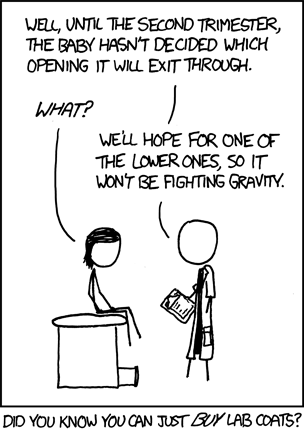
So of course I was doubly amused when the extremely Internet-savvy comic artist Randall Munroe through his comic xkcd expressed the same glee at the availability of lab coats for purchase. It's true that the lab coat is a universal badge of geeky authority, but hey, you can buy laminating badge-making machines on the Internet, too.

The Canadian shipping charges were insane, so I specified that the order be shipped to a receiver in a US border town. They e-mail you when the package has arrived and then charge your $3 to collect it. I know someone who lives near the border on the Canadian side, so arranged a trip to visit her, and then on my way home drove across the border to collect the goods.

At the border the US Customs official closed his booth just before I got to it, in order to go and talk to someone in another booth. I had become distracted reading my passport or something and didn't notice immediately when he returned to wave me forward, so I started off the conversation on a bad note. But this should be routine.

"Where are you going?"

"Just to <border town>."

"Purpose of your visit?"

"Just picking up a package."

'What sort of package?"

"I think it's a lab coat."

"A lab coat?" Suspicion hackles raised on his neck. "What is it for?"

I should have just said, "It's a gift for my friend, who is a scientist." True, and the customs guy didn't have to know he works in a branch of science that doesn't use labcoats. But I'm stunned by his need to know what a lab coat is for, cursed with the need to answer the question that I know he is asking, "To wear," I manage. I mean what else would you do with it? "It keeps stuff off your clothes."

He offered me an out, "For your job?" I could have said yes, but there's a really good chance that the screen of information my passport has pulled up on my identifies me as a pilot, so I continue trying to explain why my friend wants a lab coat.

"Because it's a ... lab coat. It's cool and science-y. Like on TV." Is he contemplating the possibility that he's about to bust up an international methamphetamine ring? Do terrorists wear personalized lab coats while building bombs in cheap hotel rooms?

He looks at the computer screen again to see if I'm a known threat, and I guess I'm not, as he finally waves me on with "Have a nice day."

I pick up the package and open it to get the invoice and to make sure the order is correct. As I cross back into Canada, I prepare to again justify my purchase.

"Where do you live?"

"<Hometown>."

"Purpose of your visit?"

"Picking up a parcel." The wrapping is evident on the passenger seat.

"What did you get?"

"A lab coat. It cost twenty-four bucks."

I brandish the receipt but he doesn't look at it. Lab coats are not suspicious objects in Canada. He was waving me through to Canada and looking at the next driver in line before I'd even finished speaking. I wasn't even asked to go inside to pay duty on my purchase. I guess it isn't worth it for them for three dollars.

So I conclude that there are three types of people with respect to lab coats: those who consider them a useful but mundane piece of apparel, those who consider them to be a cool badge of scientific authority, and those who are suspicious of anyone who would want one.

Looks like this has become the unofficial blog week for exterior markings of authority and worth.

Thursday, January 28, 2010

Cold and Macho

We meet at 6:30 for breakfast according to our strategy. The rental car can be returned at 7:00, and we've left ourselves a few hours leeway for contingencies so we can still get the airplane put away at destination (that's prearranged) and then get to the terminal and through southern airport security in time for our flights.

My boss texts as I'm gathering up my gear in my room. "Is it going to be too cold to fly?" There's a big bubble of arctic air over half the country. It's -32 here, actually a few degrees colder at destination, but as long as it's forecast to be over -35, we're okay. He doesn't want engines started below that. It takes too long for the oil to reach the moving parts at such low temperatures, and just turning over an engine could damage it.

It's always nice to have a "too cold to work" temperature that allows you to stay in bed, but usually the weather conspires to hover just above that temperature, always freezing your fingers but never allowing them to remain tucked in bed. Still, it's nice to know that it's there. I worked for a company once that had a too-hot-to-wear-a-tie uniform rule. I think the number was in the high 20s. Anything above that on the OAT and you could work in an open collar. Today I'm working in compression socks, two more pairs of heavy socks, leggings, long underwear, work pants, t-shirt, long sleeved shirt, sweater, and I think a sweatshirt over that, then my lined coat -- although not my wonderful parka. I thought we'd be going south before now. Plus a wool toque, a scarf, wool gloves and fleece-lined leather work mittens on top of that.

We unload everything on the apron next to the airplane and then I volunteer to load and secure it while he returns the car. We've done so little work this rotation, that I feel as if I have done less than my share. I had hoped to have everything ready to go when my co-worker returned, what with having to wait for paperwork and a cab and all, but I'm still securing gear when he's back already. The car rental place was all ready for the return and gave him a ride to the airport.

We untarp the airplane together. Everything is in good order, because we've been out shovelling and checking on it. There are a few patches of frozen-on ice where the tarps didn't cover properly, so I use some of the deicing fluid. I have a moment of "oh-no" when I realize that there is some old dilute fluid in the sprayer, but fortunately it hasn't frozen, and I manage to pour it out. Must remember to ... what? Rinse and dry? In the past I've kept deicing equipment in a heated hangar so I haven't encountered the problem of a frozen sprayer. Something to remember if I'm ever doing hot water deicing (works when the temperature is and will stay above freezing) and then stowing the sprayer in the plane. Everything takes more time and space to do in the cold. Anything that has to be folded or coiled actually takes up more space, because they won't bend. And the same goes for your hands. In heavy mitts they don't bend the way you are used to and if you take off the mitts and just work in gloves, pretty soon your fingers still won't bend, at least not without any strength.

My coworker is PIC so he straps into the left seat and I remove the cord from the engine block heater just before he starts. Fires up right away. We exchange delighted thumbs up and I pull the cord from the second engine. The cords are too cold to coil properly, so while he does post start checks I end up stuffing a tangled mess of electrical cords in the back of the airplane. I'm afraid I would break the plastic insulation--or even the wires inside--if I forced them to coil lightly to fit where they usually go.

I secure the rear door and then come up to the right seat. The right oil pressure is still indicating low, but the CHTs and oil temperatures are matched between the two engines. We turn on the heater and take off some of our layers of clothing as we wait for the oil to come up. It's moving--the gauge isn't dead--but really really slowly. After half an hour it still isn't registering enough for take-off. I know that as a student pilot you were taught to shut down an engine if it wasn't registering oil pressure in 30 seconds, maybe a minute if it was really cold, so why have we let it run for this long? We are almost certain we know what is going on in there.

The engine is out on the wing, a couple of metres away from me. It was kept warm enough electrically overnight to start and have oil circulating, which is why we see normal cylinder head and oil temperatures. The oil pressure gauge is on the panel in front of me. The oil pressure gauge works in the absolutely simplest way such a thing could work, and that is by having the actual oil pressure force oil through a line to the gauge. Simple is good. But now think about that line. It comes out of the engine, along the leading edge of the wing, into the fuselage and up to the instrument panel. Much of that path is unheated. We suspect that a little bit of moisture has condensed in that line and frozen solid, blocking the line. The oil coming out of the engine is warm, but cools quickly inside the narrow tube, so is not warm enough to melt the ice. If we thought there was any way that the actual oil pressure in our engine was as low as on that gauge, we wouldn't be running the engine.

Still, we're not going to take off with oil pressure in the red. We text the PRM about our predicament. He asks a bunch of questions, suggesting we do things we've already done, and adds one more. I get out and check the oil filter through the cowling vents. My coworker shuts the engine down so I can do this. I verify that the oil filter looks normal: in place, not swollen or leaking or anything. And the engine, bless its greasy soul, restarts perfectly. There wasn't really much risk of it not, as it was so warm and lubricated, but anytime you shut something down you risk not being able to restart it.

After a few more texts (we text because it's too difficult to talk on the phone in a running airplane) are exchanged the PRM concludes "I don't see that you're going to have any problems."

We text back, "We don't either. We just don't want to go without an ok from the PRM."

Understanding dawns. Now he understands we're not texting for help, we're texting to cover our butts. Butts duly covered, we fly. By the time we're in position on the runway the oil pressure is only a needle width below the green anyway, a situation one of my training manuals even accepts.

We launch and turn on course in good weather. There isn't often a lot of weather in temperatures this low. Almost all the moisture is already frozen. There's no energy to form the weather.

This airplane has two heaters, one that mainly keeps the back warm, and which runs off a heat exchanger with the exhaust gases and one that mainly warms the front, and which burns gasoline. We, obviously are in the front, but we're expecting that with the engines blasting at climb power, we'll start feeling more heat, as we won't be losing our front heat to the back of the plane. But we're feeling colder. We adjust a few knobs and hold our hand in various places before we accept the fact that the combustion heater has shut down. It is designed to run on the ground, but because of reduced airflow it is possible for the plenum to overheat and trip the circuit breaker. A reasonable precaution for a device that is literally on fire inside the fuselage. These heaters are affectionately known as "nose bombs." To prevent cold pilots from resetting the circuit breaker when there is a real problem, the circuit breaker is accessible only from the outside of the airplane.

We both know this. "This two hour flight just got a lot longer." Is that because we turned around, landed back at origin and reset the breaker? No. Is that because we landed halfway at a well-attended airport that was literally under our intended flight path and reset the breaker? No. You know from the post title. It was because two hours seems a lot longer when you are sitting still in subfreezing temperatures. We toughed it out to destination with only the rear heater, definitely not enough to keep us comfortable.

We took turns taking control while the other person reached back for and donned the outer jackets and sweaters set aside earlier. We swapped "what's the coldest you've ever been?" tales. And we laughed at ourselves. The two of us have only had one flight together where we were neither too hot nor too cold: that was the flight with the exploding moon. With passengers, obviously we would have stopped. Without airline tickets booked, perhaps we would have stopped. But whenever you stop you risk not being able to go again. You've seen on this blog how easy it is to be grounded by a stupid thing. And we know how much it costs an hour to run this thing. T land and take off again would add time and money to the cost of the trip. We can take a little discomfort in the name of efficiency. We did have cold weather gear and one heater working. (Notice that the working heater was the simple one: "run outside air past hot exhaust and duct heated air to cabin. Simple is good. We also have simple avionics without those LCD computer screens that seize up at minus five, so we don't need to worry about our radio controls freezing. I guess "liquid" crystal displays require a certain temperature to remain so.

A temperature inversion meant it was even colder on the ground than in flight, and to get there we needed to reduce engine power, drastically reducing the output of our one working heater. Brrrr. But we did it. We reached our destination, found the hangar, and got a ride to the terminal from someone who told us, "you look cold." True that.

funny graphs and charts
see more Funny Graphs

Monday, December 07, 2009

New Uniform

I think it needs over-the-knee boots, what about you?

And while I'm throwing out random links, here's one that offers an explanation for the MSP overflight that makes much more sense than alien impersonation. It also shows that the captain takes full responsibility for an error initiated by the FO.

Tuesday, July 21, 2009

Whitehorse is Awesome

I was expecting Whitehorse to be a one horse town. After all, it's not called "Whitehorses." But before we'd completed the cab ride into town we saw that this place was at least a kilohorse town. It has multilane paved roads with signs and traffic signals. We see some chain stores like Home Depot and Costco on the way in and then my co-worker cries, "There's a Starbucks!"

"There are two Starbucks," responds the cab driver, but don't think the corporate interests have taken over the town. It consists mainly of interesting wooden buildings two or three stories high. We later learn that the building code maximizes construction at four stories, so there are no skyscrapers, just medium density along astonishingly well-kept streets.

We checked into the hotel. It's obviously done up for the tourists, with moose and mounties and that sort of kitsch. You can fly direct to Whitehorse from Germany, and Whitehorse has taken pains to be the Canada the Germans expect. The elevator door is made up to look like the entrance to an old- time bank vault. Upstairs some of the corridors are very narrow, so although the hotel is in excellent repair, I think parts of it are actually quite old. We met up with our relief shift and all went out to eat in a building with an antique airline advertisement painted on the side. Menu choices included caribou stew, Musk ox stroganoff and grilled arctic char (a sort of fish). I had the musk ox, as I'd only tasted musk ox in jerky before. It was delicious, and very generous portions, too. The meals came with good salads, focaccia bread, and vegetables, all for $24, a good price for a meal of that quality and quantity anywhere in Canada. We all stuffed ourselves.

We walked around town some more. It's eminently walkable, plus dozens of people were on bikes and there were bike racks everywhere. There were a lot of stores selling things to tourists, but they tended more towards interesting well-crafted items specific to the place and not just plastic tourist junk. There were also a few very nice consignment clothing stores. Not thrift stores. That gave me pause. For stores like that to exist, there have to be women who live here who don't just wear parkas and sweaters in the winter and shorts in the summer. There have to be women here who make enough money to buy nice clothes and there have to be events and business calling for such clothes, and they have to live here long enough that the clothes go out of fashion and are replaced. I guess that was my first clue that people don't just pass through here, they come to stay.

That evening there was a midnight music festival and I went to that. I wasn't terribly impressed with the bands, but I got in free by asking the gate security people nicely, so I shouldn't dis their show. I just wanted to hang out. Wow, Whitehorse is diverse. Most northern towns just have native folk, lots of white men and a few white women. Whitehorse is every bit as diverse as Toronto, but more integrated. Caribbean accents were not what I was expecting at a midnight sun party.

When that wound down, I walked around taking pictures, giggling at myself that it was light enough to take outdoor pictures of historic buildings at 12:30 a.m. One of the rows of buildings I photographed turned out to be a trompe d'oeil mural in an alley. You know your town is clean when the tourists are photographing the dumpsters.

Despite the primping for the tourists, Whitehorse is genuine. It really is the beginning of any wilderness adventure you could want: dogsledding, horseback riding, the Chilkoot trail, river rafting, and mountain climbing all here. And it's not just any old trail or river: you'd be following the gold rush routes. That's why it's here. And ever since the gold rush people have come for one reason and stayed on. I really wished I didn't already have a ticket home. At least it's not until tomorrow afternoon so I have another half day to look around.

Sunday, June 21, 2009

Fancy Footwork

The routine continues. Wake, turn on phone, shower, wash hair, get dressed, check e-mail, check weather, tidy room, do OFP, do customer billing paperwork, fill waterbottle, replenish flight bag snacks, check e-mail again, eat, check e-mail & weather again, meet customer and go to airport.

There are thunderstorms building north of the airport, which is where we want to be, so I go into the PIK booth to check the 19Z weather that came out during the drive to the airport. There's another pilot seated at the terminal.

"Hi," I greet him, and ask, "Where are you going?"

"Whitehorse," he says.

"Ah, I'm going north too, so I'll just follow along."

"Why don't you drive," he suggests. He's unfamiliar with the Nav Canada terminal. Truth be told, while I know the website it reaches intimately, I'm not too fluent in Pilot Information Kiosk use either. The interface uses a touchpad mouse, just like my own laptop, but instead of tapping anywhere on the touchpad to select, there's a specific ENTER circle you have to tap inside. So move the cursor by sliding your finger around on the touchpad, then pick up the finger to tap on the circle. I haven't figured out how to use scroll bars with this interface. Maybe click with my thumb on the enter circle while sliding with my finger on the rest of the touchpad. I just used the arrow keys on the keyboard for scrolling.

I started with the GFA, which goes right up to Whitehorse, showing a big low there, and forecast as low as 1500' agl with generally 6000-8000' agl bases on TCU topped at 22,000'. Not a lot of change in that forecast on the subsequent GFA charts. On the the TAF/METAR page. There are thunderstorms forecast right at this airport, starting in a few hours. The traveller (or I suppose he's a "traveler") decides to wait another day before continuing north. I don't check upper winds and NOTAM because I already looked them up at the hotel. We won't be crossing mountains so I tell my customer that it is safe to go, as long as we plan to return early, so that if there is a storm cell right over the airport, I'm not trying to wait it out with minimum fuel. Also we'll talk to our respective colleagues when they land.

The airplane taxies up, completes the post-mission work with the engines running and then they shut down and the door opens. I can call a no-go decision for safety, but a no go for operational reasons is up to the customer. I repeat that I consider it safe, even though I suspect he's hunting for a pilot-driven excuse not to work today. He cancels the flight.

The other pilot sweet talks the guys into sharing one truck back to the hotel and lending us one of theirs so we can go sightseeing. There's a trapper's store seven miles (I use miles because addresses up here are based on the old mileposts from when the Americans built the Alaska Highway) south. As soon as you walk in you smell smoke-cured leather. There are full pelts for sale from all the local species, crafts made out of silly things like shellacked moose-droppings, silverwork, outdoor supplies, old-fashioned leg-hold traps (as rustic decorations: hunters use more humane traps now), and some just for display items like a pair of beaded leather mukluks. There were some amazing elbow-length gauntlets with thick leather palms and various sort of fur on the back. I was in awe of them mainly because I know it gets cold enough to need them, and that the craftspeople who made most of these things are descended from people who lived up here before there were any warm hotels to go back to. I end up buying a pair of moose leather moccasins beaded with a bear claw pattern and trimmed in beaver fur. They cost about the same as a pair of boots or of fancy party shoes, but they are a lot prettier than the former and a lot sturdier and warmer than the latter. How will anyone know I go to exotic places if I don't bring home some souvenirs?

Thursday, June 04, 2009

Random Suitcases

My co-worker took the early shift this morning, so I slept in until eight. I would normally do a workout, but I haven't got any workout clothes with me and I don't want to get what I have all sweaty. WestJet says my bag is in Grande Prairie now and they promise to send it here on the 12:45 p.m. bus, to arrive about three hours later.

My co-worker calls. She's not flying, right now, but she has heard from our boss who says he wasn't able to get a hold of me. WestJet phoned him about my bag. That must be because I gave the WestJet agent my business card with my cellphone number circled. I guess someone decided to call my head office instead of me. The boss couldn't reach me because he was using a phonelist on which he hadn't updated my cell number since the last time I was up here, and had to get a new cell phone so that people could reach me. A communications difficulty because I was proactive about solving an earlier communications difficulty.

"It's okay," I tell my coworker, "I talked to them already. They're shipping it by bus--"

"Wait!" she interrupts, "We're supposed to take the airplane to Grande Prairie tonight for scheduled maintenance. You can pick it up yourself."

I'd love to go get my bag, if it isn't already on the bus, but the customer won't want the airplane yanked out from underneath them yet. We told them we had an extension. The customer is sufficiently not pleased that phone calls go back and forth until it is decided that the airplane will be released some time in the next few days, at the customer's convenience. The mechanic can wait there until the airplane arrives. The customer is delighted. Crisis averted.

Then another call, from the mechanic who is en route. His flight was delayed and he's missed his connection in Calgary. He's not impressed to learn that he may be cooling his heels for a while. Happy customer, pissed off mechanic. There's a law of conservation of pissed-offness somewhere, I'm sure.

After all that phoning, I realize that it's after 4 p.m. I call Greyhound to see whether I pick up the suitcase or they deliver. "Twelve forty-five?" says the agent, "There's no 12:45 bus to here from Grande Prairie."

WestJet sent my stuff on a 12:45 bus. Where, I wonder, did they send it? I'm beginning to suspect that WestJet has a shelf somewhere with "random eggs" on it. Does anyone else remember the random eggs? WestJet baggage opens again in Grande Prairie between nine and ten pm so I'll find out then.

The bus from Grande Prairie will arrive tonight, but the baggage office is closed then, so if it is on that bus, I can't get it until 6:30 tomorrow morning.

"Aviatrix," I tell myself, "These readers are tuning in to find out about your job, not your company communications and lost luggage." But dealing with company communications and lost luggage is my job. Anyone who thinks it's all about soaring majestically above the peaks and lakes needs a strong dose of reality.

But okay, you want flying, here's flying. The customer wants a flight at eight p.m. tonight. The good news is that this far north it probably won't even be dark by the time I land at two in the morning. The bad news being that I'll be flying an airplane until two in the morning. Night will come and go while I'm in the air. And then WestJet, Greyhound and the hotel will all try to wake me up while I'm trying to sleep the next day.