Saturday, May 25, 2013

Cub Dreams

The following was written by a non-pilot, a man I have known since before I started this blog. He has always wanted to fly, but hasn't had the opportunity. He attended Oshkosh last year and when he sent me this, I asked for his permission to share it.

I bought tickets for the sweepstakes giveaway airplane of the year, a 1940 Piper Cub. I've learned enough about it to enjoy it even if I don't win it, though I have a strange sense that its already been determined that I will. This is based on an odd number significance. When I was a kid, for no reason, I got the sense that the number 22 was going to be significant for me. It was going to change my life. Not a bunch of times. Just once. I should watch for it. Not that I should choose it. I should just observe it.

Tickets were $1 each. There were various bundled amounts. $20 bought 27 tickets. Pages of tickets had 30 tickets per page. While tearing off the three tickets from the page that I hadn't purchased, the ticket seller said, "for $2, I'll sell you these three." So, I bought the rest of the page, suckered in for another $2. It was maybe half an hour or more later that I realized that I'd paid $22. At that point, I got the even weirder feeling that the 29th ticket was the winner. Not that I'd be able to tell, even if I won.

So, I visited this Cub every day. One day, another fellow was there and started talking to me. He said he had "the disease". He had already bought, restored and sold several cubs. He knew them inside out. He clued me in on some details I could not have otherwise recognized, and with this recognition, I can now differentiate this Cub from the 5,500 other Cubs still registered to fly. This one has a wooden prop with metal leading edge. The engine cowling has two little dents in it that looks like some tourist poked it with fingertips a little too hard. The air filter is a rectangular box with a forward/downward slant to the front face below the engine. Sticking out of the bottom of this box is a fat tube roughly 6" long and 1" in diameter with a sharply angled cutoff, leaving a hole facing down/back. This is the bypass for the carburetor heat and cabin heat. Butterfly valves divert this air flow to the carburetor or cabin, or not. Inside the cowling, you can see the two hoses (they look like vacuum cleaner hoses) going off to the sides toward these components).

The cylinder heads stick out of the cowling with a black sheet metal cover that wraps over the top, then down over the cylinder heads, perhaps to channel air flow or to shield from rainfall. The exhaust manifold goes down from the heads, then back and inward through holes in the cowling at the seam between the top cowling and the bottom cowling. In the bottom cowling, toward the pilot's right, behind the air intake is the exhaust. It seems to actually have a muffler, or at least a spark arrester. Behind the exhaust, poking through the same hole in the cowling is a much thinner pipe about 4" long that is apparently the oil sump vent. The expert told me that if this was his airplane, he'd cut that off shorter, then run a small hose from it down to the landing gear struts so that the oil mist would not dirty up the fuselage. He warned that this would happen with the current arrangement. I've seen several other Cubs. This is the only one I've seen with that particular size, angle and placement of the bypass tube and the sump tube.

The expert didn't like the leather covers over the bungee cords that make up the suspension springs. Too bulky, they'd add too much wind resistance. In his opinion. Flying 70mph, I'm not sure it really would make that much difference. They had snow skis mounted on the landing gear instead of wheel pants. Apparently, when delivered, the Cub will have both, though both can't be mounted at the same time, and the skis are offered by a sponsor, so, of course, that's what's mounted on the airplane while on display. Also, likely, kids would stand and jump on the wheel pants denting them up, so it's probably good that they don't have them on while on display.

Most Cubs don't have the foot pegs (more of a triangle, really) mounted on the leading edge of the landing gear struts. The one on the pilot's left is to help reach the one wing tank in the left wing. Since the Cub has a sunlight, the valve for the wing tank and the clear tube used as a fuel gauge are both in that inner face of the left wing, next to the magneto switch. The wing tank's air vent in the filler cap is bent 90 degrees to face toward the leading edge of the aircraft. The header tank's filler cap has the fuel gauge wire sticking up out of it. The header tank is painted black in this one, though it has been bare metal in most Cubs I've looked at, though one Cub had no header tank at all and instead had two wing tanks so the instrument panel could include deeper instruments. This one has the basic instruments installed, from left to right, the tachometer (which turns counterclockwise as it revs up), air speed (in mph), the magnetic compass (with the compass card just below it and the N-number above it), and the oil pressure and temperature gauges. It doesn't have a turn and bank indicator. Yet.

In the right corner of the dashboard is the primer. There's a smaller, black, unlabeled handle of similar shape in the left corner, which I guess must be the cabin heat. Low, on the right, in front of the door is the carburetor heat control. On the left, in a corresponding low, forward position is the header tank fuel valve. A little higher and farther back is the car-window-crank handle for the elevator trim with the rivet that moves in the slot above the handle as the position indicator. At shoulder height, each seat has a throttle handle, and each seat has a stick, rudders, and heel brakes. Different Cubs seem to have the heel brakes placed a little differently. These are somewhat inboard and closer to the seat than the rudder pedals. I think it would be challenging to both brake and work the rudders at the same time, though as I understand it, this would be pretty rare, anyway. The brakes are mostly for turning on one wheel during taxiing or for holding the position when one person is in the plane and the other is out hand propping. I think I'd prefer hand propping from behind the prop, anyway. This is common on Cubs and it just seems nicer that if the aircraft surges, it would dump me into the door toward the throttle, instead of chewing me up in the prop.

I took a workshop on hand propping. I was surprised at how little the compression resisted turning the prop. Of course, they did have a dead engine, since this was a workshop for which they had not purchased extensive insurance. This Cub has brackets on it behind the connection points for the landing gear struts, apparently for attaching something to the bottom edges of the fuselage. I have not seen another Cub with this feature and I have no idea what it's for. The leather upholstery and wood paneling floor and rear deck cover to the storage compartment are all nicely done. It's painted in the classic Cub yellow with the black lightning bolt stripe and the teddy bear Cub logo on the vertical stabilizer. It has the steerable rear wheel (not that it's very effective) spring-loaded to follow the rudder, with the click-release in case something gets hung or knocked.

I kinda know the plane now. Learning it has been fun. And though they didn't let me fly it, I did stumble on a tent with a couple of flight simulators (the machine, not just the software), and one of them was painted Cub yellow with the black lightning-bolt stripe. They even put a prop in the front of it and require you to spin the prop in order to start the engine.

Another older guy was flying it when I walked up. He was coming down to the airport rolling almost 45 degrees in each directly, alternating, fluttering his way to the ground. Once landed, he staggered out of the simulator and left it on the airport with the engine running. After asking permission, I climbed into the pilot's seat (no, they didn't have two of them, so I couldn't climb into the back one) and noted that there were no brakes and no carburetor heat. The header fuel gauge showed plenty of fuel, so I noted the compass direction and watched out the side window (since the front window showed only sky) to stay straight with the runway while smoothly, but quickly pushing to full throttle. A couple seconds later, the tail raised up and I could see in front of me. Minding the rudder to stay straight with the landing strip, I quickly pulled up to about 15' off the ground and held it there while I picked up speed. Once I passed 70, I pulled back on the stick and picked my pitch to keep the speed at 60-70mph. Keeping to less than three minutes at full throttle, I pulled back to what I guessed was 3/4 throttle. I don't know what the ideal cruising RPM should be. That's something I will learn when I win the Cub.

I leveled off, turned left and watched for the airport. Once it was beside and parallel to me, I pulled the throttle back to idle and started the downwind leg. I was a little low, so I had to bump the throttle a couple times through the pattern to stretch it out, but the turn to base and final were uneventful, and I landed straight, if a little to the right of the middle stripe on the landing strip. No noticeable cross-wind. Since I couldn't see the wheels, I couldn't judge height well enough to try a three point landing, but I kept flying the airplane until it stopped.

So, I soloed in a Cub. Sort of.

Someone else won the cub that year. I think the Winner should swing by Virginia and give my friend a ride, though.

Tuesday, May 21, 2013

Death Before Dishonour

Years ago, a chief pilot I was fond of told me during a flight that he was leaving for another company. I congratulated him (we were both working for the kind of company that even being fired from was probably grounds for congratulations) and then I reflected silently for a while, knowing I would miss him. I asked him who would be chief pilot after he left, because there wasn't a great depth of talent. He named the individual and I asked, a little puzzled, "Does he want to be chief pilot?" My soon-to-be ex-chief pilot laughed and said, "He's not as smart as you, Aviatrix." I'd always thought I was regarded as a bumbling idiot at that company, so that was a bit of a surprise.

Being chief pilot is a lot of work, and also responsibility. It probably sounds strange that a bit of legally weighted paperwork would deter someone charged with the responsibility of being the final word on whether an aircraft and prevailing conditions are safe for flight, and of operating that airplane, including making all inflight decisions down to a safe landing. If a pilot does not live up to the responsibility given to her as pilot-in-command she might not live, potentially killing herself or others. If she fails to fulfill the responsibilities of the position of chief pilot she could be fined, possibly even imprisoned. Not killed or maimed. But somehow that's a more daunting responsibility.

I want to fly airplanes, not ride herd on pilots to see if they've done their recurrent exams. I've turned down a job interview on the Groucho Marxist premise that I didn't want to work for a company that would hire me as chief pilot. You could say I've spent my career avoiding that duty. So you know what's about to happen.

I currently contract my services as a pilot. For all intents and purposes I'm an employee, but I hide behind the premise that I'm "just a contractor." Like the guy who thinks he isn't in as deep because they're only living together, not married. And then she gets pregnant. Or in my case the person holding the office of chief pilot gets out of currency and the operations manager designates me as "acting chief pilot." I look around for where to hide, but I'm the only other person in the operation qualified to hold the position of chief pilot, so there's no one I can tag. I want to fly airplanes, and the company isn't allowed to have airplanes flying without a chief pilot. I've been outmaneuvred. The "acting" part of the title goes away and now I'm it.

Sigh. If I mess up and go to jail, someone will bail me out. Or do something to get me free, right?

Saturday, May 18, 2013

Screw Bronze

Commenter Pete Templin broke the news here first: the remarkable author, athlete and rights advocate Dr. Elizabeth McClung passed away at the end of April, after spending years defying doctors' prognoses and anyone's expectations of what or who she was or could do. I met her some years ago through her blog Screw Bronze, stumbling upon an entry after a Google search and finding her to be such an interesting person that I went back to the very beginning of the blog and read it chronologically, over a number of days. As I witnessed her health worsen I compared the dates of the blog entries to the date I was reading them and feared the blog would end abruptly before the current date. It didn't. The writer was still alive, and still her despite what her condition was taking from her.

We talked in e-mail, and I sent her a number of postcards, but none as spectacular as the postcards she sent me. She had a talent for figuring out what would suit people, and make them happy, and she sent postcards to people all around the world, little rays of sunshine to people who wanted them. I felt a little guilty that she was sending me such artfully constructed postcards, and well I tried, but not hard enough. Ten minutes for her was such a great percentage of her productive time in a week that it was the equivalent to my spending hours on something. I started to hold back a bit, because she wouldn't acquiesce to my please to just enjoy what I sent and not reciprocate. That wasn't who she was. The title Screw Bronze is a reference to the frequency with which Canadian athletes achieve third place results in the Olympics. Being in the top three in the world is great, but Elizabeth fought for the gold every time, for herself and on behalf of others, and berated those who didn't to shape up. No excuses. I copied a quote someone posted in memoriam, but now I can't find the attribution. She was "a really amazing woman who went through the fires of hell and described them in detail, and still found joy in life."

We didn't always agree on things. We once got into an e-mail argument that had a serious physical effect on her, and her wife Linda had to intervene to protect her. I know Elizabeth didn't want to be treated like a delicate flower. She certainly wasn't one. She was strong beyond belief. She loved animé and manga and Japanese fandom. I'm not very conversant with these genres, so I'm probably using the wrong terminology. She also liked some aspects of Victorian gothic, but not, to my knowledge, the white make up. A composite image Elizabeth has her wearing a corset, skull earrings and Hello Kitty socks while feeding squirrels from her wheelchair, amid old tombstones adorned with spires and stone angels.

I only met her in person once. I found her as passionate about her ideas and as well informed on the topics she addresses in real life as she is on her blog. She had a seizure while I was visiting, but shrugged it off, "This is normal," I think she said afterwards. Maybe even "boring." If you read on her blog about what other medical issues she had, I suppose a seizure is boring in comparison. She had some memory issues, but also had remarkable coping strategies.

She never wanted a funeral, but on May 19th, what would have been Elizabeth's 43rd birthday, those who wish to remember her are invited to celebrate by sporting a corset and/or a skull (temporary) tattoo and telling people why.

There's a postcard from her on my desk. Amongst the colourful stamps on the back, it asks, "I'm still alive. Are you?" Yes, yes, I am Beth, and more so for having met you. Pledge to be alive your whole life, people. If you have the power to conceive of and express an excuse, you have what it takes to do something positive instead.

Thursday, May 09, 2013

Ramblings Including Oxygen

This is a story about helping to train a pilot who was hired to take my job after I leave. I want to keep this job now, but then I want every aviation job. I cried handing in my resignation from a flight instruction job to work at an airline, and I once worked three different flying jobs at once because I loved them all. Crazy girl. My resume is kind of hard to follow, and my tendency to take temporary jobs probably makes it look worse. But look! I get to fly an airplane!

The new pilot isn't on line yet. He doesn't have previous time on the aircraft type, so the insurance company has said he can't fly it until he has logged ten hours. (I happened to have flown the type before, logging time in exchange for using my navigational skills to keep the owner from getting lost. Aviation sluttery has its merits. And wow, modern GPS units have totally devalued my once-marketable excellent navigational skills.) So he is on this road trip to fly the plane and learn the ropes while I serve as the insured pilot in command. He flew the repositioning flight out here from base and handled the airplane well, but doing the part of the job that isn't getting from A to B is going to be more challenging. We've settled the FBO bill for ramp fees and fuel, walked around the airplane, and packed everything into the cargo area. I have pared down my road trip packing list (no computer!) in preparation for this, but at the last minute the boss decides we will leave him behind because we're doing high altitude work, and it may be difficult to get an oxygen refill on this holiday weekend. We literally put him on a bus.

One of the things I like about aviation is something some people might hate: nothing can be taken for granted. The airplane won't give me a pass because I flew it really well yesterday, or because it knows I know how to handle an engine failure better than that, or because it likes the look of my ass. I have to fly it correctly right now for all values of now. And the things that non pilots take for granted during their workday: access to water, restroom facilities, food, oxygen, heat, not having a mountain come through your office window... they all have to be planned.

This airplane is non-pressurized, so we have to bring and mete out compressed oxygen for all flight above 10,000'. (US rules are different, but it's 10,000' here). Technically we can be between 10,000' and 13,000' for 30 minutes without oxygen, but company policy is just to use the oxygen, because it's harder to plan exactly how long we'll be up there than it would be if we were an A to B type operation. Curiously, Canadian air law dictates that High Altitude Training is required for flight crew operating aircraft above 13,000 feet ASL before the first assignment on a pressurized aircraft and every three years thereafter. As far as I can see, this is a huge loophole through which I can fly my unpressurized aircraft at flight level 220. I assume that the framers of that law didn't consider that there are crews out here operating unpressurized aircraft in the flight levels, and not that they really thought only crew of pressurized aircraft need altitude-specific training.

Fortunately my company doesn't stop at minimum training. I was assigned to present a seminar covering the required material. Here's a little table I should know better giving time of useful consciousness at various altitudes without supplemental oxygen./p>

FL 150 30 min or more
FL 180 20 to 30 min
FL 220 5-10 min
FL 250 3 to 6 min
FL 300 1 to 3 mins

These are pretty variable between individuals. The body has an ability to acclimatize, but acclimatization takes weeks and is lost soon after descending so it doesn't really apply to flight. For example, Mt. Everest is pretty close to 30,000' tall--i.e. almost reaches FL300--but humans have climbed it without oxygen. One of my own co-workers spent a week at Everest base camp and didn't become an idiot after 20-30 minutes. I have no idea where I fall. I'm pretty fit, but does tolerance to a low partial pressure of oxygen relate to long distance running and cycling ability? We often work in the 5-10 minute zone of that chart, which is kind of a sweet spot, because I can descend from there to a level where I can breathe indefinitely in five to ten minutes, depending on how viciously I'm willing to cool the engines.

Today, after I called out in (normal) descent, "through ten thousand, oxygen off," my co-worker said, "Taking off oxygen is like taking off ski boots." Oxygen is essential, but nice to get the mask or cannula off after a while.

Oh and before you ask where I am going or about my new job: there isn't one. New guy couldn't handle the lifestyle so I came back to work again. I love the lifestyle. Five fifteen a.m. start tomorrow, so bed now.

Wednesday, May 01, 2013

Bad Vibrations?

Summer pre-dawn departure. I do the preflight inspection in a lighter hangar, then tow the airplane out onto the ramp. The sky is black, with slightly lighter grey patches where a few stratus clouds reflect city lights back towards me. The fuel truck arrives, its headlights sweeping through the dark patches between the well-lit areas of the ramp. They can't exactly put light standards in the middle of an airport ramp. I take a full load of fuel then check the tanks with a flashlight before calling ready to board. No passengers, just crew. We confirm we've completed all the pre-mission items and then go to prestart checks. Master on, nav lights on, cockpit lights on, put the flashlight down. I prime the engine, clear left, turning number one... Start goes smoothly and I record the time on the operational flight plan then start flicking the switches that distribute electrical power to where it needs to be.

Taxiing in the dark is harder than during the day. There are lights along the edges of the taxiway, but spaced out, and it's difficult to see whether a gap between two lights leads onto the next taxiway, or onto the grass. Once I have my taxi clearance I follow the yellow centre line carefully, especially through the corners and at intersections, up to the hold short line. Cleared for take-off I put in the power and watch the runway lights stream towards me until rotation speed when they drop out of sight. Everything drops out of sight. All I can see is the instrument panel and blackness out the front windshield. A night departure is a bit like a departure into IMC. My eyes drop to the gauges and I see the airplane accelerate to blue line, the single engine best rate of climb speed that I must maintain in the event of an engine failure. That's when I raise the gear, tapping the brakes first so I don't put spinning wheels in the wings, then I accelerate to my two engine best rate of climb and turn on course as I was cleared to. As I level off at en route altitude for our eastbound flight, the horizon ahead of me glows in a faint line, illuminated by the not-yet-rising sun. I take pictures, but looking at them later all I see is black. The eye sees what the cheap camera through windscreen cannot.

The second member of the crew is not a pilot. He has no duties on this repositioning flight. When I glance back I see that he has wrapped himself in one of our survival supplies sleeping bags and fallen asleep. I switch the intercom to isolate so the radio calls won't disturb him. When passengers fall asleep I have the same fuzzy trusted feeling as when a kitten sleeps in my lap. In Fate is the Hunter Ernest Gann describes looking back into the cabin during a tense time on the flight deck and seeing a mother nursing a baby. Trust. It makes me proud, but I feel its weight, too.

The sun climbs higher and my coworker wakes up. He hollers, or throws something out the snack bag at me, I don't remember which, to get me to turn the intercom back on. He has seen something outside that disturbs him. There are little sticks, each not much longer than my longest finger attached along the trailing edge of the wings and horizontal stabilizer, part of the design of the aircraft. He has noticed that one of them is vibrating wildly. They are static wicks, designed to safely discharge any static electrical charge that builds up on the aircraft, preventing it from discharging from a more essential part of the airplane and possibly damaging it. The wiggling one did not appear loose on preflight, but everything falls off eventually, I suppose. I reassure him that even if that wick departs the aircraft, it will not affect the flight nor the continued airworthiness of the vessel.

On landing we inspect it. There is no problem at all with either the wick or its attachment point. On this aircraft the static wicks are coated wire, kind of like pipe-cleaners, but not fuzzy. It's a good design because it means they don't poke me in the head when I'm inspecting the control surfaces, and they don't snap off like the plastic ones when someone accidentally brushes against them. They just bend out of the way. and that's what this one has done. It was bent in such a way that air flow over it made it vibrate. We straighten it out and all is good. Maybe it will decrease our drag. This particular crewmember likes things to be straight. I flew with him for months before I realized he was taking time to ensure that propellers were aligned symmetrically after shutdown, before we left the apron after flight. This attention to detail is part of what makes him good at his job.

Wednesday, April 24, 2013

Made in China

Li Jingchun, a farmer in China has built what amounts to an art installation or perhaps a plaything, a tribute to his love of airplanes. It's something that he's clearly been inspired to create. It's fun to look at and he has every right to be proud of it, but the media coverage is strange.

Not strange that it's covered at all. I'm assuming the story originated in the PRC, a local man does cool thing story. The same photos and pretty much the same story have appeared in other countries' press. There's nothing wrong with the news featuring a person pursuing an unusual hobby, it's just that the media seems to be unquestioningly accepting that the man built an airplane. An airplane is an aircraft that generates lift by airflow over surfaces that remain fixed while in flight. Look at the picture. Is the media humouring him, or do they really think an engine would solve the issues with this "aircraft"?

It's made of recycled iron plates. There is no camber to the wings or stabilizer. There are no control surfaces or provisions to attach any. The wing surface area is tiny. The propeller is clearly ornamental. Am I just being a spoilsport? I would love to play in Li Jingchun's creation with him. I think it's marvellous. But why does this bother me? There are two reasons.

One is scientific literacy. I'm scared that the people who wrote edited and approved these stories for publication can't tell that's a creative, fun structure inspired by airplane form, and not an airplane. I'm scared that readers depending on media for information will take it at face value that the structure in question is an airplane, thereby discounting the skill and calculation that goes into actually designing and constructing airplanes. Lack of respect for knowledge, skill and engineering leads to lack of willingness to fund education, research and safety.

And the other is that there are people who really do design and build airplanes in their back yards, a project as different from Li Jingchun's as writing a story in Chinese is from creating faux-Chinese writing wallpaper. Many homebuilt aircraft builders don't have access to the education and research that I just whined about in the previous paragraph, but function is inspiring form.

It's not clear whether Ding Shilu's project actually flies, but it appears he designed it himself with some knowledge of aerodynamics. Here's an EAA critique of the might-be airplane.

I don't have this guy's name, or a picture of anything other than his crotch, and his creation isn't an airplane either. It's a freaking gyrocopter. If you think the footage bluescreeened, there's more here, along with someone else in a homebuilt helicopter.

Yang Weiming built his from a kit, and the test flight was reportedly his first solo. Here's video of the flight. While the Gizmodo article suggests that the gyrocopter pilot avoided showing his face because he was doing something frowned on by authorities, the Chinese article implies that the government is quite proud of this activity and puts no restrictions at all on experimental aircraft.

Saturday, April 20, 2013

When Omni Was Futuristic

I'm VFR inbound to a controlled airport on a day with a high thin overcast. Beautiful day for flying: no glare, little turbulence, old snow still sparkling on the ground below, but the runways and taxiways perfectly clear. The controller tells me to call ten miles out and asks another aircraft to report "over the OMNI."

How retro. The OMNI? I think the term might be more common in the US than Canada, but it's still pretty old fashioned. Omni means all. A moment here for the non-pilots, because I think I've left them behind in a cloud of terminology a few times recently, and because I still remember the thrill of excitement I felt on first learning how the thing I'm about to explain works. It was like a grade nine physics class come to life and become useful. There's a thing in aviation called Very High Frequency Omnidirectional (Radio) Ranging. Very High Frequency is always and already abbreviated VHF, which is already a type of radio, hence the thing itself is called a VOR. ("Vee-Oh-Arr").

A VOR is two things, one that's on the ground and sends signals and one that's in your plane and receives, interprets and displays the meaning of the signals. The one the air traffic controller referred to was obviously the ground-based one. It sends a VHF radio signal on a published frequency. You know that a radio waves are depicted as squiggles, sine waves oscillating from start to finish, a little repeated radio shape at frequency times per second. That's what frequency means. Now this is the cool part. The same frequency signal is sent out twice. Once starting at the same point all the way around and the second time starting at the same point at north, but offset by one three-hundred sixtieth of the cycle for each degree of the compass away from north the signal is sent.

Now the percentage of you that know how VORs work are either bored or laughing at my obsession with these. It's probably the fifth time I've explained this now aged technology on my blog. And those of you who let your eyes glaze over at anything math or physics related are waiting for this paragraph to be over. But if there's one reader who didn't know this simple, brilliant navigation solution and is now about to grasp it, it's worth boring everyone else. Because the VOR receiver in the airplane measures the difference in phase (how many three-hundred-sixtieths, i.e. degrees, different the two signals are) and displays it as a needle swing. (Nowadays it can be displayed digitally, too, but that's not the super cool part). Do you see it? The difference between the two signals is the bearing from the ground station to the receiver.

I'm sorry if that was never the coolest thing you'd ever heard. I promise to find a more modern piece of technology to rave about soon. But nothing is as elegant anymore, now that everything new has a computer in it. Computers are amazing, but they don't have the simple brilliant simplicity of an airspeed indicator.

Hey look, this flight sim site agrees with me. "The VHF Omnidirectional Range navigation system, VOR, was probably the most significant aviation invention other than the jet engine." True! Jet engines are so amazing that they sound almost as impossible as this perpetual motion air car, but jets are real.

Wednesday, April 17, 2013

Asteroid Warning Light

Just as there are certain streets I shouldn't walk down, there are certain parts of the Internet to which I should know better than to go, but sometimes I take a wrong turn. As Randall Munroe lamented, "Someone is wrong on the Internet."


I wasn't brave enough to seek out the site the question appeared on to look at the answers given to this individual, and I know it's not fair to call them out. I have no idea how old they are nor what opportunity they have had to learn information seeking and critical thinking strategies. At least they asked.

When I taught meteorology in ground school, I used to go around the room and have everyone name a place water was found in the environment. They were usually enough people trying to be clever that the resulting list included ponds, lakes, rivers, oceans, people, animals, martinis, glaciers, the air itself, clouds, fog and so on. We'd go through the list and discuss the phase of water present in each case. Almost everyone started the class thinking that clouds were composed of water vapour. A lot of them knew that water vapour was an invisible gas in the air around them, but for some reason they rarely saw this at odds with their ability to see clouds.

While there are "clouds of gas," unqualified "clouds" are made of water, in the form of liquid droplets and/or ice crystals. The higher the altitude, the colder the air and the greater the proportion of ice to water in the cloud. The droplets may circulate upward and downward within a cloud, meaning that liquid water may freeze and ice may melt, but more dangerously, liquid water may be cooled below zero celsius yet not immediately freeze. This is dangerous because supercooled liquids tend to freeze on contact with a surface, such as an airplane flying through them. There's a readout on my dashboard giving the outside air temperature, and when that temperature is between about +4 and -15C, an amber light turns on, warning me that I'm in the icing zone. Any visible liquid moisture (clouds, fog, rain) at that altitude could be supercooled, and turn to ice on my airplane.

I don't have an asteroid warning light. Maybe on the Starship Enterprise.

Sunday, April 14, 2013

Dressing Up for Leftovers

Visit NBCNews.com for breaking news, world news, and news about the economy

An earlier version of this said the carrier was Alligiant. My brain must have riffed off "alleged." Good grief I'm a terrible blogger.

Anyway, these guys received vouchers good for free or very cheap first class airline travel from a family friend. They turned up dressed like paying passengers. Their attire was within the bounds of public decency and they wouldn't get a second glance boarding with regular tickets.

The problem is that they weren't flying on regular tickets. They were flying on buddy passes. The airline wasn't going to make any money off of them. Non-rev buddy travel is the airline equivalent of a restaurant employee being allowed to serve left over food to friends at the end of the night. Once all the paying customers are served, the buddies can have some, as long as they behave excruciatingly well, look so respectable that paying customers never guess they are freeloaders, and understand that they will eat what they are served and that there might not be any left for them.

Restaurant food isn't as perishable as airline seats--an empty airline seat becomes unusable by anyone the moment the door is closed--so if restaurants allow their employees to feed their friends, that's probably only in the form of allowing them to take leftovers home. Restaurant employees would probably get in trouble if their friends came in dressed casually to see if there was any free food available.

"But," you might say, "this is different. The airline has a program set up that allow employees' friends to come and get those free seats. They don't have to wait in the alley out of sight of paying customers until after closing." Well they kind of do. They have to wait in the boarding lounge until just before the flight is closed, and they are in no way guaranteed a seat, even if there are empty ones. And they have to be invisible, or at least completely inoffensive, to paying customers.

I'm going to take the men at their word that they had no idea that there was a dress code for first class travel as a non-revenue passenger. I suspect they received the pass from a family member who got it from the friend, and not directly through a friend, because an airline employee with any sense at all will, "put the fear of God into my BP riders," letting them know "I would CUT you," as comments on my Facebook feed put it. If a non-rev behaves inappropriately, the employee loses non-rev travel privileges. The rules were probably printed on the back of the pass, but I can't really fault the guys for not reading the fine print on the ticket.

Every airline has its own non-rev rules. This site lists them for many airlines. I found US Airways here. Including:

An agent will call you to the podium give you a boarding pass if a seat is available on the flight. Please do not hover at the counter asking to be boarded. If the agent asks you to check your carry- on luggage, please comply immediately. If your flight is sold out and you are not boarded, please wait until the agent is free before asking for assistance. The agent will either help you or direct you to another source for information.

During Travel

Please maintain a polite, appropriate demeanor during guest pass travel and refrain from discussing guest pass travel privileges or the fact that you are flying at a reduced fare.

Dress Guidelines

Guest pass travelers in Coach or First Class/Envoy may wear casual attire. US Airways asks its employees and their pass ride rs to exercise good judgment when selecting their travel attire. Clothes should be in good repair, neat, clean, and conservative. Unacceptable attire in any class includes any clothing that is torn, faded, soiled, wrinkled, cut−off, has ragged edges or holes; clothing with offensive graphics or terminology; and provocative or revealing clothing such as micro/miniskirts, bare midriff, halter, tank, tube or bra tops.

Coach Class: Eligible Pass Riders may wear casual attire, including shorts, blue jeans, sandals, and athletic footwear.

First or Envoy Class: Pass travelers may wear casual attire, including blue or black denim attire, skirts, capri-style pants, and sandals, provided it is well−groomed, neat, clean, and conservative. Unacceptable attire in First Class/Envoy includes tee shirts, shorts, jogging suits, athletic gear, baseball−style caps, athletic shoes, beach footwear, flip−flops including Croc−style footwear.

So jeans are okay, but not t-shirts or baseball caps. They were fine in the regular cabin, but didn't meet the requirements for non-rev travel in first class.

The document at this link describes AA's non-rev dress code for first class, including no denim clothing of any kind or colour, no athletic shoes and no skorts. (Skorts is not a typo. Who knew that the scourge of hybrid shorts-skirts was so great they had to be banned?) Notice that t-shirts are grounds for denied boarding to non-revs in any class on that airline. The price of your free ticket is complying with mid-twentieth century dress codes and being well behaved. Here's an e-how on the subject.

The pair probably wouldn't have upset anyone in first class with their casual attire, but on the off chance that a paying passenger is going to be put off by the presence of an under-dressed seatmate, the under-dressed person darn well better have paid a regular fare. There actually IS a cost of putting someone in an empty seat in first class: the person who paid to sit in the next seat is slightly less satisfied, and first class customers either pay a lot of money for their seats, or fly a lot and earn the miles to pay for the upgrade. Either way, you don't want that person to believe that another airline will give them a better chance at a row to themselves.

It's still possible that the US Airways non-rev dress codes are usually waived, and that gate agent who sent the men away to change was selectively applying the dress code because of personal racial prejudice. I imagine that is what the men's lawyer will have to argue to make the case, although the suit claims that they purchased the tickets. Technically they did, as the buddy passes gave a reduced rate, not completely free travel.

Increased airline loads make it hard enough to use a non-rev pass these days that many employees prefer to buy tickets. That combined with the terrible publicity airlines get from incidents like this might lead to the elimination of the privilege. Too bad.

Thursday, April 04, 2013

It Would Probably Work As an Air Filter, Too

I'm blogging about trying out a product, because it makes me feel important when people send me things for my opinion, and every once and a while this is fun to do. No one pays me to blog about any of the things they send me, nor threatens to take them away if I say mean things about their product. I'm not telling you what today's product is right off, because it has a kind of embarrassing name, and I have to work my way up to it. Nor am I telling you what it is right off, because I'm not really sure if it has an exact product category. "Clothing Accessory" would be appropriate. But it's not socks. I love socks. But I don't suppose anyone ever needs those tested. I'll test the heck out of any socks anyone needs testing.

I didn't immediately like today's product that much, but someone sent it to me to try and I was going to put it through its paces. I wanted to be fair and open-minded. The one they sent me is straw-coloured, a yellowy beige with a black design on it reminiscent of deciduous trees in winter or maybe neurons ... they come in a lot of colours and patterns, so the colour scheme of mine is not that important. I took it out of the package and stretched it around, finding it to be a short fabric tube, unfinished, no hem or edge or seam or anything, but it doesn't need one, as that would just add bulk, and it doesn't unravel. The diameter is sufficient to fit around my head stretched, or unstretched it sits loosely around my neck. When I felt it against my skin I wrote, "feels similar to poly-cotton." That was before I read the washing instructions. I'd assumed it was some kind of space age fabric, but actually it is a polyester cotton blend. Score one for the calibration level of my face. So one can put it in the washing machine, and then put it in the drier too, or just hang it up to dry and it will be dry in the morning.

But before I got to the bit about needing to wash it, I put it on like a hat and tyed a knot in the top. It hid the fact that my hair was not cooperating in any way, and distracted me from hating my hair. I took it off and hated my hair some more, then went out shopping with a friend, even though I wasn't dressed warmly enough. You know those early spring days when it looks warm because the sun is shining, but it's actually cold. And that's when I discovered one of the great uses of the thing. It has almost no volume, so you can keep it in your purse or pocket in a way you absolutely cannot do with a toque, but it's still pretty warm. Around my neck it works a lot like a scarf, except there are no loose ends, and it goes on instantly without needing wrapping or tying. I pulled it up over my ears to cover from my forehead to the nape of my neck, like a babushka scarf or a really skimpy hijab. (That's probably not a common word combination there). My friend--I hang with geeks--observed, "You're wearing a thing on your head," and when prompted ranked it four out of ten, on a scale of 1 being newspaper and garbage bags and 10 being mink and ermine, if mink and ermine weren't produced in cruel conditions. Four seems pretty low, but it's probably close to my sartorial average. I would not be playing Penny on the Big Bang Theory, the fashion-conscious woman-next-door role in a geek-oriented sitcom. I think if you know how to do fashion, it would probably look good on you. There are pictures and a video at the company's website on how to wear it. And the point is, newspaper and garbage bags are pretty damned warm, and less convenient to carry around than this. It was starting to grow on me.

I wore it work, and explained what it was. One of my co-workers says he had two of them. If you put it on before putting on a full-face motorcycle/snowmobile helmet you don't get your ears bent around during the helmet donning and removal process. I hate the ear-bending ordeal, so this is a big plus. The no ends, no ties, no loops, one-piece construction is especially beneficial in a cockpit where I already have headset cords, a shoulder belt, a reflective vest and oxygen lines in the vicinity of my head. It kept the seatbelt from chafing.

I also wore it for running. If you run you know the bit about going out in the cold wishing you were wearing a parka an then after a couple of kilometres needing to take off some of your clothes and wanting to throw them away. The Hoo Rag (there, I said it) works well for this. I can start off with it wrapped around my neck and/or head, and then as I warm up I can move it around, and take it off, without it being a burden. For the last kilometre or so I wrap it around my right hand, so that my fingers are warm enough to turn the key in the lock when I get home, without having had to wear gloves for the whole run. I threw it in the wash after that. It's been through the laundry a few times now, and kept its elasticity and colours.

So I like it. It's useful and convenient. I imagine it will provide rudimentary bug protection in the months to come. The title of this blog entry could be interpreted as the Hoo Rag's undoubted usefulness as makeshift protection for the nose and mouth in a dust storm, but that's not the reason for the title. It's an allusion to the product's greatest drawback: it's only one Hoo short of what my great-grandmother undoubtedly used in lieu of instrument air filters. Poly-cotton isn't all that absorbent, but in a desperate situation it could probably play that role too.

Sunday, March 31, 2013

Not Me and Not In Front of Me

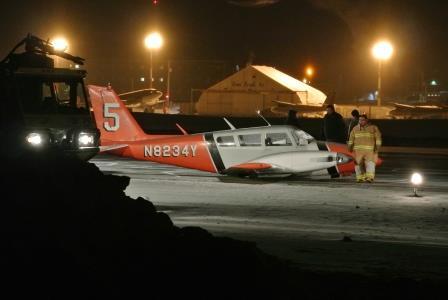
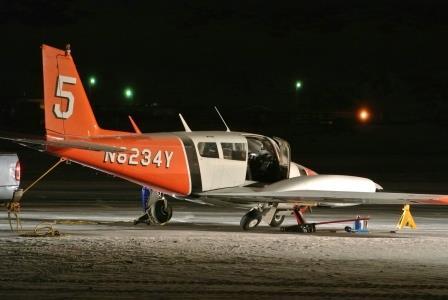
This gives me the chills, not for the usual "please don't let me forget to put the gear down" reason evoked by seeing someone else land on the belly. I imagine myself flight planned into Iqaluit of origin because having this happen ahead of me is one of the scenarios that goes through my head a lot. If I'm flying into Iqaluit I am probably carrying as much reserve fuel as I can, because there aren't a lot of places to stop n the north. It's like crossing an ocean. There's often a point of no return where I have to continue to my destination, because there's not enough fuel on board to return to Kangiqsualujjuaq. It's not a good position to be in. The weather could go bad. If there's any question of weather I wouldn't be continuing, but what if something happened right out of the blue, like a gear up landing on the only runway?

Maybe this guy (the registered owner has a man's name) knew he had a problem and held off until dusk, to burn extra fuel and wait long enough to let en route aircraft land before he shut the runway down. The type, it's a Twin Commanche has a reputation for landing gear issues. I don't know how deserved the reputation is. Airplanes do get reputations as unshakably as high school girls do, and sometimes for more trivial reasons. So maybe there was nothing wrong with the airplane. Maybe he just forgot to put the gear down. It could happen, long trip, unfamiliar airport, unfamiliar procedures. The airplane is registered to a private owner with a mailing address in Florida, so I'm assuming he doesn't fly into YFB every day.

Maybe I've been fighting a bigger headwind than I anticipated and I'm down to thirty minutes of fuel as I call up the FSS still ten minutes out. They advise me that traffic is a Twin Commanche planning left base for runway three five, no conflict and I continue inbound, to follow. Maybe I'm joining the circuit and I spot him on final, down below me and I don't see that the gear isn't down. I see him touch down and then I focus on completing my prelanding checklist and rolling out on final myself. And there I am on final with twenty minutes of fuel on board and I'm advised by either the landing pilot or the FSS that he will not be clearing the runway any time soon.

I'd spend precious fuel in the overshoot and then what? I'd already know I had nowhere else to go, so I'd throttle right back and configure for best endurance. CYFB has 9000' of runway, so it doesn't really matter where in that length the PA-30 is sitting, there's room for me. I would advise the FSS of my fuel situation and that I would be landing on the available runway. And then I would do it, checking the gear at least twelve times between downwind and touchdown.

If I had enough fuel to hold, I might have stayed circling and watched crews jack up the airplane and get the wheels down. Just because they got them to extend on jacks doesn't mean that it was the pilot's fault they weren't down the first time. The US NTSB will probably publish a report on this, based on Canadian TSB action. I haven't found any more information about the Twin Comanche: it only happened tonight, but here's a great pic of the airport from a couple of months ago.

I landed today, not in Iqaluit behind a Citation that did have its wheels down. I stayed above the glideslope all the way down, because when I centred the needles there was some wake turbulence. Not enough to be dangerous: they were five miles ahead of me, but with clear weather why not be a little high and have smoother air? I had to brake a little more aggressively than usual to make the taxiway, but I think it was worth it.

Edit: A follow up story says it was a gear collapse after landing, and that they only closed 4000' of the runway, leaving the rest open to people like me, and that the incident affected no flights.

Friday, March 29, 2013

Red Eyes Can Signify Dehydration

I was told once in a human factors course that dehydration by as little as two percent has a measurable effect on a person's decision-making ability. The course was generally dull and redundant--I remember entertaining myself by devising and sharing "Buzzword Bingo" cards--but that factoid struck a chord. I don't have a reference to the study that determined that effect, but it's referred to here, and there's more advanced information on pilot dehydration here.

I carry a 750 mL water bottle with me in the cockpit, sometimes bringing an extra litre in the summer, so I never have to ration myself on water--but then I run up against the problem that not all the water my body processes is lost in sweat or water vapour in respiration. European researchers say that the need to urinate enhances the ability to make decisions but another study says the extreme need to urinate reduces cognition and working memory as much as a 0.05% blood alcohol level.

Flying requires decision making and working memory. I heard a pilot today advise ATC that they were landing "with one secured." If I decide to shut down one engine in flight and am thus landing with the power of only one, it would probably be a good decision to delay putting the gear down until I was sure I would not need to overshoot. But despite all the things I might be thinking during that approach, I would need the working memory to remember that I haven't extended the gear yet. And I'd really rather not be landing with my legs crossed.

There are a lot of resources available through Transport Canada and other aviation agencies around the world to help us pilots improve our ability to make safe decisions. We can get information on accidents others have suffered or avoided, information on weather, deicing, aerodynamics, communication, psychology, physiology and ... I don't have time to read it all. I like to think I have the general idea, however.

There's one thing I'm out of touch on, though. How can you call yourself a professional pilot and take people's life into your hands while impaired on recreational drugs? I'm disgusted. Yellowknife is not a big place, and Tindi hires through the ramp, so he wasn't new in town. There were undoubtedly people who knew what Matthew Bromley's job was, when he was flying and what he was smoking. They are irresponsible too.

I still think this anti pot-smoking poster is hilarious, but I want my fellow pilots to be responsible. Their behaviour reflects on me.

Monday, March 25, 2013

Blog Fodder

It's time to land so I tune the ATIS, and then tell Centre its identifying letter, the code proving I have listened to the recorded information. I know from it that the wind is as strong as when I left, still straight down the runway. The ATIS gave me an altimeter setting, too, but Centre gives me a new one, and tower may give me a different one again. I dutifully dial in each, so that when I level off at each stepdown altitude I'll be safely above or below whatever traffic I've been stopped there to avoid.

Straight down the runway as it is, the high wind makes my job landing the airplane easier, not harder. It's not a problem today that ATC leaves me high in the sky staring four white PAPI lights in the eyes less than three miles back. I don't need to chop the power more than normal nor slow to final approach speed in order to extend full flaps. I can use normal approach power and speed, and half flaps, giving me my usual descent rate, but because my approach speed is a fixed airspeed, and my descent rate is in feet per minute, the headwind decreases my groundspeed but not my descent rate. Measured in feet per nautical mile, however, the descent rate is greater than usual, so crossing the fence I see two red and two white, and then all four red by the time my focus narrows to exclude them, in the flare. Yes, four red is "too low" but they lead me to a touchdown point at the end of an IFR approach, well into the runway. I want to get down and get off at the first available taxiway.

I do, and tune ground. They're talking to another airplane, so I wait, doing my after-landing checks, for the conversation to finish. The controller is telling a pilot, "We sent a truck out and found that FOD you reported. It was a diaper. That's a first."

The pilot chuckles and makes some remark, but I regret that he didn't--and neither did I--ask, "Clean or dirty." Or maybe we don't want to know. I can imagine an experienced parent doing a quick at-seat diaper change after the seat belt signs came on at top of descent. They're considerate enough not to leave the the dirty diaper at the seat, nor to hand it to a flight attendant on exit. (I imagine aircraft groomers and FAs will tell me that plenty of people do one or the other), but once outside the aircraft, masked by people trundling rollerbags and crowded around the gate check cart, mom or dad gently sets the offending package on the tarmac, collects the stroller, and hauls family and baggage indoors to baggage claim. Or maybe a clean diaper slipped out of a diaper bag as parent juggled luggage and offspring en route to the terminal.

Later on the departure frequency I hear a controller telling a US airliner, "They just finished the runway check and nothing was found." I wonder if they saw a diaper or were afraid something had fallen off their aircraft.

Monday, March 18, 2013

I Had One of Those But the Wheels Fell Off

I've had people accuse me of not liking the Dash-8 but the accusation is false. They can look a little ungainly because of their high wing and long gear legs, but why would I disrespect a versatile Canadian-made turboprop? I love Dash-8s. I'd love to be flying one right now. You manufacture over a thousand of any kind of airplane and have all kinds of people fly it in all weather all over the world, and the wheels are going to come off of a few. Sometimes literally.

For me this story started with me failing to immediately recognize that this Air Canada Facebook post was a spoof, on a humour/satire site. I could understand pilots making light of a situation in which everything ended well but usually that kind of black humour doesn't extend to the social media and marketing people. It appears that a couple of months ago a Q400 departed North Bay, landed at Toronto's Pearson International Airport, and then as it was taxiing in the right front nosewheel departed the aircraft. Reporters quote the Air Canada Jazz spokesperson as saying that the right wheel "loosened," but it must have rolled away quite noticeably, seeing as the airport scrambled emergency vehicles. All the landing gear wheels on that airplane are in pairs, two wheels on each of the three gear legs, so the airplane didn't collapse or become uncontrollable.

While looking for more information on that particular incident, I found a slightly similar report wherein a Q400 had a right inboard axle failure while taxiing out in Frankfurt. The wheel stayed attached and the flight was completed successfully, with no one realizing the issue until ATC reported sparks from the wheel area on landing. This sort of thing does happen. Airplanes hold together through all kinds of malfunctions and from the inside we can't see what they are or or not doing. I would say that every week I hear ATC or another pilot report seeing something they thought was anomalous about another airplane. Often it's nothing, like the crew who mistook a B737 gravel kit for a gear door malfunction, but pilots usually appreciate the lookout.

This one is a British Q400 in which ... oh the British are the funniest:

A number of passengers seated on the right side of the aircraft noticed sparks emanating from the right inboard wheel area during the takeoff roll and saw the right inboard wheel fall from the aircraft as the landing gear retracted. They did not inform the cabin crew at this point.

Now I know about the stiff upper lip thing, and I appreciate that people don't want to look stupid by appearing alarmed at something that is normal, but a wheel fell off the airplane! How dense or properly British do you need to not report this as an abnormal situation? Intoxicated passengers with a grade-four education and living in a part of the world where people continue to drive trucks after one of the wheels falls off were not shy about informing me of much lesser aircraft anomalies.

Finally we have a video of the wheel falling off a Q400 during landing in Buffalo. You can stop watching after the scene cut. The rest is unrelated incidents.


I had a wheel almost depart from an airplane I was flying once, a long time ago when I logged my flights in a little ten-line-per-page logbook and paid for fuel myself. I'm sure some of you have seen this story from me before, but others haven't, and maybe you can be amused if my recollections have changed. The small single-engine airplane had had maintenance affecting the nosewheel before I borrowed it, and I will take responsibility for probably missing an improperly secured cotter pin on my initial preflight. I flew an hour or so to visit someone and then the airplane sat in the snow there for a few days. Most of my preflight time before flying home went into digging it out of the snow and making sure the control surfaces were clean, so it's possible the pin was actually missing by that time and I still missed it. It was a very windy day and the runway and taxiway surfaces were rough, so I didn't notice anything wrong on the taxi out. At the end of a bumpy flight home I landed carefully in a strong crosswind. I remember being very proud of my gentle touchdown, and that taxiing back to parking in a strong crosswind was dicey. I pulled around tail to the parking spot, shut down and got out to push it back by hand. And then I saw that the nosewheel was not straight in the forks but tilted sideways, just wedged in there by something between friction and magic. Part of the axle was sticking out the side. So yeah. The wheels can come off. I'm not taking a position on the relative contribution made by design, maintenance, and pilots.

The blog title is wrong though: I never have flown the Dash-8 and while I've flown its baby cousin the DHC6, our fleet wasn't equipped with wheels at all, so even if there are landing gear similarities, I can't relate. More knowledgeable readers are welcome to correct or enhance anything here.

Friday, March 15, 2013

Here's My Transponder

I do my flight planning in the morning and drop off the documents for the hotel desk to fax. The Flight Information Region department that takes our flight plans doesn't accept electronic submissions yet. Hotel breakfast is a surprisingly good omelet. It's hard to get those things cooked properly in mass production. It doesn't have as much onion or as tasty a cheese as I would have put in it, but the eggs are cooked right and it isn't too greasy. Breakfast has to last me a long time, so I'm happy when it's good. There's multigrain toast, and honey too. We have to come back to this hotel. My coworker introduces me to "Call Me Maybe" mashups while we eat. This was last summer, but yeah, I'm still a little behind the times on Internet memes. I haven't even seen anyone do the Harlem Shake yet. Knowing that it's this year's Gangnam Style seems to be enough for me.

We check out, and I pick up my faxed flight plan, checking the fax number and number of pages on the transmission record. It won't be the hotel receptionist's problem if it didn't go through correctly. We're halfway to the airport in the cab before I realize that I didn't hand in my cardkey. Does anyone collect these things? I'll send them to you. I sometimes hang onto them for the next time we go back, but some places we'll never go back. I just hate throwing away plastic.

Preflight complete, I'm starting up on the apron. Oil pressure up, power to auxiliary systems, avionics on, get the ATIS, turn to ground. The controller calls me before I call him, asking me to turn my transponder to standby. Oops. I left it on. I'm spoiled by this transponder. It turns on automatically as I take off, so I don't have to select the altitude setting as I enter the runway, but because I haven't turned it on, I don't get that, "haven't turned it off" feeling. It's on the after landing checklist, of course, but I made a deliberate decision to leave it on, because I did my after landing checklist on the runway before taxiing off via runways. I always leave it on until I'm clear of all runways in the hopes that if something went terribly wrong, an aircraft about to land on top of me would receive a TCAS alert. I missed it in the final shutdown checks because it's electronic, so after the avionics master goes off, there's no dial position to show that it isn't selected off.

The controller says it was giving spurious readings now. Uh-oh. A malfunctioning transponder can ground us. He says it's probably just an artifact of start-up, that it read normally on the ILS yesterday, Heh, it's the same controller, and he remembers the dizzy chick who insisted on flying the ILS in VMC. At least I kept it on the glideslope, if he was watching me. He gives me my IFR clearance and I depart, the transponder apparently behaving now.

Thursday, March 14, 2013

Getting With The Times

In response to a request to make text links more readable, I took the plunge and clicked the "update blog template" button, the one I've been ignoring for years. My apologies for not seeing the low contrast issue earlier. For me all the links were always visited, and stood out vividly. I never got to see the pallor of the unvisited links.

As you may be able to see, beyond adding a background (ten Internet points to anyone who knows where it is), I haven't done anything other than click that Update Template link, so all the customization this blog once had is now lost. That's why I delayed so long. Let me know if there is any part of the old sidebar you're going to miss, and especially if the colours and layout are now more pleasing or at least more functional. What did you like more or less about the old one?

Edit: It would help if I put some links in it for you to see, wouldn't it? Here's an old article on fancy paint jobs. Here's an accident involving a pilot with multiple fake licences and no evidence of a real one.

Here's to a good--is it the weekend yet? Checks. Nope. Here's to a good rest of the week to everyone.

Tuesday, March 12, 2013

Putting the Needles on the Lines

I'm thinking of a day I've spent up in the flight levels, technically IFR, because we have to be IFR to fly this high, but my IFR flight plan is so unlike the ones that Air Canada flies that I have to file it with a separate department. I departed IFR from an airport somewhere down there. I think it had an FSS. This flight is not about the origin or destination. It really is about the journey. I'd have to look at the OFP on my lapboard to remember my point of departure, but I'm busy now, so I don't. I like being IFR. There is a greater certainty to what is expected of the pilot, and more security against conflicts with unknown traffic. It's not impossible that there's a rogue Mooney or guy in a lawnchair up here, but it's a lot less likely than in class G airspace, rocketing down some mountain valley at 5500'. ATC has given us a block of airspace to call our own and mostly leaves us alone. Occasionally they vector someone near enough to us that they let us know.

I watch our groundspeed to determine the wind direction and try to get a three-dimensional picture of the weather systems affecting our flight. The wind will back on descent, that is blow from a direction counterclockwise around the compass compared to up here, and it should decrease with decreased altitude as well. The wind affects my turns and will affect my time to get home, where 'home' is an as-yet-unknown hotel in an as-yet-unknown town where we will land. ATC doesn't let me put "TBA" in the destination blank on the flight plan, but I might as well for all the relevance what I did put has to where I'll eventually let rubber touch runway. We have honestly selected a place to land based on a desire for Vietnamese food, although usually our landing criteria are a little more operational than that.

The needles on the analogue fuel gauges are now close enough to the E-markers that I can't see the difference between this and empty, but the fuel flow meter tells me I have how many gallons I have remaining in these tanks. It's about twelve minutes worth, assuming that the fuel is equally distributed between the two tanks, but of course it isn't, because the engines aren't exactly equal and I have leaned each for best economy at this power setting, a fuel flow that changes with altitude and temperature, and probably phase of the moon. Engines are like the economy: a purely manmade thing that we are often at the mercy of. My goal is to switch tanks before there is any decrease in fuel flow caused by fuel starvation, but without leaving anything in the lowest tank. If I wait too long I'll know right away. Pilots call it "blowing a tank." The airplane seems to surge forward on one side, but really it's the airplane lagging on the side where the starved engine has just stopped providing thrust. If I get it exactly right I'll know when I watch the numbers on the fuel truck as they put in slightly more than the placarded useable fuel for this tank. They can get slightly more because "useable fuel" counts only fuel that is available to the engine at all reasonable flight attitudes, and in straight and level flight I can burn some of the fuel that is unusable in climb. When I finally decide that's all the fuel I'm going to get, I put on the electric fuel pumps and move the fuel selector to a set of tanks that are full, fuel except for the tiny amount that I burned in the run-up to make sure there was no malfunction blocking the tank or limiting the movement of the fuel selector. If I couldn't access the fuel in the other tanks I'd have a few minutes of normal flight now before the engines died, and then fifteen or twenty minutes of quiet gliding to find and land at an airport or perhaps a highway.

On this occasion the tank switch works and then we are unexpectedly done work early, so head in to the nearest airport while fuel is no concern. Typically I cancel IFR through 12,500' and complete a VFR approach and landing, but this is a somewhat busy airport with an ILS and there is a lot of traffic, so I hang onto the IFR. I like the extra airspace protection and given the extra fuel I can waste a bit of time. I want to practice flying an ILS. It's a severe clear day and I can hear the controllers being bemused by my request, but they don't try to talk me out of it. I think my request may be a bit annoying for the controllers, but they have more than one runway to play with and I'm sure they'd rather my do this practice now, than have to go missed on a crappy day because my skills weren't up to the task. They vector me around for a long gate. ("Gate" is how far out from the airport you get to intercept the beam that leads you to the runway). In poor weather I get vectored for a really short gate, because I'm slow and light and they want to keep me away from wake turbulence, so this is useful. I get to track the localizer and then descend, tightening up my skills at holding the right glideslope all the way to cleared to land. The needles weren't as close to their respective centreline as that fuel gauge was to the E earlier. That's why we practise.

Taxi off, park and call for fuel. I forgot to record the numbers on how much went into each tank, because I landed with a couple of hours left, so fuel wasn't high on my list of concerns at the end of the flight. Probably only a couple of litres from the shiny dry metal at the bottom of the left outboard. Last flight of the day: secure the aircraft and head to the hotel.

Friday, March 08, 2013

Stompin' Tom

I'm not much of a music aficionado, approaching songs the way a blind person does a Playboy magazine: for the words alone. (Yes, there is, or at least was once a Braille edition of Playboy). I like interesting lyrics that tell a story and make me laugh. And I enjoy listening to songs about the places I'm flying over and landing in. No one has ever written songs to make me laugh about the places I fly like Stompin' Tom Connors. He died yesterday, after a lifetime of singing, travelling and performing in small towns. I doubt I have to introduce any Canadians to him, but foreign readers don't be surprised if he's not as familiar as Shania Twain, Justin Bieber and Celine Dion. He's the musician we kept. He remained in Canada writing Canadian songs for his whole career, and he's a legend here. His death is at the top of the CBC news site, and pretty much every other news outlet, and was immediately commented on by the Prime Minister and the National Hockey League. Here's Jian Ghomeshi's tribute to him. He dedicated the first hour of his show on CBC One this morning to the man. Where Stompin' Tom is concerned, Canadian stereotypes are dialed up to full volume. This song, Sudbury Saturday Night is one of my favourites.

For those Sudbury is a northern town, not so northern in latitude, but northern in attitude. It's on the north shore of Lake Huron, a little bit south of the northernmost reaches of Michigan, but it's hours of bleak driving from anywhere else. Its principle employer used to be the nickel mining company Inco, since bought out by a Brazilian multinational. There's a giant nickel beside the highway (Canadians love our giant roadside things, and don't forget that a Canadian nickel has a beaver on one side, our Queen on the other and is now our lowest denomination coin--we officially stopped producing one cent coins last week). I've never been anywhere in the US that was like Sudbury. Maybe there's a mining town three hours drive from anywhere along a bleak snowbound highway with moose jumping out at you. Listen to the song and maybe you'll recognize it.


I found this version of him singing The Cremation of Sam McGee. Stompin' Tom's stories will be retold for as long as the story poems of Robert Service, and I hope his last words inspire more Canadian songwriters to sing about our land and people and institutions.
P.S. I'm not disregarding the request to make links more visible. It's just going to take a bit of work because I've never upgraded my Blogger template and it will probably break if I use the new tools, so I'm hesitant to go there.

Thursday, March 07, 2013

Russia: The New Frontier

I know that Russia is a very old frontier, probably somewhat explored well before most of North and South America were populated for the first time, and by some of the same people, judging by the similarities of the circumpolar languages, but now it appears to be the cutting edge of lawless innovation. A hundred years ago the vast majority of the population were uneducated peasants. Not stupid or incapable: they operated farms and other pre-technological businesses in a harsh climate in isolated areas where they made what they need out of what they had. They "electrified" and technologized that country in a few decades, but didn't lose the can-do spirit that got the crops in and and the cows home no matter what the weather. Today much of the population has benefited from free and fairly high-quality education under the communists, along with a national pride in science and engineering, and they continued to need innovation and guile to survive their own government. Котоматрица, the Russian equivalent of I Can Haz Cheeseburger? reveals little examples of how the Russians live in a more rugged, less processed society. Food that happens to be in the background of the pictures will be potatoes rather than french fries, fish in a bucket or a chicken waiting to be plucked rather than supermarket meat on a foam slab and there's less of a sanitized safety infrastructure.

Now this can be very bad. But it's also an environment in which innovation occurs. And stuff like this.

I was thinking that the seat of innovation and adventure would move to somewhere in Africa for a while, and I know there are some batshit crazy things done in Africa, with and without airplanes, but while chaos is conducive to invention, there may not be enough money or education in Africa to fuel the next wave of crazy cool stuff. It's not that what is probably a twenty-year old ultralight is innovation in itself. It's just that there doesn't seem to be a lot of attitude stopping it from going further. Not like the time I built a sea-going vessel out of driftwood and old bicycle tires, and some old lady called the coastguard on me. Apparently she thought I was too young to be out there. I was over thirty. I just act young.

Sunday, March 03, 2013

Human Beings Are Awesome

I'm further south today, in more civilized climes. We're coordinating with a second crew that operates at different altitudes, a different range of speeds, and has set up the job with totally different parameters. They are from a sister company, but they must be that distant sister who moved out before we really knew what was going on, so we have different SOPs, and oh yes a different language in the cockpit. Coordination takes a career's worth of communication skills, and I'm not sure we all like each other at the end of the day.

After five hours aloft I'm descending out of the flight levels like a bat out of hell. There are no fuel endurance issues, no speed limits and no turbulence, so I'm pitched down at cruise power driving the airspeed indicator into the yellow arc. The yellow speed range denotes caution. It's okay to be here, as long as I don't make abrupt control movements or otherwise stress the airframe. I'm outside controlled airspace and plummeting towards a controlled airport where there will be food, avgas, washrooms, an oxygen fill and taxicabs that take us to hotels. Forty miles out I pick up the ATIS. Or maybe it was an AWOS. The difference is that the content of the ATIS is determined by human beings while AWeOS is created by bored robots. The bored robots at this airport tell me the density altitude and give the winds as "variable." They always say the winds are variable here. I think they are programmed to so that the tower controller can make up whatever wind makes the runway he asks me to land on seem reasonable. I swear I am not kidding when I tell you that once I was coming in here and successively given clearance to all six runways. (To be fair, I called up a long way out and there was a thunderstorm passing right through the airport at the time). I'm given no more than two different runways on this occasion, and land without event on the second one.

There were taxicabs, and I believe sangria.


A lot of the time things like this do the opposite of inspire me, because I feel I have so much but haven't achieved in proportion, but Jessica just looks so darned cheerful. It must be intensely frustrating sometimes to be constantly celebrated for what you don't have instead of what you do. "Shut up about my arms already! I'm going to Ethiopia to help children!" I can achieve the tiniest slice of empathy from the times that people can't get over the fact that I'm a woman and I fly airplanes. I wonder if anyone ever treats Jessica as if her lack of a penis is a greater handicap than her lack of arms. As a Tae Kwon Do black belt I'll bet she considers kicking them in the balls, but I suspect she has better social skills than to follow the thought through.

I'd feel a little voyeuristic watching her do everyday things so naturally, but she's raising money to make a documentary in order to help handicapped kids in less privileged countries. If you'd like more information or to contribute, here's the project page.