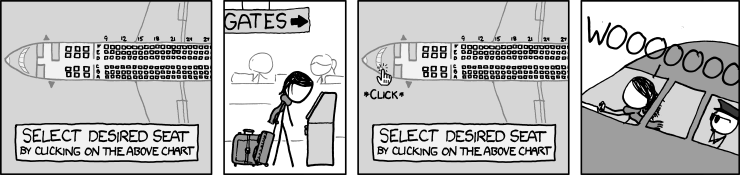
Once I'm clear of Calgary's airspace, I climb to 7500' and then level off and trim every which way while the speed stabilizes. The GPS is set direct to destination, the trackbar to the track I am following to get there and the heading bug to the heading I'm flying to hold it in northwest winds. I turn on the autopilot, and press the Engage button. Unlike Star Trek the airplane doesn't flash and disappear into a rainbow rubber band of light. Instead it rolls into a thirty degree right bank and drops into a 300 fpm descent. I retake control, climb back to 7500', disable altitude control and switch it from nav mode to heading mode. When I reengage it, it follows the bug straight ahead, and left and right when I move it. I go back to nav mode and watch it for a bit. I'm a few hundred metres off the centre of the track and apparently when you're an autopilot this calls for drastic measures to regain track. I guess when you're an autopilot that's your whole job, so you take it pretty seriously. Or when you're an autopilot designed in the seventies, you only know one strategy for getting on track: you bank thirty degrees towards the track until you're within some logic of centred and then you roll level.
It's kind of interesting that the autopilot, which was designed in the 1970s works with a brand new GPS unit. There's no computer in the autopilot and no mechanical parts in the GPS. The truth is, they don't talk at all. They communicate entirely through an intermediary, the HSI ("horizontal situation indicator," the second stupidest aviation abbreviation after DME). The autopilot also talks to the flight director, which is part of the attitude indicator, but I don't believe the GPS participates in that conversation. The GPS tells the HSI how far off course we are and then the autopilot rolls the airplane into a bank to regain the course, with the flight director telling the autopilot when it has reached the bank limit. I have to set the heading bug and track bar manually.
After I get tired of correcting the autopilot, I turn off the altitude hold feature and keep altitude myself while the autopilot holds the course. This doesn't work that well because it doesn't take much force to disconnect and doesn't have a disconnect alarm, and every once in a while I turn the yoke inadvertently and disconnect it, so that it drifts off course. But I persevere. I'll have to get used to this.
Spring is coming to the prairie but there are still snow curls on the ground, highlighting all the ditches and gullies. As I approach the destination airport, I start looking at water features on the ground for confirmation that the runway I am anticipating is the correct one. I get caught by this every time: when the snow is off frozen ponds look just like open water from the air, and the ripples are frozen right in. So they're only useful to determine landing direction if I have a time machine to the day they froze. I take a guess and then compare the GPS ground speed to my airspeed to confirm that I don't have an untenable tailwind.
I land and taxi slowly in, then text the flight follower. He tells me whom to call for a pick up. Fuel is closed for the night, so I park in front of the terminal and plug into an outlet there. I don't know anything about what kind of power I can draw from it, so I only activate the cabin heater to keep the computers warm overnight. The engines will have to settle for tents and plugs. Shiny new engine plugs which keep the heat in in the winter and the birds out in the spring and summer.
I see the uv damage lines on the tire again as I chock. They're just on the surface, but they bug me because they aren't usually there. I unload my baggage, and a box of parts which must be everything they took out while doing the work. The client picks me up and laughs at the parts box. He offers to leave it in his truck so I don't have to keep it in my hotel room.
Supper is something generic at a local restaurant. I use a trick I learned from another pilot to avoid eating more than I need: I ask to have a takeout container brought with the meal. Then right away, before I eat any, I put half the food in the takeout container. That protects me from unconsciously eating it all even though its more than I need. My other strategy for this month is the iTunes tactic: whenever I'm tempted to buy a chocolate bar from the hotel vending machine, I'm going instead to buy a new song from from iTunes. It costs exactly the same and I'll have the at least as much fun picking it out. And they I'll put it on repeat and get up and dance to it.
It's the end of the day so I just check in and veg out. The TV comes on at the weather channel. A lot of hotels do that. If they don't have their own dedicated advertising channel shilling for the pay movies, they have the default channel be weather. It's useful to most people and completely inoffensive. It will never come on in the middle of a violent TV show or a sexy movie. Unless you're offended by pressure charts or footage of a woman walking down the street carrying her cat in a front slung baby carrier, you're going to be happy or bored watching this. And then they toss off a casual mention that a Chinese oil tanker has just taken a dump on the Great Barrier Reef. I literally scream. I don't know what caused the accident. Probably a stupid autopilot. I don't want to read more about it. I hate horrible things that I can't do anything about, and as a consumer of petroleum products I have to acknowledge some responsibility, too. Not too many years from now global climate change will result in easy passage through the once treacherous Northwest Passage and countries that didn't even know it existed before will be plying the arctic waters. It's a completely different ecosystem, but just as vulnerable as the coral reefs. I'm glad I'm not immortal. The future has amazing 3-D movies but dead barren seas.